wayground logo

Free Printable Worksheets

Font size

S
M
L
XL
Worksheets

Geometry Module 1 Review

Total questions: 83

Worksheet time: 2hrs 17mins

Name
Class
Date
1.
An exact location in space with no length or width.
a)
Ray
b)
Point
Point
c)
Line
d)
Line segment
2.
An example of 2 non-collinear points.
a)
D, E
b)
C, B
c)
M, E
d)
F, B
3.
Name the Image
a)
Angle
b)
Line
c)
Line Segment
d)
Ray
4.
A line that contains point M.
a)
Line q
b)
Line p
c)
Line r
d)
Line NH
5.
Give another name for line k.
a)
Line BC
b)
Line BCE
c)
Line ED
d)
Line k is the only name, there isn't another name.
6.
In geometry, a plane is a ...
a)
flat surface
b)
a flying object
c)
grassy area
7.
A plane is named by...
a)
Any 1 point on the plane.
b)
Any 3 collinear points on the plane or a lowercase script letter.
c)
Any 3 non-collinear points on the plane or an uppercase script letter.
d)
All points on the plane that aren't part of a line.
8.
A plane containing point A.
a)
Plane DEA
b)
Plane k
c)
Plane CDF
d)
Plane F
9.
Part of a line. Has two endpoints and includes all of the points in between.
a)
Point
b)
Angle
c)
Line
d)
Line Segment
10.
Name the image
a)
Line
b)
Ray
c)
Line segment
d)
Angle
11.
Are points D and E collinear or coplanar?
a)
Collinear
b)
Coplanar
12.

If two lines intersect, then they intersect at exactly one point. This is an example of a...

a)

Definition

b)

Conjecture

c)

Postulate

d)

Theorem

13.

A straight line can be drawn between any two points. This is an example of a...

a)

Definition

b)

Conjecture

c)

Postulate

d)

Theorem

14.

The answer to the first five problems on a multiple choice test was C. Based on this information, Sean concluded that the answer to the 6th problem would also be C. This is an example of a...

a)

Definition

b)

Conjecture

c)

Postulate

d)

Theorem

15.

Mr. Blome's salary increased by $1000 each of the last five years. Based off this information, Mr. Blome concluded that his salary would increase by $1000 again the next year. This is an example of a...

a)

Definition

b)

Conjecture

c)

Postulate

d)

Theorem

16.

Complementary angles are a pair of angles that sum to 90 degrees. This is an example of a...

a)

Definition

b)

Conjecture

c)

Postulate

d)

Theorem

17.

Parallel lines are lines in a plane which do not meet. This is an example of a...

a)

Definition

b)

Conjecture

c)

Postulate

d)

Theorem

18.

If a triangle is a right triangle, then the square of the hypotenuse is equal to the sum of the squares of the other two sides.

a)

Definition

b)

Conjecture

c)

Postulate

d)

Theorem

19.
What does the word BISECT mean?
a)
To cut something into more than five pieces.
b)
It is a plane with two sets of wings.
c)
A shape that has three sides. 
d)
To cut something into two congruent pieces or in half.
20.

If two lines being cut by a transversal are parallel, then alternate interior angles are congruent.

a)

Definition

b)

Conjecture

c)

Postulate

d)

Theorem

21.
Bisector
a)
A point, line or line segment that divides a segment or angle into two equal parts
b)
A part of a line between two points on the line
c)
A figure before a transformation has taken place
22.
This point divides a line segment into 2 equal parts.
a)
point
b)
vertex
c)
midpoint
d)
segment
23.
Used to prove that a conjecture is false.
a)
Counterexample
b)
Inductive Reasoning
c)
Concluding statement
d)
Conjecture
24.
Given that C is between A & B, which Segment Addition statement is correct?
a)
AC + AB = CB
b)
AC + CB = AB
c)
AB + BC = AC
d)
CA + CB = CA
25.

Let A, B, and C be collinear points. If B is between A and C, then the Segment Addition Postulate states....

a)

AB + BC = AC

b)

A + B = C

c)

AB + AC = BC

d)

AC - BC = AC

26.
a)
m∠GHK=26, m∠KHJ=26
b)
m∠GHK=26, m∠KHJ=52
c)
m∠GHK=52, m∠KHJ=52
d)
m∠GHK=52, m∠KHJ=26
27.
Solve for x
a)
x = 2
b)
x = 4
c)
x = 6
d)
x = 8
28.
Translations, reflections and rotations are all known as ________________________.
a)
Geometry
b)
Transformations
c)
Congruent
29.
The result of a transformation.
a)
Pre-image
b)
Image
30.
The original figure prior to a transformation.
a)
Pre-image
b)
Image
31.
Which transformation is NOT a rigid motion (the size changes)?
a)
reflection
b)
rotation
c)
dilation
d)
translation
32.
A slide is also called a _________.
a)
Translation
b)
Reflection
c)
Rotation
d)
Transformation
33.
Translation are always _______
a)
Congruent
b)
Bigger
c)
Smaller
d)
Rotated
34.
When you translate, (x-4,y) will move _____.
a)
4 units right
b)
4 units left
c)
4 units up
d)
4 units down
35.
Write a rule for the translation.
a)
 (x -1, y  + 2)
b)
 (x -2, y  + 1)
c)
 (x +2, y  - 1)
d)
(x +1, y  -  2)
36.
Name the transformation.
a)
Translation
b)
Reflection
c)
Rotation
37.
When you reflect a shape, you ______ over an axis or line.
a)
Flip
b)
Rotate
c)
Slide
d)
Expand
38.
Point (-5,2) is reflected over the y axis.  Where is the new point located?
a)
(5,2)
b)
(-5,-2)
c)
(-5,2)
d)
(5,-2)
39.
Identify the transformation from ABC to A'B'C'.
a)
90o clockwise rotation
b)
90o counter clockwise rotation
c)
Reflection across the y-axis
d)
Reflection across the x-axis
40.
True or false: A reflection makes a congruent figure. 
a)
true
b)
false
41.
A turn is also called a ___________.
a)
Translation
b)
Reflection
c)
Rotation
d)
Transformation
42.
How many degrees was the figure rotated?
a)
90 degrees counterclockwise 
b)
180 degrees
c)
90 degrees clockwise
43.
If you were to rotate ABCD 180°  about the origin, what would the coordinate of A' be?
a)
(-5, 5)
b)
(-3, -5)
c)
(-5, 3)
d)
(-3, 3)
44.

Triangle B is rotated 90° clockwise with the origin as the center of rotation to create a new figure. What rotation would produce the same effect?

a)

180° counter-clockwise rotation

b)

270° clockwise rotation

c)

270° counter-clockwise rotation

d)

90° counter-clockwise rotation

45.
Sarah just moved here from Chicago, and she has blue eyes.  Therefore, all people from Chicago have blue eyes. 
a)
Deductive
b)
Inductive
46.
All cars have at least two doors.  A Ford Focus is a car, so the Ford Focus has at least two doors. 
a)
Deductive
b)
Inductive
47.

Given <1 and <2 are a linear pair, choose the correct reasoning to conclude that m<1+m<2=180 degrees.

a)

Given <1 and <2 form a linear pair then by the Linear Pair Theorem the two angles are supplementary. If the two angles are supplementary then by the definition of supplementary, the sum of their measures is 180 degrees. Therefore, m<1+m<2 = 180 degrees.

b)

Given <1 and <2 form a linear pair then by the definition of supplementary, the sum of their measures is 180 degrees. Therefore, m<1+m<2 = 180 degrees.

c)

Given <1 and <2 form a linear pair then by the Linear Pair Theorem the two angles are supplementary. Therefore, m<1+m<2 = 180 degrees.

d)

Given <1 and <2 form a linear pair then the two angles are supplementary. If the two angles are supplementary then the sum of their measures is 180 degrees. Therefore, m<1+m<2 = 180 degrees.

48.

Linear Pair Theorem

a)

If two angles form a linear pair then the angles are supplementary.

b)

If two angles form a linear pair then the angles add to 180 degrees.

c)

If two angles form a linear pair then the angles are congruent.

49.
Identify the property you would use to solve this equation:
4x = 72
a)
Addition Property of Equality
b)
Subtraction Property of Equality
c)
Multiplication Property of Equality
d)
Division Property of Equality
50.
Identify the property you would use to solve this equation:
y – 7 = 28
a)
Additive Property of Equality
b)
Subtraction Property of Equality
c)
Multiplicative Property of Equality
d)
Division Property of Equality
51.
Name the first property you will use to solve this equation:
3(x – 7) = 42
a)
Multiplication Property of Equality
b)
Commutative property
c)
Associative Property
d)
Distributive Property
52.
Name the property described:
If PQ = RS then RS = PQ
a)
Reflexive
b)
Symmetric
c)
Transitive
d)
Addition
53.
If a = b, then a may be replaced by b in any expression.
a)
Transitive Property         
b)
Reflexive Property             
c)
Symmetric Property 
d)
Substitution Property
54.
For any numbers a, b, and c, if a = b and b = c, then a = c.
a)
Transitive Property         
b)
Symmetric Property
c)
Reflexive Property
d)
Substitution Property
55.
For any number a, a = a.
a)
Transitive Property         
               
b)
Reflexive Property             
c)
Symmetric Property           
d)
Substitution Property
56.
What property would I use to solve this equation?
7 + x = 14
a)
Multiplication Property
b)
Subtraction Property
c)
Division Property
d)
Substitution Property
57.
Find the distance between (-12, 1) and (12, -1).
a)
24.05
b)
24.06
c)
24.07
d)
24.08
58.
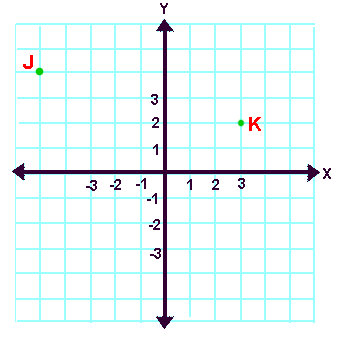
Find the distance between J and K.
a)
8.2
b)
7.7
c)
9
d)
10.2
59.

Find the midpoint of the line segment with endpoints (-2,0) & (9,-1).

a)

(1, 3)

b)

(3.5, -.5)

c)

(-.5, 3.5)

d)

(6, -.5)

60.
a)
RM=6, MS=6
b)
RM=3, MS=3
c)
RM=3, MS=6
d)
RM=6, MS=3
61.

Which diagram represents the following statement?


Point S is the midpoint of segment RT.

a)
b)
c)
d)
62.

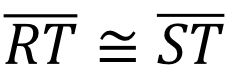
If point S is the midpoint of segment RT, what conclusion can you make?
a)
b)
c)
d)

It is not possible to make a conclusion from the given information.

63.

Which equation would you use to find the value of x?

a)

(4x - 1) = (4x - 1)

b)

(4x - 1) + (3x + 3) = 180

c)

(4x - 1) = (3x + 3)

d)

(4x - 1) + (3x + 3) = 90

64.

The midpoint of ST is M(3, 2) and endpoint S is (1, -3) and . What are the coordinates of T, the other endpoint?

a)

(2, -.5)

b)

(5, 7)

c)

(.5, 2.5)

d)

(2, 2.5)

65.

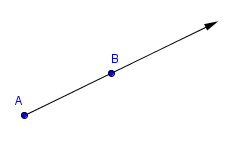
What is the correct way to name this ray? If more than one answer exists, choose all that apply.

a)

ray AB

b)

ray B

c)

ray A

d)

ray BA

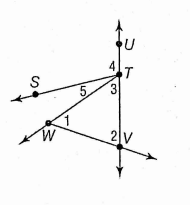
66.

Name the vertex of ∠5.

a)

S

b)

T

c)

U

d)

V

e)

W

67.
If I wanted to name ∠KGL which colored angle am I talking about?
a)
light blue
b)
yellow
c)
blue 
d)
green
68.
If I named ∠LGH, what angle am I talking about?
a)
red
b)
pink
c)
yello
d)
green
69.
How many letters do you need to name an angle? (if more than one angle is stemmed from the vertex)
a)
0
b)
2
c)
3
d)
4
70.
What is another name for ∠H
a)
∠KGH
b)
∠LGH
c)
∠LHG
d)
∠K
71.
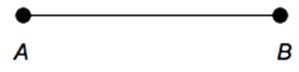
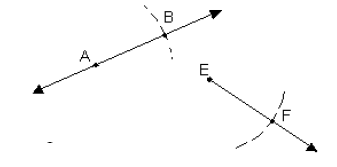
When copying line segment AB using a straight edge and a compass, the compass should be used to:
a)
Draw an arc above point A
b)
Measure the length of segment AB
c)
Draw an arc between point A and point B
d)
Measure half the length of line segment AB
72.
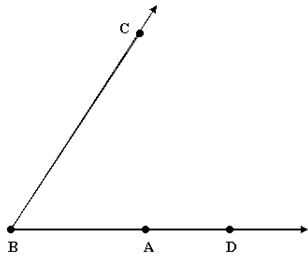
Suppose we wish to construct angle EFG congruent to angle DBC using a compass and straightedge. Which step would be correct to do first?
a)
Place the compass point at B
b)
Place the compass point at C
c)
Place the straightedge along A and C
d)
Place the straightedge along C and D
73.
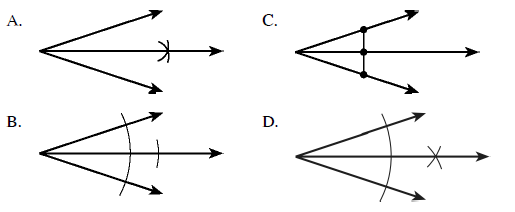
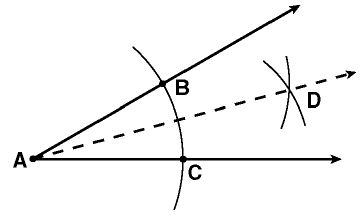
Which diagram shows a correct mathematical construction using only a compass and a straightedge to bisect an angle?
a)
A
b)
B
c)
C
d)
D
74.
Given: angle A
What is the first step in constructing the angle bisector of angle A?
a)
Draw ray AD
b)
Draw a line segment connecting points B and C.
c)
From points B and C, draw equal arcs that intersect at D.
d)
From point A, draw an arc that intersects the sides of theangle at points B and C.
75.
Based on the construction, which statement must be true?
a)
A
b)
B
c)
C
d)
D
76.
A straightedge and compass were used to create the construction. Arc EF was drawn from point B, and arcs with equal radii were drawn from E and F.
a)
A
b)
B
c)
C
d)
D
77.
The picture represents a compass and straightedge construction of _________?
a)
Bisect a line segment
b)
Copy an angle
c)
Bisect an angle
d)
Copy a line segment
78.
PR represents a-b. What does RQ represent?
a)
segment a
b)
segment b
c)
a+b
79.
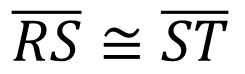
The following means 
a)
line AB
b)
segment AB
c)
ray AB
d)
angle AB
80.
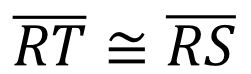
The following means
a)
line AB
b)
ray AB
c)
segment AB
d)
plane AB
81.
Line segments that have the same length are called ______________________________.
a)
congruent segments
b)
congruent angles
c)
midpoint
d)
segment bisector
82.
Define a Point
a)
Part of a line between two endpoints.
b)
A straight path that extends forever in two directions.
c)
Part of a line that starts at an endpoint and extends forever in one direction.
d)
Represents a location and has no size.
83.
Define Noncollinear
a)
Points that do NOT lie on the same line.
b)
Two collinear rays with the same endpoint.
c)
Points that lie on the same line.
d)
Flat Surface