
 Worksheets
Unit One Review
Total questions: 23
Worksheet time: 44mins

f(x)=2x2+x

f(x)= -x3+2x+1

x→ ∞, y→⁻∞
x→⁻∞, y→∞
x→∞, y→⁻∞


Identify the degree of the polynomial and the sign of the leading coefficient
Degree - Even
Degree - Odd
Degree - Even
Degree - Odd

Identify the degree of the polynomial and the sign of the leading coefficient
Degree - Even
Degree - Odd
Degree - Even
Degree - Odd
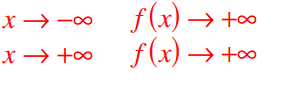
Which function has this end behavior?
Note: f(x)=y
-x2 - 3x + 1
-x3 + 2x2 + 3
x4 + 3x3 - 4x + 1
x5 - 4x4 + 2x2 - 1

What are the zeros of the function?
(4, 0) and (1, 0)
(3, 0), (1, 0), (-2, 0), and (-5, 0)
(-3, 0), (-1, 0), (2, 0), and (5, 0)
(-2, 0) and (4, 0)

What is the degree of the shown polynomial?
Positive
Negative
Odd
Even

The function shown in the graph is:
A
even
B
odd
C
neither even nor odd
D
both even and odd

The function in the graph is:
A
even
B
odd
C
neither even nor odd
D
both even and odd

The function shown in the graph is:
A
even
B
odd
C
neither odd nor even
D
both odd and even

What is the range?
A
(-4, 5]
B
[-4, 5)
C
(-3, 3)
D
[-3, 3]

Where is the function increasing?
A
(4, ∞)
B
(−4, ∞)
C
(6 , ∞)
D
(−∞ , 4)

When is this function increasing?
A
(−2.5, 2.5)
B
(0, 5)
C
(5, 0)
D
(−5, 0)

What is the 2nd interval in this graph?
Decreasing (5, 2)
Decreasing (-4, 2)
Decreasing (5, 1)
Decreasing (-4, 1)

How many intervals of change are represented in this graph?
6
5
4
3

What is the first interval in this graph?
Decreasing (∞, -4)
Decreasing (∞, -4)
Decreasing (-∞, -4)
Decreasing (-∞, 4)
Write the following set of numbers using set notation.
The set of all integers less than −20
{x∣x ≤ -20}
{x∣x < -20}
{x∣x ≥ -20}
{x∣x > -20}
[3, 5]

Over what interval is this function constant?
(-5, ∞)
(-3, 4)
(4, ∞)
(5, ∞)

Find the x- and y-intercepts.
xint = (-4,0), yint = (0,3)
xint = (-3,0), yint = (0, -4)
xint = (4, 0) , yint = (0, -3)
xint = (-4, 0), yint = (0, -3)

