
 Worksheets
Unit 1 - Properties & Conservation of Mass
Total questions: 62
Worksheet time: 1hrs 19mins
2H2 + O2 ----> 2H2O What are the products?
H2SO4
C2H8O
A capital letter or combination of a capital letter and a small letter that is used to represent an element is called a(n) ________
chemical symbol
abbreviation
A subscript is the small number below and to the right of a(n) ________ that tells the number of _______ of that element.
element symbol; atoms
atom; element symbol
subscript; protons
compound; elements
The law of conservation of matter states that
chemical reactions change matter.
it is mandatory that you recycle.
atoms are neither created nor destroyed in chemical reactions.
a chemical equation can be balanced or unbalanced.
If there is no subscript by an element in a chemical formula, how many atoms of that element are there?
0
2
only 1
1 million
Which chemical equation is balanced?
Chemical equations must have the same number and type of atoms before and after a reaction
A chemical reaction is balanced when
both sides have the same elements
Both sides have the same number and type of atoms
Same subscripts
Same coefficients
The big number in front of a chemical formula is a __________ and it tells us the number of __________ present in that formula
Subscript; Atoms
Coefficient; Molecules
Superscript;Molecules
Charge;Atoms

How many oxygen atoms are in this chemical formula?
6 oxygen atoms
2 oxygen atoms
3 oxygen atoms
4 oxygen atoms
Mass cannot be created or__________ during a chemical reaction?
Reacted
Transferred
Born
Destroyed

Which compounds are the PRODUCTS of this reaction?
CO2 + H2O
C6H12O6 + O2
C6H12O6 + CO2
H2O + O2
Which compounds are the REACTANTS of this reaction?
CO2 + H2O
C6H12O6 + O2
C6H12O6 + CO2
H2O + O2

How many different elements are in the REACTANTS side of this balanced equation?
1
2
3
4
2Al2O3 is on the ____________ side of this equation.
Reactants
Products

Dissolving sugar in water is an example of a _____.
Homogeneous Mixture
Heterogeneous Mixture
How many Hydrogen atoms are in this chemical formula?
8Fe(H2O)4(OH)2
16
64
72
80
How does the Law of Conservation of Mass apply to chemical reactions?
The reactants must have fewer atoms than the products.
The products must have twice as many atoms as the reactants.
The reactants and products must have exactly the same number and type of atoms.
The reactants and products must have close to the same number and type of atoms.
Which is an example of a heterogeneous mixture?
sugar water
brass
table salt
salad
Smallest and basic particle of matter
element
atom
compound
mixture
A combination of two or more substances that are not chemically combined
element
atom
compound
mixture
A mixture in which different materials can be easily distinguished
heterogeneous mixture
homogeneous mixture
chemical formula
molecule
A group of atoms bonded together
chemical formula
chemical bond
molecule
solution
A mixture that forms when one substance dissolves another
molecule
solution
pure substance
compound
What is CO2 an example of?
Element
Compound
Atom
Mixture
Lemonade consists of several substances that are NOT chemically combined, so lemonade is classified as
pure substance
a compound
a mixture
an element

Which of the models of a chemical reaction best represents the Law of Conservation of Mass?
A
B
C
D
Based on the Law of Conservation of Matter, describe the relationship between the mass of the reactants and the mass of the products.
The mass of the products is always greater than the mass of the reactants.
The mass of the reactants is less than the mass of the products.
The mass of the reactants equals the mass of the products.
The mass of the reactants is greater than the mass of the products.
What happens to atoms in a chemical reaction?
they are destroyed
they are created
they are rearranged


Which pH number below reflects a weak acid?
1
6
8
13
Which pH number below reflects a weak base?
1
6
8
13
Which of the following is an example of COHESION?
water sticking to water
water sticking to glass
oil sticking to plastic
hydrogen sticking to oxygen
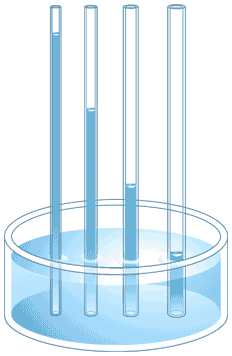
What is the term for water's ability to defy gravity and climb up a tube?
Capillary Action
Specific Heat
Universal Solvent
Magic
Surface tension of water is the cohesive force between water molecule and other molecule.
True
False



True or False
This chemical equation demonstrates the Law of Conservation of Matter
True
False

True or False
This chemical equation represents the Law of Conservation of Matter
True
False

