
 Worksheets
Chapter 123 Review (H)
Total questions: 55
Worksheet time: 48mins
Name
Class
Date
1.
How many sig figs are there?
100.00 m
a)
1
b)
3
c)
4
d)
5
2.
How many sig figs are there?
4004 g
a)
1
b)
2
c)
3
d)
4
3.
What is 78.5 rounded to one significant figure?
a)
79
b)
78.5
c)
70
d)
80
4.
How many Significant Figures in the number below?
4.56 x 10³
4.56 x 10³
a)
5
b)
4
c)
6
d)
3
5.
When performing the calculation 34.530 g + 12.1 g + 1222.34 g the final answer must have
a)
Three significant figures
b)
One decimal place
c)
Two decimal places
d)
Three decimal places
6.
Calculate 12.47 m ÷ 3.2 s and give your answer with the correct number of significant figures.
a)
4 m/s
b)
3.9 m/s
c)
3.90 m/s
d)
3.897 m/s
7.
How many significant figures will be in the answer to the following question:
7.62 x 6.98 x 3.2645
7.62 x 6.98 x 3.2645
a)
1
b)
2
c)
3
d)
4
8.
What is the correct SI unit for mass?
a)
Kilograms
b)
newtons
c)
pounds
d)
grams
9.
The amount of space an object takes up or the amount of space something contains
a)
volume
b)
weight
c)
mass
d)
force
10.
The amount of matter or stuff in an object
a)
volume
b)
mass
c)
force
d)
matter
11.
a measurement of how hot or cold something is
a)
force
b)
temperature
c)
length
d)
mass
12.

The distance between New York City and Miami, Florida would be measured in __?__.
a)
kilometers (km)
b)
meters (m)
c)
centimeters (cm)
d)
millimeters (mm)
13.

The SI unit for temperature is __?__.
a)
degree fahrenheit (° F)
b)
degree celsius (° C)
c)
kelvin (K)
d)
degree centigrade (°C)
14.

28 °C = __?__ K
a)
301
b)
245
c)
401
d)
345
15.
2.0 milligrams is
a)
2.0 x 10⁻³ grams
b)
2.0 x 10⁻⁶ grams
c)
2.0 x 10⁻² grams
d)
2.0 x 10⁻⁹ grams
16.
3.0 microliters is
a)
3.0 x 10⁻³ liters
b)
3.0 x 10⁻⁶ liters
c)
2.0 x 10⁻² liters
d)
2.0 x 10⁻⁹ grams
17.
True or false 1,000 milligrams in a gram
a)
TRUE
b)
FALSE
18.
What kind of properties can only be observed when a substance changes into a different substance?
a)
physical properties
b)
chemical properties
c)
liquid properties
d)
real properties
19.
Which of the following is a sign that a chemical reaction has occurred?
a)
change in shape
b)
melting
c)
formation of a gas
d)
dissolving
20.
Is bleaching your hair a physical or chemical change?
a)
physical
b)
chemical
21.
What is an example of a Chemical change?
a)
Ripped paper
b)
boiled egg
c)
cracked egg
d)
sugar in water
22.
Which is a physical change?
a)
burning match
b)
vinegar in baking soda
c)
melting butter
d)
cooking an egg
23.
Which of the following properties is a physical property?
a)
magnetism
b)
reactivity with oxygen
c)
flammability
d)
non-reactive
24.
Which physical property means "the ability to be flattened into sheets"?
a)
malleable
b)
conductivity
c)
ductility
d)
brittleness
25.
Example for physical property
a)
odor
b)
burns in air
c)
reacts with water to create hydrogen gas
d)
rust
26.
Physical properties are
a)
properties that can be observed without changing the identity of the substance
b)
properties that describe how a substance changes into a completely different substance
27.
Jack has a rock. The rock has a mass of 14g and a volume of 2cm3. What is the density of the rock?
a)
7 mL
b)
7 g/cm3
c)
28 g/cm3
d)
1/7 g/cm3
28.
Which lab tool might you use to measure the volume of a liquid?
a)
electric scale
b)
bunsen burner
c)
test tube
d)
graduated cylinder
29.
Frank has a paper clip. It has a mass of 9g and a volume of 3cm3. What is its density?
a)
3 g/cm3
b)
1/3 g/cm3
c)
27 g/cm3
d)
39 g/cm3
30.

Which mixture separation method would use to sort trail mix?
a)
filtration
b)
magnet
c)
boiling/evaporation
d)
sorting physically
31.
Two or more substances mingled together, but not chemically combined are known as a
a)
residue
b)
solution
c)
distillate
d)
mixture
32.
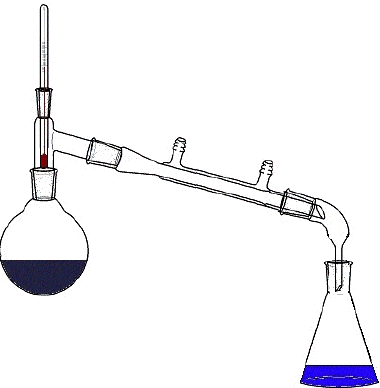
Water and alcohol are easily separated by distillation because of their
a)
different melting points
b)
different colours
c)
different densities
d)
different boiling points
33.
Boiling point is a point at which liquid turns in to..
a)
solid
b)
liquid
c)
molten
d)
gas
34.
The attendance for the basketball game was estimated to be 15,000 people but 12,500 people attended. What was the percent error?
a)
16.67%
b)
20%
c)
2500%
d)
80%
35.
The students measured length during a science experiement, they got 12 cm. But the actual measurement was 14.25 cm. What was the percent error?
a)
15.79%
b)
18.75%
c)
2.25%
d)
18%
36.
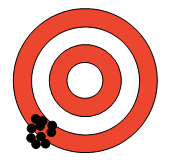
This bullseye demonstrates...
a)
High Accuracy & High Precision
b)
High Accuracy & Low Precision
c)
Low Accuracy & High Precision
d)
Low Accuracy & Low Precision
37.
How close a measurement is to the true value is called..
a)
Accuracy
b)
Precision
c)
Significant
d)
Estimate
38.

The metal is 7.1 cm long
a)
7 is the estimated digit
b)
1 is the estimated digit
c)
7 is the uncertain digit
d)
Both 7 and 1 are estimated digits
39.
How many estimated digits should there be in an accepted measurement?
a)
0
b)
1
c)
2
d)
3
40.
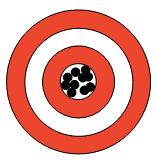
?
a)
High Accuracy & High Precision
b)
High Accuracy & Low Precision
c)
Low Accuracy & High Precision
d)
Low Accuracy & Low Precision
41.

a)
Student A
b)
Student B
c)
Student C
d)
Cannot be determined
42.

Type of mixture that has the SAME COMPOSITION in every part.
a)
Homogenous
b)
Heterogeneous
43.

Type of mixture that DOESN'T HAVE the same composition in every part.
a)
Homogeneous
b)
Heterogeneous
44.

M&M's is an examples of a
a)
homogeneous mixture
b)
heterogeneous mixture
45.
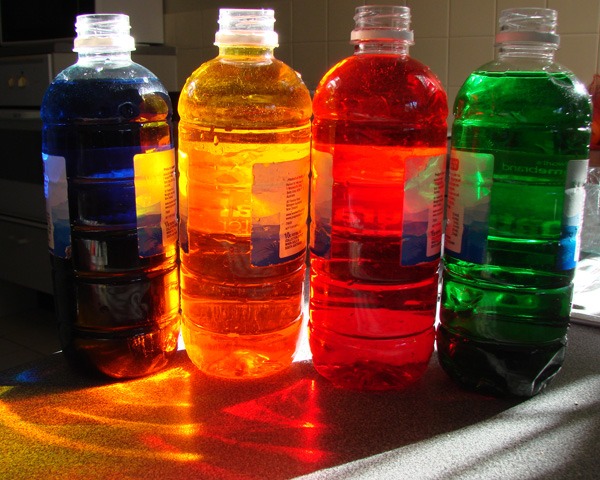
Coloured water is an example of a
a)
homogeneous mixture
b)
heterogeneous mixture
46.
The tool used to measure the mass of a substance or object is a ______________.
a)
balance
b)
graduated cylinder
c)
ruler
d)
thermometer
47.
What is the formula for density?
a)
density = mass x volume
b)
density = mass / volume
c)
density = mass + volume
d)
density = mass - volume
48.
____________ is the branch of chemistry that would identify enzymes and determine reaction mechanisms for biochemical reactions.
a)
Organic Chemistry
b)
Biochemistry
c)
Physical Chemistry
d)
Analytical Chemistry
49.
____________ is the branch of chemistry that would analyze new chemicals made from carbon-containing building blocks.
a)
Inorganic Chemistry
b)
Organic Chemistry
c)
Biochemistry
d)
Analytical Chemistry
50.
____________ is the branch of chemistry that would measure the amount of energy released or absorbed in chemical processes.
a)
Inorganic Chemistry
b)
Organic Chemistry
c)
Biochemistry
d)
Physical Chemistry
51.
____________ is the branch of chemistry that would study and develop new materials to improve existing products or make new ones.
a)
Organic Chemistry
b)
Inorganic Chemistry
c)
Biochemistry
d)
Physical Chemistry
52.
____________ is the branch of chemistry that would analyze the composition of medicines and research new combinations of compounds to use as drugs.
a)
Analytical Chemistry
b)
Organic Chemistry
c)
Biochemistry
d)
Inorganic Chemistry
53.
Color
a)
Intensive Property
b)
Extensive Property
54.
Volume
a)
Intensive Property
b)
Extensive Property
55.
Density
a)
Intensive Property
b)
Extensive Property
100 %

