
 Worksheets
Topic 6
Total questions: 37
Worksheet time: 31mins
Name
Class
Date
1.
Which of the following must be true for natural selection to occur in an "RNA world"?
a)
RNA molecules must turn into DNA molecules
b)
RNA molecules must undergo mutations
c)
RNA molecules must replicate
d)
Both b and c are correct
2.
One difference between DNA and RNA is that....
a)
Only RNA has the base Uracil
b)
only RNA contains the base Thymine
c)
only RNA contains the base Cytocine
d)
only RNA contained the base Guanine
3.

The apparatus in the experiment was used to mimic what?
a)
Proteins
b)
Present Earth conditions
c)
Early Earth conditions
d)
Nucleic acids (DNA/RNA)
4.
Which question were the scientists trying to answer with this experiment?
a)
Where do cells come from?
b)
How did prokaryotes form cell membranes?
c)
How are biomolecules formed?
d)
What gave rise to the Eukaryotic cell?
5.

This experiment was conducted by the scientists:
a)
Stanley Miller and Harold Urey
b)
Harold Urey and Albert Einstein
c)
Louis Pasteur and Francesco Redi
d)
James Watson and Francis Crick
6.
Miller/Urey and other scientists have shown that:
a)
Life on early Earth required material from space
b)
Cells survived in the primitive atmosphere
c)
Amino acids could be produced from inorganic molecules
d)
Simple cells can be produced in a laboratory
7.
The idea that Earth's early oceans had organic molecules that became the first life is called the...
a)
Primordial soup hypothesis
b)
Bubble hypothesis
c)
Miller-Urey Experiment
d)
Radioactive dating theory
8.
Earth formed 4.5 billion years ago, but life did not show until around...
a)
3.5 billion years ago
b)
1 million years ago
c)
200,000 years ago
d)
4.2 billion years ago
9.
The smallest unit which can be considered life is
called __________.
a)
a prokaryote
b)
a LUCA
c)
a cell
d)
a phospholipid
10.
Which statement best describes conditions on early Earth?
a)
hot with volcanic activity and electrical storms
b)
dry land covered with volcanic dust
c)
cold oceans
d)
dark and dusty with abundant water
11.
Which of the following describes what the first life form resembled?
a)
Eukaryotes
b)
Plants
c)
Bacteria
d)
Fungi
12.

Cells without a nucleus are said to be _____________________.
a)
Eukaryotic
b)
Prokaryotic
13.
Which of the following supports the hypothesis of an “RNA world” on early Earth?
a)
Some
RNA molecules are important catalysts in modern cells.
b)
The oldest known fossils contain trace
amounts of RNA.
c)
Single-stranded RNA molecules are
linear and do not form three-dimensional shapes.
d)
RNA is the primary genetic material of
many viruses.
14.
Why do some scientists believe that RNA, rather than DNA, was the first genetic material?
a)
RNA probably mutated
into DNA
b)
RNA
has both information storage and catalytic properties.
c)
RNA can replicate more accurately than
DNA.
d)
RNA contains uracil in place of
thymine.
15.
RNA World Theory states that ...
a)
Life came from RNA
b)
Life came from life
c)
Life came from non living things
d)
Life came from outer space
16.
Which of these are the ingredients NEEDED for life to form?
a)
organic macromolecules
b)
atoms
c)
methane
d)
inorganic molecules
17.
Which came last?
a)
Prokaryotes
b)
Dinosaurs
c)
Eukaryotes
d)
the genetic code
18.
Which of the following supports the hypothesis of an “RNA world” on early Earth?
a)
Some
RNA molecules are important catalysts in modern cells.
b)
The oldest known fossils contain trace
amounts of RNA.
c)
Single-stranded RNA molecules are
linear and do not form three-dimensional shapes.
d)
RNA is the primary genetic material of
many viruses.
19.
Which type of cell came first?
a)
Eukaryotic
b)
Prokaryotic
c)
Plant
d)
Both Eukaryotic and Prokaryotic cells evolved around the same time
20.
Which of the following was probably not present
in the atmosphere of the primitive Earth?
a)
methane
b)
oxygen
c)
water
d)
carbon dioxide
21.
What is the most critical thing for the development
of life on Earth?
a)
oxygen
b)
carbon dioxide
c)
time
d)
land
22.
Asexual reproduction refers to
a)
puberty
b)
sexual maturity
c)
an organism reproducing on its own
d)
genetic recombination between two
different organisms
23.
Which came first?
a)
Oxygen
b)
Photosynthetic bacteria
24.
What gas was necessary for complex (eukaryotic) life to evolve?
a)
Carbon dioxide
b)
Oxygen
c)
Dihydrogen monoxide
d)
Methane
25.
The term unicellular refers to an organism with many cells.
a)
True
b)
False
26.

The primary source of energy for all living things on earth is:
a)
Plants
b)
The sun
c)
The moon
d)
Animals
27.
Endosymbiosis gave rise to which organelle(s)?
a)
Golgi bodies
b)
Chloroplasts and Mitochondria
c)
Ribosomes and Nuclei
d)
The rough and smooth endoplasmic reticulum
28.
Miller/Urey and other scientists have shown that:
a)
Life on early Earth required material from space
b)
Cells survived in the primitive atmosphere
c)
Amino acids could be produced from inorganic molecules
d)
Simple cells can be produced in a laboratory
29.
Miller/Urey and other scientists have shown that:
a)
Life on early Earth required material from space
b)
Cells survived in the primitive atmosphere
c)
Amino acids could be produced from inorganic molecules
d)
Simple cells can be produced in a laboratory
30.
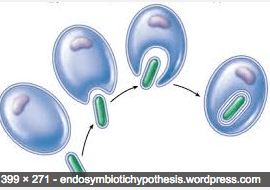
What process is shown within this diagram?
a)
Natural selection
b)
Endosymbiosis
c)
Chemical evolution
d)
Abiogenesis
31.

The diagram shows fossils in different rock layers. Which of these statements about the age of these fossils is most likely correct?
a)
Fossil A and C are the same age
b)
Fossil B is older than fossil C
c)
Fossils A is older than fossil B
d)
Fossil D is older than fossil C
32.
The idea that Earth's early oceans had organic molecules that became the first life is called the...
a)
Primordial soup hypothesis
b)
Bubble hypothesis
c)
Miller-Urey Experiment
d)
Radioactive dating theory
33.
The early Earth's atmosphere was lacking:
a)
Carbon Dioxide
b)
Water
c)
Lightning
d)
Oxygen
34.
Put these organisms in order based on their appearance on the early Earth.
1. Animals - Eukaryotic - heterotrophic cells
2. Photosynthetic Bacteria
3.Plants - Eukaryotic - autotrophic cells
4.Heterotrophic bacteria
a)
2 - 4 - 3 - 1
b)
1 - 2 - 3 - 4
c)
2 - 3 - 4 - 1
d)
4 - 3 - 2 - 1
35.
Which of the following concepts explains the presence of mitochondria and chloroplasts in eukaryotic cells?
a)
Bubble hypothesis
b)
Panspermia
c)
Spontaneous generation
d)
Endosymbiotic theory
36.
Which scientist designed a special flask that allowed air in but kept microbes out and once and for all disproved spontaneous generation?
a)
Redi
b)
Needham
c)
Spallanzani
d)
Pasteur
37.
Why were mitochondria and chloroplasts once believed to be prokaryotic organisms?
a)
They both contain ribosomes and a plasma membrane.
b)
They both contain their own DNA and reproduce by binary fission.
c)
They both contain DNA found in modern bacteria and reproduce sexually.
d)
They both contain their own nuclei and plasma membranes.
100 %

