wayground logo

Free Printable Worksheets

NEW

Font size

S
M
L
XL
Worksheets

Oceans

Total questions: 41

Worksheet time: 25mins

Name
Class
Date
1.

The graphic shows ocean floor topography. Which is most likely represented by letter V (or W)?

a)

continental slope

b)

oceanic trench

c)

volcanic island

d)

abyssal plain

2.

A seamount is an underwater mountain that peaks at least 1,000 meters above the ocean floor and does not reach the ocean's surface. Which letter on the diagram is a seamount?

a)

V

b)

W

c)

X

d)

Y

3.

The picture shows the ocean floor topography. What is the ocean feature at point Y?

a)

continental slope

b)

midocean ridge

c)

seamount

d)

trench

4.

A ship is mapping the structure of the ocean floor using sonar technology. Which describes the basic method used in this type of mapping?

a)

A radio wave is sent from the ship and reflects off the ocean floor back to a receiver on the ship.

b)

A sound wave is sent from the ship and reflects off the ocean floor back to a receiver on the ship.

c)

A radio wave is sent by the ship and is absorbed by the ocean floor.

d)

A sound wave is sent by the ship and is absorbed by the ocean floor.

5.

Why is upwelling an important process in a marine ecosystem?

a)

Upwelling replaces sand and gravel on beaches lost as the result of wave and tidal action.

b)

Upwelling decreases the temperature differences between different layers of ocean water.

c)

Upwelling cycles nutrients from decomposers along the ocean floor to producers in surface waters.

d)

Upwelling returns salt to the surface from the benthic zone as part of the global conveyor belt current.

6.
The process of removing salt from sea water.
a)
desaliniation
b)
salinity
c)
ocean water
d)
purification
7.
The weight of the water pressing on an object.
a)
jetty
b)
water pressure
c)
desaliniation
8.
What is the deepest part of the ocean?
a)
continental shelf
b)
abyssal plain
c)
trench
d)
tidal wave
9.
What is the FLATTEST part of the ocean?
a)
abyssal plain
b)
continental shelf
c)
trench
d)
Mid Ocean Ridge
10.
Produces most of our Earth's Oxygen
a)
trees
b)
grass
c)
phytoplankton
11.
What is the deepest part of the ocean?
a)
a rift zone
b)
an abyssal plain
c)
a seamount
d)
an oceanic trench
12.
The area next to the beach that is only about 100 meters deep would be called the ...
a)
continental shelf
b)
the continental slope
c)
the mid-ocean ridge
d)
the ocean basin
13.
As you go deeper in the ocean, the water is warmer and less salty.
a)
True
b)
False
14.
The amount of salt found in water is -
a)
temperature
b)
salinity
c)
pollution
d)
clarity
15.
Which letter is the Abyssal Plain?
a)
B
b)
C
c)
D
d)
E
16.
Which letter is the Slope?
a)
B
b)
C
c)
D
d)
F
17.
This part of the ocean is a submerged part of a continent.
a)
Continental Shelf
b)
Abyssal Plain
c)
Ocean Basin
d)
Continental Slope
18.
How many continents are there in the world?
a)
4
b)
5
c)
6
d)
7
19.
How many oceans are there in the world?
a)
7
b)
6
c)
5
d)
4
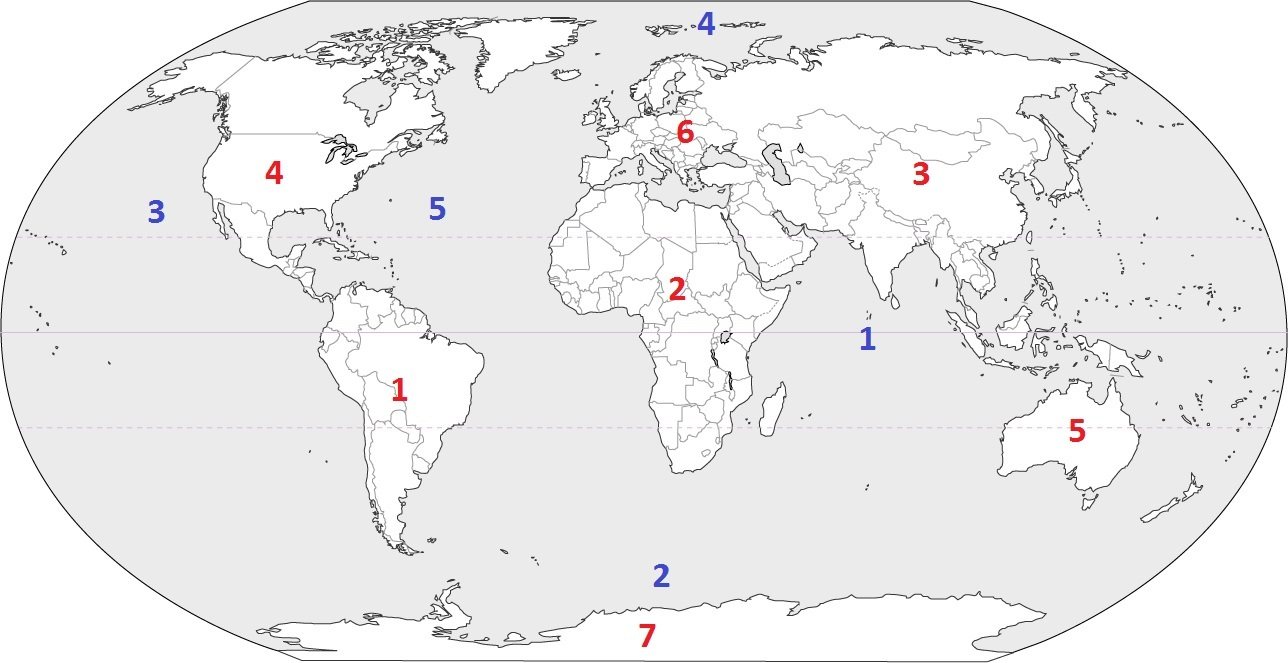
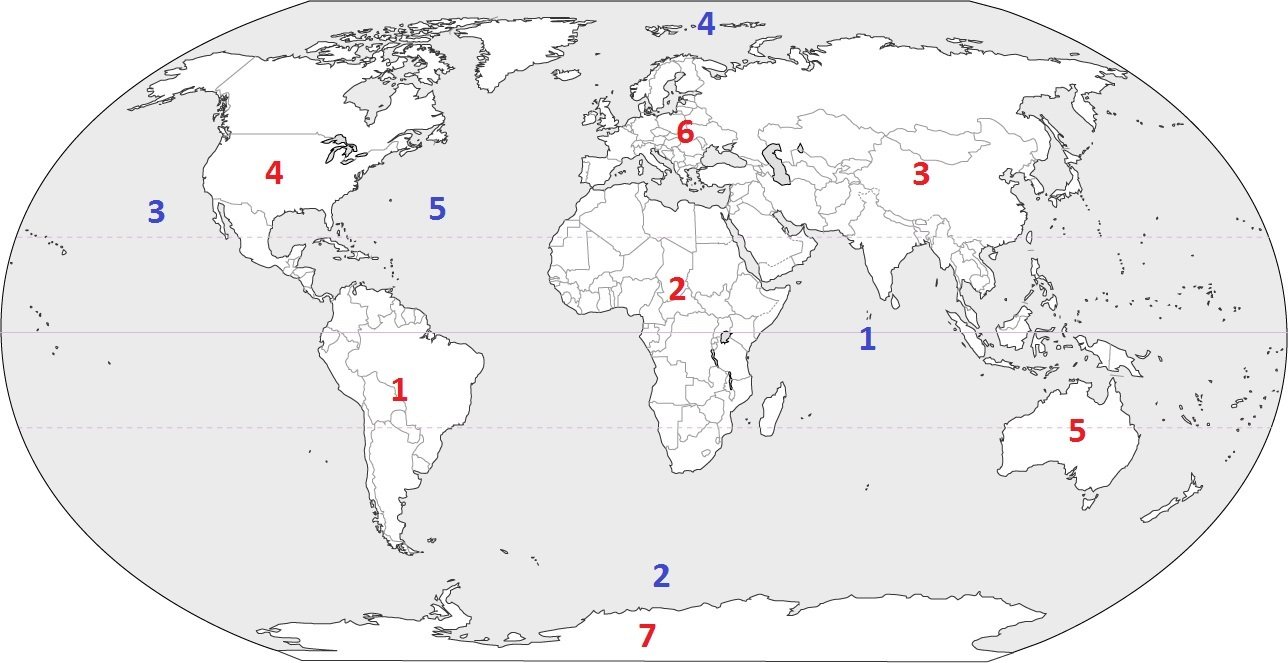
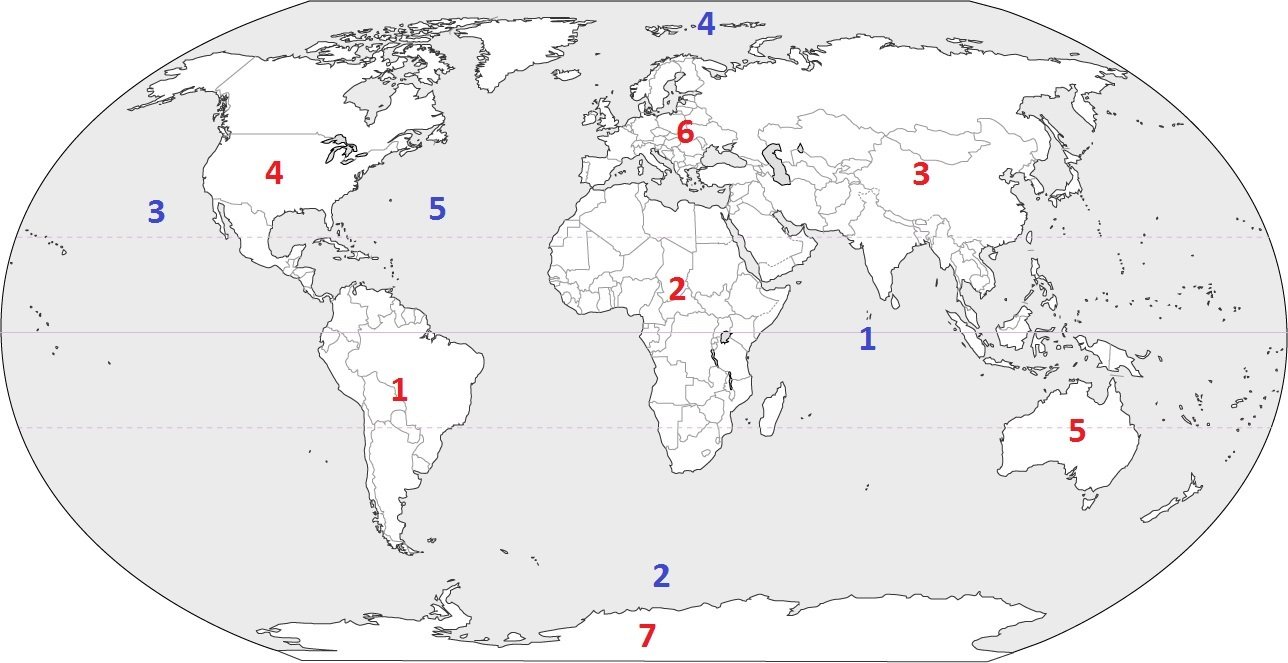
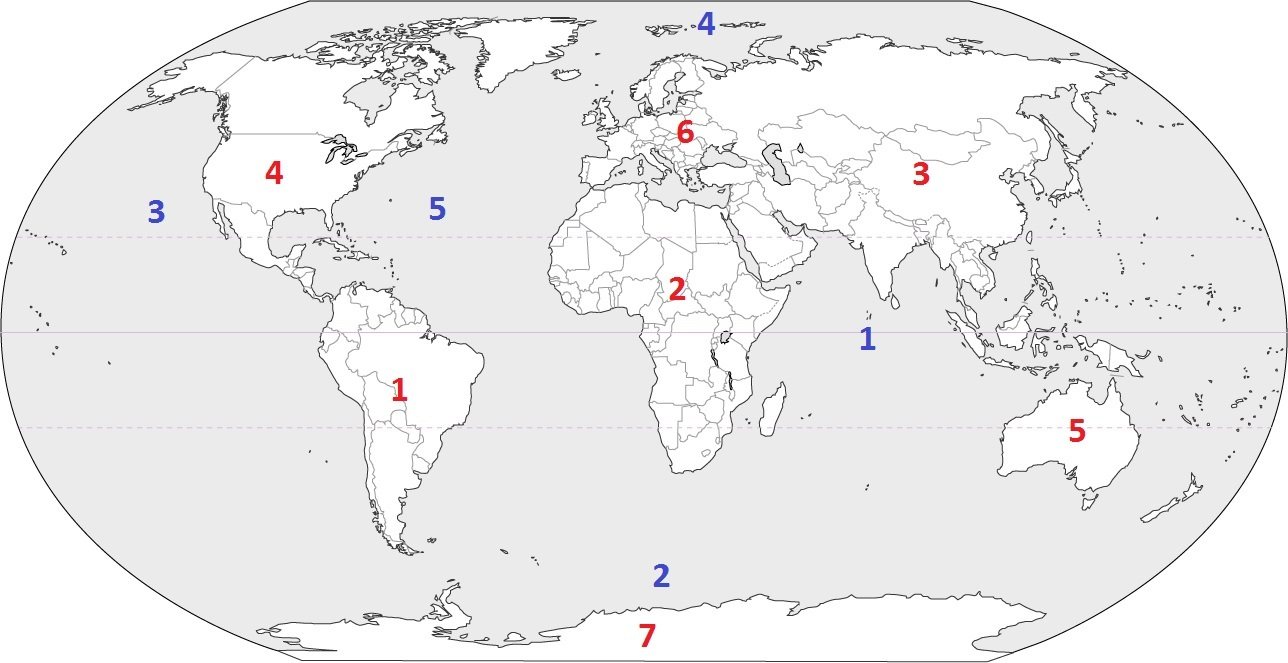
20.
On this continent, you can find animal species such as penguins, seals and some birds. This is the coldest continent.
a)
North America
b)
Antarctica
c)
South America
d)
Europe
21.
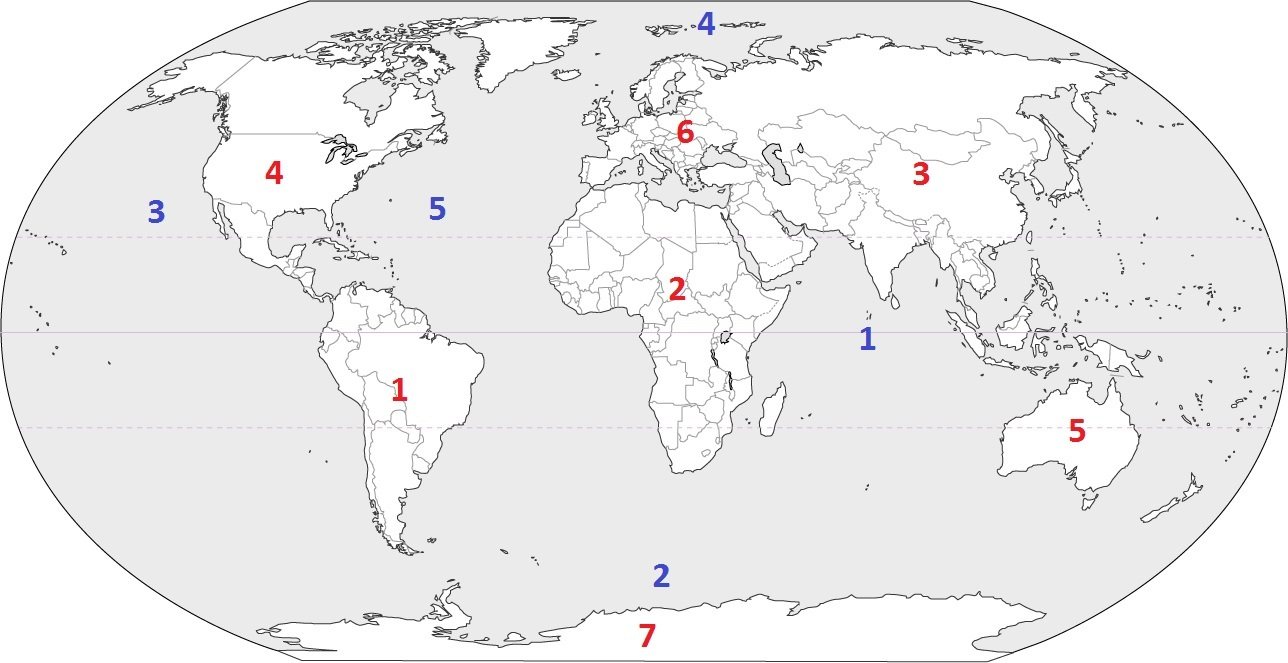
Identify the ocean at location #3
a)
Atlantic Ocean
b)
Arctic Ocean
c)
Pacific Ocean
d)
Indian Ocean
22.
Identify the ocean at location #5
a)
Atlantic Ocean
b)
Southern Ocean
c)
Pacific Ocean
d)
Arctic Ocean
23.
Identify the ocean at location #2
a)
Indian Ocean
b)
Pacific Ocean
c)
Southern Ocean
d)
Arctic Ocean
24.
Identify the ocean at location #1
a)
Southern Ocean
b)
Arctic Ocean
c)
Atlantic Ocean
d)
Indian Ocean
25.
Identify the ocean at location #4
a)
Indian Ocean
b)
Pacific Ocean
c)
Arctic Ocean
d)
Atlantic Ocean
26.
Approximately what percentage of Earth's surface is covered by oceans?
a)
40%
b)
50%
c)
60%
d)
70%
27.
What happens to pressure as you go deeper into the ocean? 
a)
increases
b)
decreases
c)
stays the same
d)
doubles
28.
When we go to beach, we walk on the ____________
a)
continental slope
b)
continental shelf
c)
abyssal plain
d)
seamount
29.
An opening in the surface where lava flows
a)
volcano and seamount
b)
ocean basin and plains
c)
mid ocean ridge and mountains
d)
canyon and trench
30.
What do you call an underwater mountain?
a)
trench
b)
abyssal plain
c)
seamount
31.
Which of following is the world's largest ocean? 
a)
Indian
b)
Pacific
c)
Artic
d)
Atlantic
32.
Which of the following statements describes the Earth 4-5 billion years ago? 
a)
Earth had not formed
b)
It was covered by water
c)
it had no oceans
d)
It had 3 oceans
33.
What could happen if the ocean did not absorb energy from the sun?
a)
nothing
b)
the air would be cold all the time
c)
Nights would be very cold, and days would be hot
d)
Life would go on as always
34.

A technique that uses sound waves to measure the depth of the ocean floor.

a)

SCUBA

b)

JASON

c)

Sonar

d)

weighted lines

35.

A range of mountains that wind through the ocean floor

a)

Abyssal plain

b)

volcanic island

c)

seamount

d)

mid-ocean ridge

36.
The diagram shows a boat using sonar to gather information in the ocean. What is most likely being measured with this technology?
a)
ocean depth
b)
ocean temperature
c)
pH level
d)
turbidity level
37.
The population of photosynthetic organisms is higher in the neritic zone and surface waters than in the deep ocean. Which statement best explains the reason for this?
a)
There is more space for plants to grow in these areas of the ocean.
b)
There is more dissolved oxygen for plants in these areas of the ocean.
c)
The availability of sunlight and nutrients supports photosynthetic organisms.
d)
The high salinity and cool temperature supports photosynthetic organisms.
38.
Which statement about oceans is true?
a)
Pressure is lower on the ocean floor.
b)
Water temperature increases with depth.
c)
More photosynthesis occurs in the warmer surface waters.
d)
The colder, deeper waters are less dense than the surface waters.
39.
A snaggletooth fish has a glowing lure that extends from its chin to attract prey. In which ocean zone does this fish most likelylive?
a)
bioluminescent zone
b)
intertidal zone
c)
neritic zone
d)
oceanic zone
40.
Which tool would most likely  be used by scientists to explore a hydrothermal vent at the Mid-Atlantic Ridge?
a)
buoy
b)
remote operated vehicle
c)
satellite imagery
d)
sonar
41.
A group of students developed a model to represent the different zones of an ocean. Which factor prevents the growth of aquatic plants in the aphotic zone?
a)
absence of tides
b)
absence of sunlight
c)
underwater volcanoes
d)
salinity of water