wayground logo

Free Printable Worksheets

NEW

Font size

S
M
L
XL
Worksheets

PAP biochemistry review

Total questions: 65

Worksheet time: 46mins

Name
Class
Date
1.
______ are examples of carbohydrates
a)
glucose & fructose
b)
guanine & cytosine
c)
glycine & glutamine
d)
samose & deanose
2.
__________ are nucleic acid functions
a)
store & transfer genetic info
b)
store & create energy
c)
structure & energy for cells
d)
membrane structure and nutrient transfer
3.
___________ are some functions of lipids.
a)
storing energy and  cell membrane structure
b)
providing actin & providing myosin
c)
cellulose structure and digestive assistance
d)
storing & transferring genetic info
4.
Cellulose is a type of ____________
a)
carbohydrate
b)
nucleic acid
c)
lipid
d)
protein
5.
These organic molecules are used by the body to store the genetic code.
a)
Carbohydrates
b)
Lipids
c)
Proteins
d)
Nucleic Acids
6.
These organic molecules are used by the body for long term storage of energy and make up the structure of cell membranes.
a)
Carbohydrates
b)
Lipids
c)
Proteins
d)
Nucleic Acids
7.
Sugars (glucose) and starch are examples of this organic molecule:
a)
Carbohydrates
b)
Lipids
c)
Proteins
d)
Nucleic Acids
8.
Fatty acids such as butter and oils and phospholipids are examples of this organic molecule:
a)
Carbohydrates
b)
Lipids
c)
Proteins
d)
Nucleic Acids
9.
Sugars usually end in....
a)
-ose
b)
-ace
c)
-ats
d)
-ids
10.
Examples of nucleic acids?
a)
DNA and RNA
b)
carbohydrates
c)
potatoes
d)
meats
11.
A(n) __________  is the part of the enzyme the substrate fits into.
a)
product
b)
active site
c)
enzyme
d)
substrate
12.
Made of monomers of monosaccharides
a)
Carbohydrates
b)
Lipids
c)
Proteins
d)
Nucleic Acids
13.
Made of monomers of nucleotides
a)
Carbohydrates
b)
Lipids
c)
Proteins
d)
Nucleic Acids
14.
Made of glycerol and fatty acids
a)
Carbohydrates
b)
Lipids
c)
Proteins
d)
Nucleic Acids
15.
Enzymes are considered to be 
a)
Lipids
b)
Carbohydrate
c)
Protein
d)
Nucleic Acid
16.
What is the purpose  of an enzyme?
a)
give permission for the reaction
b)
raise activation energy
c)
speed up reactions
d)
control how many reactions occur
17.
When electrons are shared between two atoms, the bond formed is
a)
ionic
b)
covalent
c)
hydrogen
d)
peptide
18.
A substance with a pH of 4 is considered a(n)
a)
base
b)
neutral
c)
acid
19.
The energy needed to start a reaction
a)
activation energy
b)
adhesion energy
c)
chemical energy
d)
cohesion energy
20.
Which of the following statements about enzymes is NOT true?
a)
enzymes are reusable
b)
enzymes work best at specific pH and temperatures
c)
enzymes are lipids
d)
enzymes are proteins
21.
Which property makes water molecules stick to other water molecules?
a)
adhesion
b)
cohesion
c)
capillary action
d)
polarity
22.
The basic unit of any molecule; The six common ones necessary for life are CHNOPS
a)
Element
b)
Monomer
c)
Polymer
d)
Compound
23.
Describes a molecule containing carbon and hydrogen together (usually along with others)
a)
Organic
b)
Inorganic
c)
Disorganic
d)
Monorganic
24.
The process/reaction used to link compounds/monomers together.  Releases water.
a)
Dehydration
b)
Hydrolysis
c)
Enzomatic
d)
Tetratonic
25.
A large molecule made up of multiple monomers
a)
Polymer
b)
Polysaccharide
c)
Macromolecules
d)
Protein 
26.
The image is an example of a
a)
Lipid
b)
Polysaccaride
c)
Protein
d)
Lipid (polypeptide)
27.
Which of the following is not a job of a protein
a)
Act as hormones and enzymes
b)
Do much of the work in cells and transport materials
c)
Build tissues and muscles 
d)
store and transmit genetic information 
28.
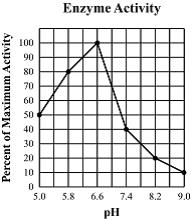
Which of the following conclusions can be drawn from this graph?
a)
The optimum pH of the enzyme is 6.6.
b)
The optimum pH of the enzyme is 5.8
c)
The enzyme’s activity increases as pH increases 5.0 to 9.0
d)
The enzyme’s activity is greater around pH of 8.0 .
29.
Any substance that is acted upon by an enzyme is called a(n)?
a)
Coenzyme
b)
Substrate
c)
Vitamin
d)
Polypeptide
30.
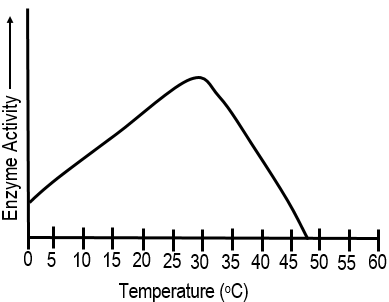
Based on the graph, what is the optimal temperature for this enzyme? 
a)
15oC
b)
40oC
c)
30oC
d)
35oC
31.
What happens when enzymes are heated to a high temperature?
a)
The enzymes die.
b)
The shapes of the enzyme are altered denature
c)
The enzymes' amino acid sequence changes.
d)
The enzymes remain the same
32.
Which of these is NOT true?
a)
Enzymes can denature (change shape) when the temperature gets too high.
b)
Enzymes can only be used once in a chemical reaction. 
c)
Extreme pH can denature enzymes.
d)
Enzymes speed up chemical reactions. 
33.
Subunit is to Macrocolecule like ___ is to ____
a)
Building is to Bricks.
b)
Brick is to Building.
c)
Carpenter is to Building.
d)
Building is to Carpenter.
34.
What property of water makes it the 'universal solvent'?
a)
it is a polar molecule
b)
it is an ionic compound
c)
it contains hydrogen bonds
d)
it steals electrons from other atoms
35.
Carbohydrates are made of... 
a)
C H O
b)
C H O N
c)
C H O N P
d)
C H O N S
36.
How many different amino acids are there?
a)
4
b)
20
c)
6
d)
46
37.
True of False. Glycogen is a starch that is found in animals. 
a)
True
b)
False
38.
Attractions between water molecules are called
a)
Covalent bonds
b)
Ionic bonds
c)
Polar bonds
d)
Hydrogen bonds
39.

The smallest basic unit of matter is the

a)

molecule

b)

compound

c)

cell

d)

atom

40.

Which of the following has the highest H+ ion concentration?

a)

a solution with a pH of 1

b)

a solution with a pH of 4

c)

a solution with a pH of 7

d)

a solution with a pH of 10

41.

Substances that are changed during a chemical reaction are the

a)

products

b)

catalysts

c)

enzymes

d)

reactants

42.

The attraction among molecules of different substances is called

a)

surface tension

b)

adhesion

c)

cohesion

d)

specific heat

43.

An exothermic reaction

a)

does not absorb any energy

b)

forms products with higher bond energy than reactants

c)

is in a state of equilibrium

d)

releases more energy than it absorbs

44.

What is formed when atoms gain or lose electrons?

a)

ions

b)

elements

c)

molecules

d)

compounds

45.

Chemical reactions that absorb more energy than they release are

a)

exothermic

b)

catalyzed

c)

activated

d)

endothermic

46.
What is the correct order from smallest to largest?
a)
molecules, atoms, cells, organelles
b)
atoms, molecules, organelles, cells
c)
atoms, cells, organelles, molecules,.
d)
Gabby, Talia, Trinity, Yostina
47.
Bread, fruit, vegetables, and starches are examples of
a)
carbohydrates
b)
lipids
c)
proteins
48.
Which of the following is a pure substance that can't be broken down?
a)
Compound
b)
Element
c)
Law
d)
Molecule
49.

A molecule with a partial positive charge on one side and a partial negative charge on the other side is called

a)

polar

b)

non-polar

c)

ion

d)

charged molecule

50.

Electrons responsible for bonding

a)

ions

b)

protons

c)

neutrons

d)

valence electrons

51.
In this Bohr model of Neon, how many valence electrons (electrons in the last shell) are there?
a)
10
b)
20
c)
8
d)
16
52.
This particle has a positive charge
a)
electron
b)
proton
c)
neutron
d)
atom
53.
This particle has a negative charge
a)
electron
b)
proton
c)
neutron
d)
atom
54.
This particle has a neutral charge
a)
electron
b)
proton
c)
neutron
d)
atom
55.
If Helium has 2 protons, how many electrons will it have if there is no charge?
a)
0
b)
1
c)
2
d)
4
56.
When electrons in the outer energy levels reach the magic number 8, then it is said to be:
a)
stable
b)
unstable
c)
unreliable
d)
an ion
57.
This is a substance that there is more of, and that dissolves the other substance.
a)
solute
b)
solvent
58.
This measures the concentration of H+ ions.
a)
Periodic table
b)
Carbon chains
c)
Bohr's Models
d)
pH scale
59.
Inside of the nucleus, you will find which particles?
a)
electrons and protons
b)
neutrons and electrons
c)
protons and neutrons
d)
electrons only
60.
Matter is defined as
a)
the simplest form of a substance
b)
anything that has mass and takes us space
c)
two or more elements bonded together
d)
when a water molecule is attracted to another water
61.
Which sub-atomic particle has the LEAST mass and is the smallest?
a)
electron
b)
proton
c)
neutron
d)
nerve cell
62.
An isotope contains a different number of ____.
a)
protons
b)
neutrons
c)
electrons
d)
ions
63.
Which bonding transfers electrons
a)
Hydrogen
b)
Covalent
c)
Ionic
d)
Van der Waals
64.
Which foods are high in protein?
a)
Meats, cheeses, milk, eggs
b)
Breads, pasta, grains
c)
Butter, oil, lard
d)
Apples, Bananas, Grapes
65.
The "lock and key" analogy attempts to explain the mechanism of
a)
Vacuole formation
b)
Pinocytosis
c)
Sharing of electrons
d)
Enzyme specificity