wayground logo

Free Printable Worksheets

NEW

Font size

S
M
L
XL
Worksheets

Paleo/Neolithic review

Total questions: 72

Worksheet time: 57mins
Name
Class
Date
1.
Scientists believe that the earliest humans evolved in and migrated from which continent? 
a)
Europe 
b)
North America 
c)
Asia 
d)
Africa 
2.
Which best describes the nomadic lifestyle of the Paleolithic people? 
a)
They lived in large villages, where they raised crops and livestock.
b)
They migrated, or moved, from place to place
c)
They stayed in one place, living in caves and beneath rock shelters.
d)
They lived in small villages and farmed the land. 
3.
Which statement best describes hunters and gatherers?
a)
They were experts at using their environment to meet their basis needs. 
b)
The tools they made from metal helped them to survive.
c)
They domesticated animals to help with daily activities. 
d)
They developed ways to bring water to their crops. 
4.
Which of the following is NOT a possible reason for the cave paintings made by the Paleolithic people? 
a)
The paintings were the first expressions of art.
b)
The paintings taught young hunters how to hunt. 
c)
The paintings taught young farmers how to plant seeds.
d)
The paintings had religious significance.
5.
What did the hunters and gatherers have to develop before they could effectively work together? 
a)
tools 
b)
language 
c)
fire
d)
domestication of animals
6.
What change in farming technology influenced the food supply? (hint: only one of these is a "technology" - created by humans) 
a)
more advanced tools 
b)
global climate change 
c)
rich, fertile soil 
d)
longer days 
7.
Which statement best explains the greatest effect the emergence of agriculture had on early societies?
a)
The population steadily decreased.
b)
People were not able to specialize in just one trade. 
c)
Agriculture made it harder to find food. 
d)
The population steadily increased. 
8.
What was the main role women played in Paleolithic society?
a)
Women gathered wild plants for food. 
b)
Women hunted animals for food.
c)
Women planted seeds for food. 
d)
Women domesticated animals for food. 
9.
Neolithic villages grew larger and made it necessary to develop
a)
art 
b)
tools for hunting
c)
written language
d)
government 
10.
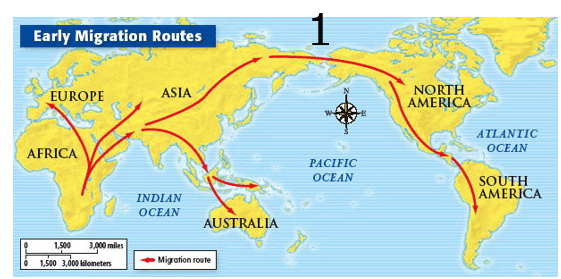
The map shows the migration routes of early humans. What made it possible for them to move from Asia to North America?
a)
They constructed large ships to sail across at #1. 
b)
They crossed the land bridge at #1. 
c)
They swam the short distance at #1. 
d)
They built a bridge out of wood at #1.
11.
Which statement best describes the clothing of early cultures?
a)
Paleolithic people learned to weave plants for cloth. 
b)
Neolithic people used only animal skins for clothing.
c)
Paleolithic people used wool collected from domesticated sheep. 
d)
Neolithic people made clothes from cloth, wool, and animal skins. 
12.
Which statement is true?
a)
During the Neolithic Era people migrated from place to place. 
b)
During the Paleolithic Era people migrated from place to place. 
c)
During the Neolithic Era people developed language.
d)
During the Paleolithic Era people used animals to help with farming. 
13.

Simple flint tools

a)

Paleolithic

b)

Neolithic

14.

Farming

a)

Paleolithic

b)

Neolithic

c)

both

d)

neither

15.

invented fire

a)

Paleolithic

b)

Neolithic

16.

Old Stone Age

a)

Paleolithic

b)

Neolithic

17.

hunting large animals

a)

Paleolithic

b)

neolithic

18.

Domestication of animals

a)

Paleolithic

b)

Neolithic

c)

both

d)

neither

19.

Cave painting

a)

Paleolithic

b)

Neolithic

c)

both

d)

neither

20.

Written Language

a)

Paleolithic

b)

Neolithic

c)

both

d)

neither

21.

nomads

a)

Paleolithic

b)

Neolithic

c)

both

d)

neither

22.

What did the Neolithic Revolution bring about?

a)

a. Storms

b)

b. Drought

c)

c. Agriculture

d)

d. extinction

23.
One Way that farming changed the way people lived was____________________.
a)
They no longer were nomads
b)
Life expectancy was shorter
c)
They had to move around to new farms
24.
Record Keeping is a _________________.
a)
Way to communicate
b)
What DJ's do
c)
Characteristic of a Civilization
25.
1.  Schools,  Government, and Religion are examples of ________________________.
a)
   Advanced cities
b)
     Complex Institutions
c)
       Specialized Workers
26.
1.  The United States is a civilization?
a)
True
b)
False
27.
During the Neolithic Revolution
a)
People learned to grow food
b)
People migrated to find food
c)
People were nomadic
28.
What is another name for the Neolithic Age?
a)
New Stone Age
b)
Old Stone Age
c)
Prehistoric Period
d)
The Ice Age
29.
How did man get his food during the Paleolithic Age?
a)
Growing crops
b)
Hunting and Gathering
c)
Stealing from others
d)
Scavenging
30.
Which of the following is NOT a domesticated animal?
a)
cattle
b)
horses
c)
lions
d)
sheep
31.
Which of the following would you most likely find in the Paleolithic Era?
a)
jewelry made of smooth stones
b)
farms
c)
 cave paintings
d)
domesticated animals
32.
The movement of people from one location to another is called______________.
a)
transportation
b)
glaciation
c)
Paleolithic
d)
migration
33.
Why do historians call the Neolithic Revolution a revolution?
a)
It was during this time that people first started using weapons against each other.
b)
During the time, huge changes occurred in how people lived
c)
Paleolithic people fought against Neolithic people
d)
People first started using tools.
34.

Pre-history means...

a)

the time before humans could communicate with systematic language

b)

past events after written records were invented

c)

any time before written history

d)

the time when humans were still cavemen

35.

Which of these do NOT happen as a direct result of the discovery of fire?

a)

tools can be made easier

b)

humans can migrate to different climate regions

c)

humans began settling in towns and small cities

d)

fire is used as a source of light and warmth

36.

Neanderthals (stage 4) do all of the following EXCEPT..

a)

create cave art

b)

have some religious ideas

c)

have specialized jobs

d)

use weapons and tools

37.

Historians study creation myths for these reasons EXCEPT

a)

they give insight into the human mind and reveal universal truths

b)

the similarities among myths show the connections between groups of people

c)

to study their development into other stories over time

d)

to understand them as objective fact

38.

The Neolithic Revolution spurred at the same time across continents: the invention of agriculture spread quickly from place to place.

a)

True

b)

False

39.

The most integral aspect of the Neolithic Revolution is that...

a)

people began to settle down and be sedentary

b)

genders became unequal

c)

diets became more insipid

d)

copper and bronze tools develop

40.

Why was the fertile Crescent the site of many early settlements?

a)

Lots of gold

b)

Yummy Crescent Rolls

c)

Good soil for crops

d)

Warm and deep caves for living

41.
person who lives by hunting & gathering plants
a)
technology
b)
hunter-gatherer
c)
revolution
d)
animism
42.
person who moves from place to place without a permanent home
a)
culture
b)
nomad
c)
settler
d)
irrigate
43.
tools & skills people use to meet their needs & wants
a)
hunter-gatherer
b)
nomad
c)
technology
d)
revolution
44.
Which of these BEST describes the importance of mankind's first use of fire approximately 1 million years ago?
a)
People were more protected from predators.
b)
Humans could now invent tools to make life easier.
c)
Harnessing fire meant that dinosaur meat could now be cooked.
d)
Hunter-gatherers' ability to hunt at night meant they could eat more.
45.
Which of these is MOST associated with the Neolithic Era?
a)
Invention of stone tools
b)
the end of the Bronze Age
c)
development of agriculture
d)
development of medicine & languages
46.
About 10,000 years ago, human civilization changed in a major way. What was this change?
a)
Humans began to make tools.
b)
Humans began to use spoken language.
c)
Humans increasingly became literate.
d)
Humans began to farm & domesticate animals.
47.
Which is the only Cradle of Civilization located on the continent of Africa?
a)
Egypt
b)
Mesopotamia
c)
Harappan
d)
Shang
48.
What do all these civilizations have in common?
a)
Located near mountains; necessary for their protection.
b)
Located near seas; necessary for their trading.
c)
Located near rivers; necessary for the shipping of goods.
d)
Located on rivers; necessary for the irrigation of crops
49.
What is the name for the civilization located at letter B?
a)
Harappan
b)
Mesopotamia
c)
Egypt
d)
Shang
50.
What river is located at letter C?
a)
Nile
b)
Tigris
c)
Huang He
d)
Indus
51.
There is consensus among historians that the ______  and the Neolithic Revolution were linked.
a)
domestication of animals
b)
Industrial Revolution
c)
 use of written language
d)
development of stone hunting tools
52.
Early man migrated from what area to populate the world?
a)
Africa
b)
Europe
c)
Asia
d)
Ameria
53.
Man migrated from Asia to America via what route?
a)
The Pacific Ocean
b)
The Atlantic Ocean
c)
The Bering Strait
d)
The North Sea
54.
The very first tools for Paleolithic man were?
a)
Shovels
b)
Plows
c)
Bones
d)
Sticks & Rocks
55.
Artifacts are -
a)
Manufactured items
b)
Man-made items
c)
Items that paleontologists work with
d)
Another name for carbon-dating
56.
What made the Neolithic Age different from the Paleolithic Age?
a)
Settled communities
b)
Increased Agriculture
c)
Pottery & Weaving skills
d)
All of the above
57.
By studying cave art, archaeologists determine - 
a)
How people lived
b)
Interpret written records
c)
Understand spoken language
d)
Study farming techniques
58.
What made it possible for Paleolithic people to survive during the ice age?
a)
rocks
b)
tools
c)
fire
d)
water
59.
Which statement best describes the process of evolution?
a)
Populations can survive in different locations on earth
b)
Environmental conditions limit the number of species on Earth
c)
Populations grow when resources are abundant
d)
The traits of a species can change over time
60.

Modern humans and their closest relatives belong to the same family. Members of this family are called:

a)

hominids

b)

primates

c)

homo sapiens

d)

Lucy

61.

What is human evolution?

a)

Long process of change by which primates became modern humans

b)

Long process of change by which humans became modern primates

c)

Long process of change by which hominids turn into humans

d)

Long process of change by which humans became homo habilis

62.

Why is Homo Habilis considered the first species to be human?

a)

Because of his toolmaking skilss

b)

Because they developed language

c)

Because they developed art

d)

Because they discovered fire

63.
The scientific study of humans and their ancestors by excavation and examination of material remains.
a)
archaeology
b)
fossilization
c)
bipedalism
d)
collective learning
64.
What is the scientific name for modern humans?
a)
Australophithecene
b)
Homo ergaster (erectus)
c)
Homo habilis
d)
Homo sapiens
65.

The abundance of rain was a climate change that influenced human evolution

a)

True

b)

False

66.
Time of extreme cold when great sheets of ice covered parts of the earth
a)
Bronze Age
b)
Ice Age
c)
Stone Age
d)
Golden Age
67.
The early period of human history
a)
Iron Age
b)
Bronze Age
c)
Ancient Age
d)
Stone Age
68.
Paleolithic people were able to survive because they used
a)
Rocks
b)
Water
c)
Caves
d)
Fire
69.
How did people spend their time during the Paleolithic Age?
a)
Building cities
b)
Learning new jobs
c)
Finding food
d)
Weaving and Farming
70.
One of the most important technologies used during the Paleolithic Age
a)
Tools
b)
Written Language
c)
Art
d)
Religion
71.
Which of the following developed after the Paleolithic Age?
a)
Spoken language
b)
Farming
c)
Art
d)
Tools
72.
1.  What were the primary occupations of people during the Paleolithic Era?
a)
a.  Hunters & Gathers
b)
a.  Toolmakers
c)
a.  Farmers