
 Worksheets
Rocks, Minerals, and Soil
Total questions: 56
Worksheet time: 54mins
Name
Class
Date
1.

The process when rocks break into smaller pieces due to exposure to natural elements is called
a)
erosion
b)
weathering
c)
sediments
d)
deposition
2.
The movement of weathered material (sediment) is called?
a)
weathering
b)
erosion
c)
deposition
d)
cementation
3.
The process when rocks break into smaller pieces due to exposure to natural elements is called
a)
erosion
b)
weathering
c)
sediments
d)
deposition
4.
What is deposition?
a)
Dropping off sediment
b)
Movement of sediment
c)
Breaking down of sediment
5.
What is deposition?
a)
Dropping off sediment
b)
Movement of sediment
c)
Breaking down of sediment
6.
How light reflects off of a mineral is called the mineral's
a)
luster
b)
streak
c)
cleavage
d)
fracture
7.
Diamond has a hardness of ___ on Mohs Hardness Scale.
a)
1
b)
5
c)
8
d)
10
8.
Dull, silky, waxy, pearly, and earthy are terms that best describe which property of minerals?
a)
luster
b)
color
c)
streak
d)
cleavage
9.

By definition, a mineral has which of the following characteristic(s)?
a)
definite chemical composition
b)
crystal structure
c)
naturally occuring
d)
all of the above
10.
How do you test the hardness of a mineral?
a)
Throw it against a wall
b)
Step on it
c)
Scratch Test
d)
Kick it until it breaks
11.

What mineral is used for pencils?
a)
Graphite
b)
Galena
c)
Magnetite
d)
Quartz
12.
A naturally occurring, inorganic solid with a crystal structure and a definite chemical composition is referring to
a)
density
b)
streak
c)
mineral
d)
non silicate mineral
13.
What mineral is the softest mineral on Moh's Hardness Scale and the main ingredient in baby powder?
a)
feldspar
b)
talc
c)
gypsum
d)
kaolinite
14.
A mineral's resistance to being scratched is called?
a)
streak
b)
luster
c)
hardness
d)
heft
15.
The ________ measures how hard a mineral is.
a)
Miller Scale
b)
Dishong Scale
c)
Curly Scale
d)
Mohs Scale
16.
_________ is how easily something can be scratched.
a)
specific gravity
b)
luster
c)
hardness
17.
___________ describes how the mineral reflects light.
a)
cleavage
b)
magnetic
c)
luster
18.
Minerals are identified by observing their ___________.
a)
physical properties
b)
name
c)
location
19.
Minerals are identified by observing their ___________.
a)
physical properties
b)
name
c)
location
20.
Which of the following is NOT a way to identify a mineral?
a)
Luster
b)
Hardness
c)
Heaviness
d)
Density
21.
Which of the following properties does the Mohs scale measure?
a)
Luster
b)
Hardness
c)
Density
d)
Streak
22.
Which of the following is NOT true of minerals?
a)
They are liquids
b)
They are formed in nature
c)
They are inorganic
d)
They have crystalline structure
23.
What mineral is known as "fools gold"?
a)
graphite
b)
quartz
c)
galena
d)
pyrite
24.
A mineral's resistance to being scratched is called?
a)
streak
b)
luster
c)
hardness
d)
heft
25.

By definition, a mineral has which of the following characteristic(s)?
a)
chemical composition
b)
crystalline structure
c)
natural
d)
all of the above
26.

The mineral in the picture has a ____________ luster.
a)
Nonmetallic
b)
Metallic
c)
Pearly
d)
Earthy
27.
What is the relationship between a rock and a mineral?
a)
Rocks are made up of minerals.
b)
Minerals are made up of rocks.
c)
Rocks are on the Earth's surface. Minerals are found underground.
d)
Rocks and minerals are different names for the same thing.
28.
What is the relationship between a rock and a mineral?
a)
Rocks are made up of minerals.
b)
Minerals are made up of rocks.
c)
Rocks are on the Earth's surface. Minerals are found underground.
d)
Rocks and minerals are different names for the same thing.
29.
A scientist made an object in a lab that has a crystal structure and was solid. Why is the object not considered a mineral?
a)
It is a solid
b)
It is man-made
c)
It is inorganic
d)
It has a crystalline structure
30.

Which minerals would all scratch apatite?
a)
diamond, topaz, quartz
b)
quartz, calcite, gypsum
c)
fluorite, talc, calcite
d)
diamond, fluorite, corundum
31.

Which mineral would scratch calcite but not scratch apatite?
a)
fluorite
b)
gypsum
c)
talc
d)
topaz
32.

Which indicator would not be good as the only indicator when identifying a mineral?
a)
Color
b)
Breaking Pattern
c)
Specific Gravity
d)
Hardness
33.
When determining which minerals will scratch other minerals, you would need to refer to the:
a)
Periodic Table of Elements
b)
Rocks Guide Book
c)
Moh's Hardness Scale
d)
Richter Scale
34.

Which mineral is number 6 on the hardness scale?
a)
Conrundum
b)
Topaz
c)
Quartz
d)
Orthoclase
35.
Soil formation begins with the weathering of_______.
a)
Humas
b)
Subsoil
c)
Litter
d)
Rock
36.
The layer of soil which the topsoil is found.
a)
Horizon A
b)
Horizon B
c)
Horizon C
d)
Horizon D or R
37.
The MAIN thing Decomposers do for the the soil is the following:
a)
Store moisture
b)
Burrow deep in the soil
c)
Make space for air and water
d)
Break down and digest dead organisms
38.
Decayed organic material in soil is called______.
a)
Litter
b)
Silt
c)
Humus
d)
Clay
39.
The movement of rocks and weathered materials is called_________.
a)
Chemistry
b)
Physical
c)
Weathering
d)
Erosion
40.
Which combination creates sand?
a)
Rocks and ocean waves
b)
Wind and ocean waves
c)
Long waves and wind
d)
surf and ocean waves
41.
Topsoil which contains the HUMUS is the soil layer best for growing plants.
a)
True
b)
False
42.
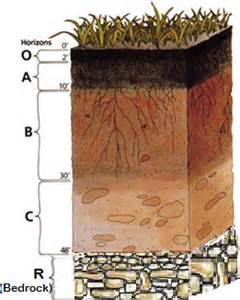
In which horizon is most of the HUMUS?
a)
Horizon A
b)
Horizon B
c)
Horizon C
d)
Horizon D or R
43.
Soil's one of the Earth’s most valuable resources. Everything on Earth depends on soil somehow.
a)
True
b)
False
44.
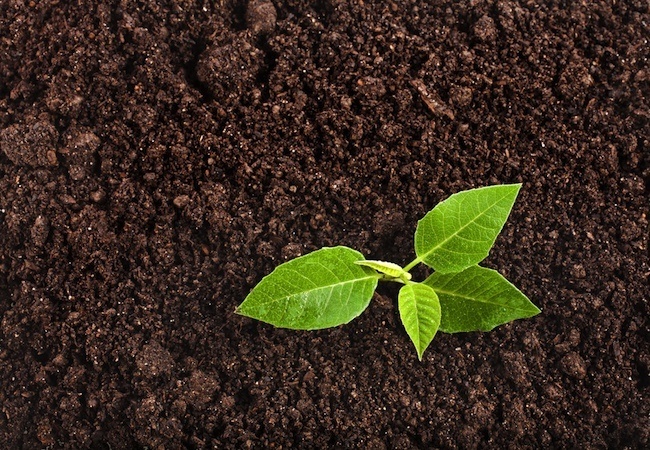
Which of the following is NOT one of the three types of soil?
a)
clay
b)
sand
c)
silt
d)
mud
45.

_______ is the type of soil used most often with plants and on farms. It is a mixture of clay, sand, and silt.
a)
loam
b)
humus
c)
soil
d)
dirt
46.

Are there minerals in soil?
a)
Yes
b)
No
47.
Ellen grabs a topsoil sample in her hand. She rolls it into a ball. The soil feels gritty and the ball falls apart. What part of the topsoil most likely made the topsoil feel gritty?
a)
clay
b)
sand
c)
silt
d)
humus
48.
When plants, animals, and other organisms die, they break down and become part of the soil. What is this part of the soil called?
a)
sand
b)
silt
c)
clay
d)
humus
49.
Which of the following is the largest particle in soil?
a)
sand
b)
silt
c)
humus
d)
clay
50.
You dig a small hole in the soil and the next day it rains. The hole fills with water, but does not empty even after several days of dry weather. What is the soil mostly made of?
a)
clay
b)
sand
c)
humus
d)
silt
51.
Which of the following best describes soil erosion?
a)
A. the breakdown of soil
b)
A. the improvement of soil
c)
A. the addition of soil
d)
A. the movement of soil by wind or water
52.
Which type of soil can hold the greatest amount of water?
a)
sand
b)
silt
c)
clay
d)
loam
53.
Many plants cannot grow in sandy soil. Why is this true?
a)
Sandy soil does not hold enough water.
b)
Air cannot pass through sandy soil.
c)
Roots cannot easily push through sandy soil.
d)
Sandy soil has too many nutrients.
54.

Wind blowing dirt and sand through the air is an example of...
a)
weathering
b)
erosion
55.

Water gets into the cracks of rock and freezes, causing the rock to break. What is this an example of?
a)
erosion
b)
weathering
56.

Soil is made of
a)
weathered rocks and minerals
b)
dead plants and animals
c)
air and water
d)
all of the above
100 %

