

wayground logo

Free Printable Worksheets

NEW

Font size

S
M
L
XL
Worksheets

Population: Ch. 2

Total questions: 61

Worksheet time: 42mins

Name
Class
Date
1.
Zero population growth occurs when the TFR (total fertility rate) is at
a)
1.2
b)
2.1
c)
2.7
d)
1.9
2.
Nearly all the world's population growth is clustered in what areas?
a)
Urban areas
b)
MDC's
c)
LDC's
d)
Suburban areas
3.
There are NO countries in which stage?
a)
Stage 3
b)
Stage 2
c)
Stage 4
d)
Stage 1
4.
If the GNP(Gross National Product) increases the birth rate of that country?
a)
decreases
b)
increases slowly
c)
doesn't change
d)
increases rapidly
5.
Thomas Malthus thought
a)
population would increase at the same rate as farming production
b)
population would eventually decline due to birth control and family planning
c)
population would eventually outgrow food production
d)
moral restraint would lower population growth 
6.
The ratio of people who are too young or too old to work compared to the working population is called the
a)
dependency ratio
b)
population pyramid
c)
interconnected ratio
d)
retirement ratio
7.
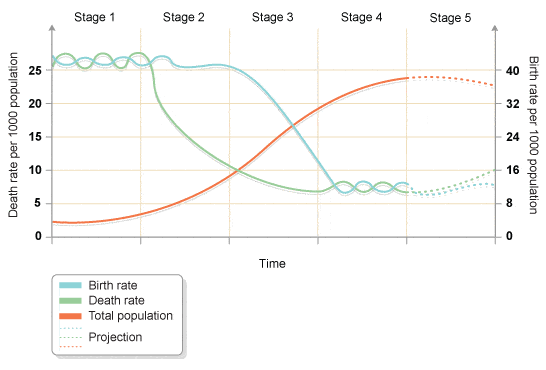
Death rates fall rapidly due to increased hygiene and medical advances during stage
a)
1
b)
2
c)
3
d)
4
8.
Lowest CDR occurs during stage
a)
1
b)
2
c)
3
d)
4
9.
Highest population growth occurs during stage
a)
1
b)
2
c)
3
d)
4
10.
In LDC's this would be typically low.
a)
CDR
b)
CBR
c)
Infant mortality
d)
life expectancy
11.
The annual worldwide natural increase rate is
a)
1.2%
b)
12%
c)
12 million
d)
12 trillion
12.
The time it takes for the world population to go from 3 billion to 6 billion or 6 billion to 12 billion is called
a)
overpopulation
b)
doubling time
c)
natural increase
d)
life expectancy
13.
The average number of children a woman will have in her lifetime is the
a)
birth rate or CBR
b)
natural increase or NIR
c)
mortality rate
d)
total fertility rate or TFR
14.
This caused a jump in the worlds' population.
a)
the Renaissance
b)
the Industrial Revolution
c)
the Medical Revolution
d)
the Scientific Revolution
15.
The ___________ __________ stabilized the world's population 10,000 years ago.
a)
Industrial Revolution
b)
Reformation
c)
Black Plague
d)
Agricultural Revolution
16.
Which area is the most habitable?
a)
high areas
b)
cold areas
c)
warm areas
d)
dry areas
17.
Which area has the highest urbanization rate?
a)
Indochina
b)
 Western Europe
c)
East Asia
d)
South Asia
18.
The world's most populated country is
a)
India
b)
Nigeria
c)
China
d)
Indonesia
19.
The world's most populated region is 
a)
North America
b)
East Asia
c)
South Asia
d)
Africa
20.
Overpopulation is 
a)
too many darn people for the world
b)
too many darn people for a country
c)
too many darn people for an area
d)
too many darn people for the resources
21.
ZPG stands for
a)
Zero population growth
b)
Zero pending growth
c)
Zero pollution growth
d)
Zero pounds growth
22.

Based on the data above, which statement best describes the trend in Thailand´s population between

1980 and 2015?

a)

It has continued to grow at a rapid rate during the last 35 years

b)

It has slowed over time, from rapid growth to very little growth over the last 35 years

c)

It has shown no change in the last 35 years

23.

Education of women worldwide as lowered birthrates partly because

a)

educated women need to bear many children to ensure that some will survive

b)

educated women may focus on their careers more than raising large families

c)

educated women contribute less to their family income

d)

all of the above

24.

Which statement describes how humans are affecting the balance of carbon in the atmosphere?

a)

Fewer agricultural crops are planted, reducing the amount of carbon dioxide released into the atmosphere

b)

Burning fossil fuels in greater quantities has increased the amount of carbon dioxide in the atmosphere

c)

Overgrazing of grasslands has reduced the amount of carbon dioxide in the atmosphere.

d)

D. Severe drought in large areas of the world has decreased the amount of carbon dioxide that is released into the atmosphere

25.

The largest population that an environment can support at any given time.

a)

Parasitism

b)

Growth Rate

c)

Carrying Capacity

d)

Commensalism

26.

The basic facilities of a country or region, such as roads, bridges, and sewers.

a)

Age Structure

b)

Demographic Transition

c)

Migration

d)

Infrastructure

27.

An increase in the ratio or density of people living in urban areas rather than in rural areas.

a)

Urbanization

b)

Migration

c)

Survivorship

d)

Arable Land

28.

Farmland that can be used to grow crops.

a)

Migration

b)

Fertility Rate

c)

Arable Land

d)

Urbanization

29.

The average length of time that an individual is expected to live.

a)

Life Expetancy

b)

Arable Land

c)

Infrastructure

d)

Age Structure

30.

The number of births (usually per year) Per 1,000 women of childbearing age.

a)

Fertility Rate

b)

Arable Land

c)

Urbanization

d)

Age Structure

31.

A resident of ______________ is likely to leave the largest ecological footprint.

a)

Indonesia

b)

Britain

c)

United States

d)

India

32.

Which of the following is NOT a strategy that would reduce population size?

a)

Economic incentives for families for having fewer children.

b)

Legal punishments for people who have too many children.

c)

Limiting education of women

d)

Public advertising showing families with fewer children having a better life.

33.

A wealthy country with an advanced economy

a)

Developed Country

b)

Erosion

c)

Developing Country

d)

Life Expectancy

34.
The scientific study of populations 
a)
Demography
b)
Population studies 
c)
Geography
d)
Ecology 
35.
Difference between birth and death rates 
a)
Mortality 
b)
Fertility 
c)
Doubling time 
d)
Natural Increase
36.
Average number of people living on one square mile
a)
Population Movement 
b)
Population Distribution 
c)
Population Density 
d)
Population Growth 
37.
Which factor is most directly related to the level of economic development of a country?
a)
High urban population/ Urbanization
b)
Fertility rate
c)
Mortality rate
d)
Religion
38.
How would high fertility rates and low life expectancy affect a nation's population?
a)
GDP per capita would slightly decrease
b)
Literacy rate would increase
c)
Average age of population would be high
d)
Average age of population would be low
39.
What areas have the highest populations?
a)
Mountains
b)
Deserts
c)
Coasts
d)
Tundras
40.
A country with limited wealth and technology.
a)
Developing Country
b)
Developed Country
c)
Death Rate
d)
Communism 
41.
The growth of cities by people looking for work and opportunities. 
a)
Urbanization
b)
Communism
c)
population density 
d)
population 
42.
Which type of country has the highest birth rates?
a)
Developed Countries
b)
Developing Countries
43.
Which is not used to determine a country's level of development?
a)
per capita GDP
b)
Literacy Rate
c)
Government System
d)
life expectancy
44.
High infant mortality rate, low literacy rate and low life expectancy indicates what level of development?
a)
newly developed
b)
more developed
c)
less developed
d)
over developed
45.
What public need does this population pyramid indicates for the future of the country?
a)
investment in healthcare for the elderly
b)
economic expansion due to a large number of young workers
c)
new schools needed for young people
46.
A population pyramid with a small number of males ages 20-40 years old might reflect which recent event?
a)
major disease epidemic
b)
extended war
c)
economic recession
d)
increased birth rate
47.
High literacy rates, high levels of technology and industry are indicators of which level of development?
a)
newly developed
b)
highly developed
c)
more developed
d)
less developed
48.
There are roughly how many people living on Earth right now?
a)
10 Billion 
b)
1 Billion 
c)
7 Million 
d)
7 Billion 
49.
Mexico is an example of a(n)                  because it is transitioning from a primarily agricultural economy to an economy primarily focused on manufacturing and industrial activities. 
a)
Agrarian country
b)
Newly industrialized 
c)
More developed
d)
Less developed 
50.
Pattern of human settlement 
a)
Population density 
b)
Natural Increase 
c)
Population Movement 
d)
Population Distribution 
51.

Which generalization is best illustrated by the world map shown?

a)

Climate is the primary factor influencing population distribution

b)

People are spread out evenly throughout the world

c)

The majority of the worlds population lives between 30° North and 60° North latitude

d)

More people live in the Western Hemisphere been in the Eastern Hemisphere

e)

People have preserved fertile land for farming by choosing to settle heavily in areas with poor farmland

52.

Which might explain the asymmetrical part of the population pyramid?

a)

A high death rate among men aged 20 to 50

b)

A large temporary immigrant worker population

c)

An over counting of children during the census

d)

An epidemic with high rate of mortality among the elderly

e)

A major war fought in the years 2006 to 2010
53.
According to Thomas Malthus, natural “checks” on a population include all of the following except
a)
disease
b)
famine
c)
war
d)
agricultural advancements
54.
Why was the Demographic Transition Model based on England’s experience?
a)
England was the first country to pass through all stages of the model.
b)
England’s territory has changed little.
c)
The church kept excellent birth and death records from the year 1000 CE.
d)
all of the above
55.
Into which stage of the demographic transition model would Australia and Canada fit?
a)
1
b)
2
c)
3
d)
4
56.
Into which stage of the demographic transition model would Poland and Japan fit?
a)
4
b)
3
c)
5
d)
1
57.
Into which stage of the demographic transition model would Brazil and Mexico fit?
a)
1
b)
2
c)
3
d)
4
58.
A characteristic of stage 3 of the demographic transition shows
   
a)
High birth and death rates
b)
Low death and high birth rates
c)
Declining birth and death rates 
d)
High death and low birth rates
59.
What is the portion of earth's surface occupied by permanent human settlement?
a)
Ecumene 
b)
Census 
c)
Cohort 
d)
Pandemic
60.
 Globally, the four largest population concentrations are located in
a)
Europe, North America, and East Asia, Latin America
b)
  East Asia, Southeast Asia, South Asia and Western Africa
c)
Southeast Asia, Southern Africa, East Asia, Europe
d)
 Europe, South Asia, SE Asia and East Asia
61.
On average, since 1950, the world infant mortality rates have
a)
slightly decreased
b)
drastically decreased
c)
stayed the same
d)
incresed slightly
