wayground logo

Free Printable Worksheets

Font size

S
M
L
XL
Worksheets

Midterm Review

Total questions: 76

Worksheet time: 1hrs 6mins

Name
Class
Date
1.
Which particle has a positive charge?
a)
electron
b)
orbital
c)
proton
d)
neutron
2.
Choose the particle that has no charge.
a)
nucleus
b)
neutron
c)
proton
d)
electron
3.
This particle determines what element you have - the elements identity.
a)
electron
b)
proton
c)
neutron
d)
valence shell
4.
This causes the mass of the nucleus to increase.
a)
adding an electron
b)
adding a neutron
c)
more orbitals
d)
adding negatively charged particles
5.
An electron has a _____ charge.
a)
negative
b)
positive
c)
neutral
6.
Describe an Electron Cloud?
a)
the mist outside of an atom
b)
home of the protons
c)
where electrons are located
d)
nucleus
7.
What are the maximum number of electrons that go on the first 3 energy levels?
a)
2,4,16
b)
2,8,18
c)
4,8,12
d)
3,4,6
8.
What are valence electrons?
a)
electrons on the first orbital always
b)
nucleus
c)
the outermost shell
d)
the number of electrons on the outermost orbital
9.
Which particles make up the nucleus of an atom?
a)
protons and neutrons
b)
electrons and protons
c)
electrons, protons, and neutrons
d)
electrons and neutrons
10.
The particles of the atom you can find by knowing the atomic number.
a)
neutrons
b)
protons and electrons
c)
protons and neutrons
d)
atomic mass
11.
What charge does the nucleus have and why?
a)
positive - the neutrons do not have a charge
b)
positive - the neutrons and protons are positively charged particles
c)
neutral - the neutral charge dominates the positive charge
d)
neutral - electrons cancel out the positive charge of the atom
12.
What is the mass number and name of an element with 8 protons and 8 neutrons?
a)
16 - Carbon
b)
16 - Oxygen
c)
24 - Oxygen
d)
8 - Neon
13.
An element with a mass number of 11 and an atomic number of 5 has how many neutrons?
a)
11
b)
5
c)
6
d)
16
14.
Elements on the periodic table increase by...
a)
atomic mass
b)
size
c)
mass number
d)
atomic #
15.
Most of the mass of an atom is contained here.
a)
electron orbitals 
b)
nucleus
c)
shells
d)
atomic #
16.

As wave frequency increases, what happens to wavelength?

a)

It increases

b)

It decreases

c)

Nothing, they are independent of each other

17.

Which section of the electromagnetic spectrum has the highest frequency?

a)

Radio Waves

b)

Microwaves

c)

Ultraviolet light

d)

Gamma Rays

18.

What caused the color in the flame test?

a)

Electrons absorbing energy

b)

Electrons emitting photons of energy

c)

Electrons moving to a higher energy level

d)

Electrons moving to a lower energy level

19.
How many valence electrons?
a)
2
b)
3
c)
5
d)
10
20.
What group does this element belong to?
a)
Group 1: Alkali metals
b)
Group 18: Noble Gases
c)
Group 2: Alkaline-Earth Metals
d)
Group 17: Halogens
21.
What is the atomic number of this atom?
a)
2
b)
4
c)
6
d)
none of the above
22.
What is the name of this element?
a)
Beryllium
b)
Boron
c)
Barium
d)
Bromine
23.
The shortest wavelength in visible light is______.
a)
violet
b)
red
c)
blue
d)
yellow
24.
How many neutrons does the isotope of lithium have?
a)
8
b)
3
c)
4
d)
5
25.
How many electrons should Flourine have around its Lewis dot model?
a)
5
b)
6
c)
7
d)
8
26.
How many electrons should Magnesium have around its Lewis dot model?
a)
1
b)
2
c)
3
d)
4
27.
What is an ion?
a)
A Charged Atom
b)
A Large Atom
c)
A Small Atom
d)
A Cute Atom
28.
Barium atoms want to form...
a)
an anion
b)
a cation
c)
an onion
d)
a cuddly kitten friend
29.
Why are ions formed?
a)
To make our lives difficult
b)
Because atoms want 8 valence electrons
c)
Because atoms have the same number of protons and electrons
d)
Because atoms gained neutrons
30.
Cations are...
a)
Positive
b)
Negative
c)
Neutral
d)
Purring
31.
Anions are...
a)
Positive
b)
Negative
c)
Neutral
d)
Crying
32.
An atom becomes _________ when it gains electrons.
a)
Positive
b)
Negative
c)
Neutral
d)
Invinsible
33.
An atom becomes _______ when it loses electrons.
a)
Positive
b)
Negative
c)
Neutral
d)
Invinsible
34.
A Silicon atom wants...
a)
3 more electrons
b)
3 less electrons
c)
4 more or less electrons
d)
2 more electrons
35.
What is a Rubidium ion's symbol?
a)
Rb-
b)
Rb+
c)
Rb-2
d)
Rb+2
36.
What is the ionic symbol for a Gallium atom?
a)
Ga+3
b)
Ga-3
c)
Ga+2
d)
Ga-2
37.
What is the ionic symbol for Selenium?
a)
Se-2
b)
Se+2
c)
Se-3
d)
Se+3
38.
The electron configuration of an atom is 1s22s22p6.  The number of electrons in the atom is 
a)
3
b)
6
c)
8
d)
10
39.
What atom matches this electron configuration?
1s22s22p63s23p64s23d10
a)
Zinc
b)
Copper
c)
Nickel
d)
Germanium
40.
What is the noble gas shorthand electron for Sulfur atom?
a)
[Ar] 3p4
b)
[He] 3s23p4
c)
[Ne] 3s23p4
d)
[Na] 3s23p4
41.
An orbital can at most hold how many electrons?
a)
1 electron
b)
2 electrons
c)
3 electrons
d)
4 electrons
42.
How many electrons can the first energy level hold?
a)
1
b)
2
c)
8
d)
0
43.
The electron configuration of an atom is 1s22s22p6.  The number of valence electrons in the atom is 
a)
3
b)
6
c)
8
d)
10
44.
What is the highest occupied energy level?
a)
1
b)
2
c)
3
d)
4
45.
Which element is depicted from this atomic orbital diagram?
a)
Carbon
b)
Nitrogen
c)
Oxygen
d)
Phosphorus
46.
Atoms that gain & lose electrons are called _________
a)
ions
b)
isotopes
c)
radioactive
d)
corrosive
47.
Cations are _______ that form ____________ ions and __________ electrons.
a)
nonmetals, positive, lose
b)
nonmetals, negative, gain
c)
metals, positive, gain
d)
metals, positive, lose
48.
Anions are _______ that form ____________ ions and __________ electrons.
a)
nonmetals, positive, lose
b)
nonmetals, negative, gain
c)
metals, positive, gain
d)
metals, positive, lose
49.
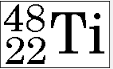
How many protons does this isotope of titanium have?
a)
48
b)
22
c)
26
d)
70
50.
How many neutrons in C-14?
a)
6
b)
7
c)
14
d)
8
51.
What do these isotopes of carbon all have in common?
a)
neutrons & mass number
b)
atomic number and neutrons
c)
atomic number and electrons
d)
protons, atomic number, and mass number
52.
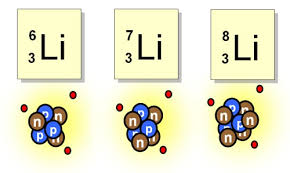
which atom has  4 neutrons?
a)
Li-6
b)
Li-7
c)
Li-8
d)
they have the same # of neutrons
53.
which explanation of this notation is correct?
a)
 12 is proton #
b)
6 tells you there are 6 neutrons
c)
6 tells you there are 6 protons
d)
12 is not a mass # here
54.
Which type of nuclear radiation is being emitted here?
a)
Alpha
b)
beta
c)
gamma 
d)
none
55.
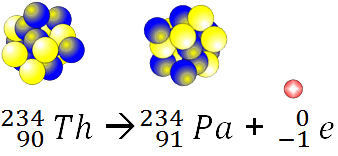
Uranium-238  decays into  Thorium-234  by emitting .........
a)
an alpha particle
b)
a beta particle
c)
gamma rays
d)
visible light
56.
A helium nucleus with two protons and two neutrons is called a(n) ____.  
a)
alpha particle
b)
electroscope
c)
beta particle
d)
gamma ray
57.
__________________is the time it takes for half of the radioactive atoms in an element to decay.
a)
dating range
b)
half life
c)
parent isotope
d)
daughter isotope
58.
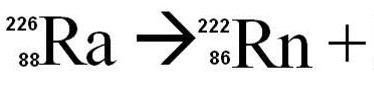
Complete the nuclear equation and determine the type of decay that is occurring in this reaction. 
a)
alpha
b)
beta
c)
gamma
d)
none
59.
What type of particle is released during beta decay? 
a)
Nucleus
b)
Neutron
c)
Proton
d)
Electron
60.

What type of radioactive decay involves only the release of high-energy photons and therefore does not change the mass of an atom of a radioactive isotope?

a)

Alpha emission

b)

Beta emission

c)

Gamma emission

d)

Fission

61.
Which of the following terms identifies the change from a liquid to solid?
a)
Melting
b)
Condensation
c)
Vaporization
d)
Freezing
62.
When the temperature of matter increases the particles...
a)
speed up and move closer
b)
speed up and move farther apart
c)
slow down and move closer together
d)
slow down and move farther apart
63.
Definite shape and a definite volume.
a)
Gas
b)
Liquid
c)
Solid
64.
No definite shape, but has a definite volume
a)
Gas
b)
Liquid
c)
Solid
65.
No Definite Shape and No Definite Volume
a)
Gas
b)
Liquid
c)
Solid
66.
Phase change from a gas to a liquid.
a)
condensation
b)
evaporation
c)
melting
d)
deposition
67.
In which state are the particles least able to move?  (Which is the solid?)
a)
State A
b)
State B
c)
State C
d)
None
68.
change from liquid to gas is called....
a)
expansion
b)
evaporation
c)
condensation
d)
sublimation
69.
Boiling is ...
a)
liquid to gas
b)
gas to solid
c)
gas to liquid
d)
solid to liquid
70.
What is the temperature on the thermometer?
a)
 28° Celsius 
b)
 20° Fahrenheit 
c)
 18° Celsius 
d)
 20° Celsius 
71.
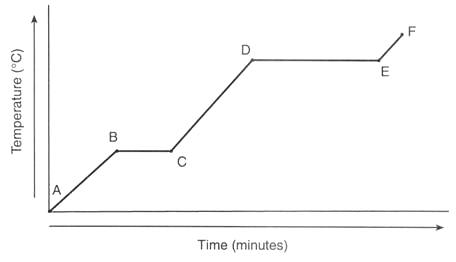
Describe the substance between letters A and B. 
a)
Solid
b)
Liquid
c)
Melting
d)
Evaporating
72.
Between which points is the temperature of the substance remaining constant?
a)
A-B only. 
b)
A-B, C-D, E-F
c)
B-C only. 
d)
B-C, D-E
73.
According to the phase diagram, water exists as a _____________ at 700 mmHg and 50 °C.
a)
solid
b)
liquid
c)
gas
d)
supercritical fluid
74.
At 10 atm, dry ice is heated from -100 °C to 30 °C.  What changes occur?
a)
freezing, then condensation
b)
melting only
c)
sublimation only
d)
melting, then boiling
75.
What state of matter is Y?
a)
solid 
b)
liquid
c)
gas
d)
supercritical fluid
76.

Which of the following transitions would emit a photon with the shortest wavelength?

a)

n=2 to n=3

b)

n=3 to n=2

c)

n=5 to n=2

d)

n=2 to n=4