wayground logo

Free Printable Worksheets

Font size

S
M
L
XL
Worksheets

Review- Intro to Chem

Total questions: 73

Worksheet time: 3hrs 36mins

Name
Class
Date
1.
Round 1009 to three sig figs
a)
100
b)
101
c)
1010
d)
1000
2.
Round 1047.78 to three sig figs
a)
104
b)
105
c)
1050
d)
1050.00
3.
Round 0.010229 to four sig figs
a)
1022
b)
1023
c)
0.01023
d)
0.01022
4.
What is 98.907 rounded to 1 significant figure?
a)
98.9
b)
90
c)
100
d)
98.91
5.
Calculate 5.50 cm + 5.50 cm and give your answer with the appropriate number of significant figures.
a)
11 cm
b)
11.0 cm
c)
11.00 cm
d)
11.000 cm
6.
Calculate 12.34 + 1.234 + 0.1234 and give your answer with the appropriate number of significant figures.
a)
13.6974
b)
13.697
c)
13.70
d)
13.7
7.
Calculate 7.987 m - 0.54 m and give your answer with the appropriate number of significant figures.
a)
7.45 m
b)
7.447 m
c)
7.4 m
d)
7.5 m
8.
When performing the calculation 34.530 g + 12.1 g + 1222.34 g the final answer must have
a)
Three significant figures
b)
One decimal place
c)
Two decimal places
d)
Three decimal places
9.
Calculate 1.23 m x 0.89 m and give your answer with the appropriate number of significant figures.
a)
1.0 m2
b)
1.1 m2
c)
1.0947 m2
d)
1.09 m2
10.
Calculate 123000 m x 3234 m and give your answer with the appropriate number of significant figures.
a)
3.97 x 10⁻⁷ m2
b)
39800000 m2
c)
398 m2
d)
3.98 x 10⁸ m2
11.
Calculate 923 g ÷ 20312 cm3 and give your answer with the appropriate number of significant figures.
a)
0.04 g/cm3
b)
0.045 g/cm3
c)
0.0454 g/cm3
d)
4 x 10⁻² g/cm3
12.
Calculate 12.47 m ÷ 3.2 s and give your answer with the appropriate number of significant figures.
a)
4 m/s
b)
3.9 m/s
c)
3.90 m/s
d)
3.897 m/s
13.
Calculate 0.020 cm x 50 cm x 11.1 cm and give your answer with the appropriate number of significant figures.
a)
10 cm3
b)
11.1 cm3
c)
11 cm3
d)
11. cm3
14.

How many sig figs are in 1010?

a)

1

b)

2

c)

3

d)

4

15.

Identify the number of sig figs in 0.0810.

a)

2

b)

3

c)

4

d)

5

16.

Which answer is rounded to the correct place for the equation below?

292.92 / .0024 = 121750.0

a)

121750.0

b)

121800

c)

122000

d)

120000

17.

How many significant figures are in the number? 4.06 x 10⁻⁵ m

a)

3

b)

7

c)

5

d)

unknown

18.

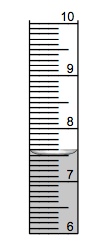
What is the measurement of the liquid in the graduated cylinder?

a)

65 mL

b)

66 mL

c)

6.7 mL

d)

6.6 mL

19.

How many significant figures are in the following number?

100

(a)  

20.

What is the length of the screw in centimeters (cm)?

a)

5 cm

b)

6 cm

c)

5 mm

d)

6 m

21.
What is the scale on this graduated cylinder?
a)
.1 mL per line
b)
.2 mL per line
c)
.5 mL per line
d)
1 mL per line
22.

T/F: A qualitative observation does not include a number quantity.

a)

True

b)

False

23.

A gray elephant stampeding across the Savannah is an example of a ______ observation.

a)

Quantitative

b)

Qualitative

c)

Neither quantitative nor qualitative

24.

Steve used a ruler to measure the length of a cube. He found the cube to be 3 cm. This is an example of a ______ observation.

a)

Quantitative

b)

Qualitative

c)

Neither qualitative nor quantitative

25.

It is a measure of how closely measurements align with each other when they are made in the same way.

a)

Accuracy

b)

Precision

c)

Error

d)

Extrapolation

26.

What is the term for how close a measurement is to the accepted value?

a)

Accuracy

b)

Precision

c)

Significant

d)

Estimate

27.

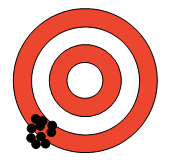
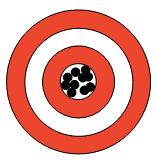
This bullseye demonstrates...

a)

High Accuracy & High Precision

b)

High Accuracy & Low Precision

c)

Low Accuracy & High Precision

d)

Low Accuracy & Low Precision

28.

Which of the following is the best scenario?

a)

High Accuracy & High Precision

b)

High Accuracy & Low Precision

c)

Low Accuracy & High Precision

d)

Low Accuracy & Low Precision

29.

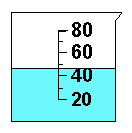
What is the volume?

a)

48 mL

b)

48.2 mL

c)

48.25 mL

d)

4 mL

30.

A controlled experiment:

a)

Introduces bias

b)

Tests several variables at once

c)

Tests one variable and has limited bias

d)

Changes no variables

31.

How many significant figures does the following number have?
0.00345

a)

6

b)

5

c)

3

d)

Ambiguous: 3, 4, 5, or 6

32.

How many significant figures does the following number have: 0.00204?

a)

6

b)

4

c)

3

d)

2

33.

How many significant figures does the following number have: 100.00210?

a)

7

b)

8

c)

10

d)

Ambiguous: 7 or 8

34.

How many significant figures are there in the number 7945?

a)

1

b)

2

c)

3

d)

4

35.

How many significant figures are there in 0.150?

a)

1

b)

2

c)

3

d)

4

36.

Measure the length to the nearest centimeter (cm).

a)

610 mm

b)

7 cm

c)

6 cm

d)

60 cm

37.

What are you measuring when you use a ruler?

a)

Volume

b)

Length

c)

Mass

d)

Weight

38.

What is the volume of the liquid in this graduated cylinder?

a)

19 mL

b)

35 mL

c)

24 mL

d)

1.9 mL

39.

What is the volume of the liquid in this graduated cylinder?

a)

8.5 mL

b)

7.5 mL

c)

8 mL

d)

0.1 mL

40.

What instrument would you use to measure the volume of a liquid?

a)

Triple beam balance

b)

Graduated cylinder

c)

Metric ruler

d)

Thermometer

41.

What are the units of measurement for mass?

a)

Liters

b)

Meters

c)

Grams

d)

Yards

42.
What is length?
a)
the amount of matter in an object
b)
the amount of space an object takes up
c)
the distance between two points
d)
the amount of stuff in an object
43.
What units do we use to measure length?
a)
meters (m)
b)
milliliters (mL)
c)
grams (g)
d)
cubic centimeters (cm3)
44.
What is mass?
a)
the distance between two points
b)
the amount of matter (stuff) in an object
c)
the amount of space an object takes up
d)
the distance between three points
45.
What units do we use to measure mass?
a)
milliliters (mL)
b)
liters (L)
c)
centimeters (cm)
d)
grams (g)
46.
The amount of space taken up by an object
a)
Mass
b)
Volume
c)
Density
d)
Weight
47.
What is the formula for DENSITY?
a)
D=M*V
b)
D=M/V
c)
D=V*M
d)
D=V/M
48.
Measure to the nearest milliliter.
a)
73 mL
b)
73.0 mL
c)
76 mL
d)
76.1 mL
49.
Read this graduated cylinder to the nearest tenth of a milliliter
a)
21.5 
b)
22.5
c)
20
d)
21
50.
This refers to how close the measurement is to the true or accepted value
a)
estimate
b)
accuracy
c)
precision
d)
mean
51.
This refers how close a group of measurements are to eachother
a)
estimate
b)
accuracy
c)
precision
d)
mean
52.

Which diagram shows the MOST dense object?

a)

left

b)

center

c)

right

53.

A block of aluminum occupies a volume of 15.0 mL and weighs 45.0 g. What is its density?

a)

3.00 g/mL

b)

0.3333 g/mL

c)

675 g/mL

d)

I have no idea

54.

A sample of liquid has a mass of 300 g and occupies 50 mL in a graduated cylinder. What is the density?

a)

15,000 g/mL

b)

.16667 g/mL

c)

6 g/mL

d)

Yup, still no clue

55.

Using the equation ρ=mV\rho=\frac{m}{V}  work out the density of this object.

a)

2.7 kgm3\frac{kg}{m^3}  

b)

7.2 kgm3\frac{kg}{m^3}  

c)

0.72 kgm3\frac{kg}{m^3}  

d)

0.27 kgm3\frac{kg}{m^3}  

56.

What is the density of the sphere, if its mass is 50 g?

a)

40 grmL\frac{40\ gr}{mL}  

b)

65mLg\frac{65mL}{g}  

c)

2 gcm3\frac{2\ g}{cm^3}  

d)

25gmL\frac{25g}{mL}  

57.

Which box has a higher density?

a)

A

b)

B

c)

They are the same

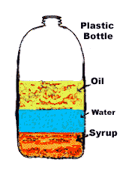
58.
Which liquid is the least dense?
a)

oil

b)

water

c)

syrup 

59.
Frank has an eraser. It has a mass of 4g, and a volume of 2cm3. What is its density?
a)
8 g/cm3
b)
2 g/cm3
c)
1/2 g/cm3
d)
24 g/cm3
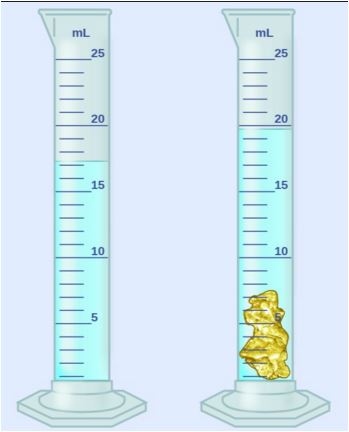
60.
An irregularly shaped piece of gold was lowered into a graduated cylinder holding a volume of water equal to 17 ml. The height of the water rose to 20 ml. If the mass of the gold was 27 g, what was its density?
a)
9 g/mL
b)
10.5 g/mL
c)
6.5 g/mL
d)
8 g/mL
61.
An archaeologist estimated that a fossil was 520 years old. It was actually 500 years old. What was the percent error?
a)
4%
b)
20%
c)
3.8%
d)
none of these
62.

Find the percent error. Round to the nearest tenth of a percent.

Actual speed: 38 mph

Estimated speed: 35 mph

a)

8.1%

b)

0.79%

c)

7.9%

d)

6.8%

63.

Jill estimates the weight of her cat to be 8 pounds. The actual weight of the cat was 10 pounds. Find the percent error.

a)

15%

b)

20%

c)

25%

d)

30%

64.

The students measured length during a science experiment, they got 12 cm. But the actual measurement was 14.25 cm. What was the percent error? (Round to the nearest tenth)

a)

15.8%

b)

18.8%

c)

2.3%

d)

18%

65.

The deer population is estimated to be 17,600 in northern Illinois, but an actual count was 21,300. What is the percent error? (Round to the nearest tenth)

a)

21%

b)

17.37%

c)

17.4%

d)

21.02%

66.

Max went to the store and bought a bag of chips. He estimated there would be 350 chips in the package, but realized there were only 205 chips in that package. What was his percent error? (Round to the nearest tenth)

a)

71%

b)

41%

c)

145%

d)

.71%

67.

7,000 g = ____ kg

a)

70

b)

700

c)

7

d)

0.07

68.

648 g = ____ mg

a)

6,480

b)

64,800

c)

648,000

d)

64.8

69.

240 cm = ___________ m

a)

2400

b)

24

c)

2.4

d)

0.24

70.

3 km = ___________ mm

a)

30

b)

300

c)

3,000

d)

3,000,000

71.

1000 grams = _____ kilograms

a)

0.0001

b)

1,000,000

c)

10

d)

1

72.

1 L = _______ mL

a)

1

b)

10

c)

100

d)

1000

73.

What is the basic unit of length/distance in the metric system?

a)

Liter

b)

Meter

c)

Gram

d)

Kilometer