
 Worksheets
DMS Chemistry Final
Total questions: 70
Worksheet time: 53mins
A mixture in which different materials can be distinguished easily- has a non-uniform composition
Compound
Homogeneous Mixture
Heterogeneous Mixture
Solution
A mixture that is uniform in composition; components are evenly distributed and not easily distinguished.
Compound
Homogeneous Mixture
Heterogeneous Mixture
Solution
A substance made up of atoms of two or more different elements joined by chemical bonds; water being made up of oxygen and hydrogen is an example.
Compound
Heterogeneous Mixture
Homogeneous Mixture
Solution
Pure substance that consists entirely of one type of atom.
Solution
Mixture
Compound
Element
Elements have the most similar properties if they are in the same _______?
Periods
Groups
Rows
Blocks

What type of elements does the image show?
Metals
Nonmetals
Gases
Metalloids
What two sub-atomic particles are found in the nucleus of an atom?
Neutrons and Protons
Shells and Electrons
Electrons and Protons
Electrons and Neutrons

Which of the chemical equations in the image best supports the Law of Conservation of Matter? Equations must be balanced if they support the law.
A
B
C
D
Which physical property would most likely be a nonmetal
Good conductor
Ductile-can be formed into a wire
Brittle-cracks with applied force
Shiny
Substances that are the result of a chemical change is/are ................... . These are found on the right side of the arrow in a chemical equation.
reactant(s)
reaction
product(s)
H2O
Balance the Equation .
___ N2 + ___ F2 --> ___ NF3
1 , 3 , 1
1 , 3 , 3
1 , 3 , 2
2 , 3 , 2
An atom has an atomic mass number of 45 and an atomic number of 21 what is it's neutron number?
21
24
45
66
24
Solutions A, B, C and D have pH 3, 4, 6 and 8. The solution is the strongest acid?
A-pH of 3
B-pH of 4
C-pH of 6
D-pH of 8
pH value less than 7 indicates that the solution is –
Acidic
Basic
Neutral
No effect
Which is the stronger acids ?
pH 1
pH 8
pH 13
pH 7
Value from 0-14 that determine the acidity of a solution
pH scale
Base
Number line
Acid
Pure water has a pH of 7
is a base
is a neutral substance
is an acid
could be either an acid or a base
When dissolved in water, acids produce:
bases
salts
hydrogen ions
hydroxide ions
Which has a slippery texture?
Acid
Base
Tastes Sour
Acids
All
Bases
Salts
A substance has a pH value of 8. It is most likely to be what?
Strong acid
Weak acid
Strong base
Weak base
A type of chemical that forms solutions that taste sour, due to high concentrations of positive hydrogen ions
acid
base
salt
pH
What is considered to be in the middle of the pH scale
acidic
neutral
basic
indicator

This diagram represents...
An element
A molecule
A compound
A mixture of elements and compounds


Which of the following is not a chemical change?

state of matter, such as being a solid, liquid, or gas
What kind of properties can only be observed when a substance changes into a different substance during a chemical reaction or chemical change?
The mass of a rock is measured with a balance. The rock is then broken into many smaller pieces and the total mass of all the pieces is measured again. Which of the following sentences about the mass is TRUE?
The mass of the rock will be greater than the total mass of the smaller pieces.
The mass of the rock will be less than the total mass of the smaller pieces.
The mass of the rock will be same as the total mass of the smaller pieces.
The mass of the rock will not be the same as the total mass of the smaller pieces.
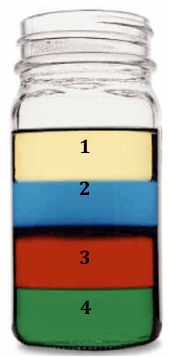

Which box has a higher density?
A, because its particles are more crowded
B, because its particles are less crowded
They are the same
An object has a volume of 6 cm3 and a mass of 42 g. What's it's density?
7 g/cm3
48 g/cm3
42 g/cm3
6 g/cm3
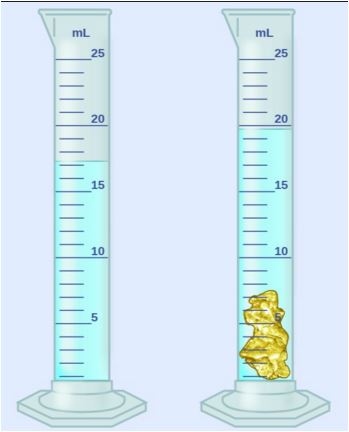
Which of these are true?
Mass refers to how much matter is in an object.
Weight of an object can vary depending on its elevation.
Mass and weight are both physical properties.
All of these are true.
An object has a density of 3 g/cubic cm. Will it float it water?
yes
no
Matter cannot be created but can be destroyed.
true
false
Which of the following is not true?
The smallest part of an element is one atom of that element.
The smallest part of a compound like water is one molecule of that compound.
The smallest part of a compound like water is one atom of that compound.
Trail mix is a heterogeneous mixture.
An element's atomic number is always equal to....
the number of neutrons in one atom of that element
the number of protons in one atom of that element
the number of electrons in one atom of that element
the number of protons and neutrons added together
Atomic mass is the sum of....
protons and neutrons
protons and electrons
electrons and neutrons
Who knows???
Which particle(s) are found in the nucleus of an atom?
protons only
neutrons only
Electrons and neutrons
Protons and neutrons
If an element has a shiny luster, is ductile, and can conduct heat and electricity, it is most likely...
aa non-metal
a metal
a metalloid
a halogen
If an element can conduct electricity, is dull, and has a low density, it is most likely .....
a metal
a non-metal
a metalloid
a noble gas
Which of the following is NOT true about the Periodic Table of Elements?
There are 7 periods
Elements are arranged by increasing atomic mass
There are 18 groups or families
Elements in the same group have similar chemical or physical properties.
Which of the following IS true about the Periodic Table of Elements?
Metals are found on the right side
Non-metals are found on the left side.
Group 1 elements are very reactive.
Metalloids are located in group 18.
Which of the following IS correct about sub atomic particles?
Neutrons have no charge.
Electrons have a positive charge.
Protons have a negative charge.
Ions are neutral.
Which of the following would neutralize 10 mL of a substance with a pH of 4?
5 mL of a substance with a pH of 10
10 mL of a substance with a pH of 10
10 mL of a substance with a pH of 7
10 mL of a substance with a pH of 11
Which of the following IS true of acids and bases?
Acids release hydroxide ions in water.
Acids have a higher pH than bases.
Bases release hydroxide ions in water.
Another name for acid is alkalkine.
Lactic acid is an acid produced by muscle cells during strenuous exercise that can cause muscle soreness.
True
False
Where are reactants found in a chemical equation?
on the left of the arrow
on the right of the arrow
over the arrow
both sides of the arrow
In order to be balanced, a chemical equation must have an equal number of atoms of each element that are equal on both sides of a chemical equation.
True
False
Sometimes
Which of the following CAN be changed in order to balance a chemical equation??
subscripts only
coefficients only
subscripts and coefficients
Why would you even try to balance a chemical equation???
How many total atoms are in 6 molecules of water? Think about the chemical formula for water.
3
2
6
18
Which of the following IS NOT true?
Group 1 elements are very reactive.
Group 17 elements are very reactive.
Group 18 elements are non-reactive.
Metalloidd are found in group 1.
Heating substances gives their particles more energy. What effect does this usually have on density?
Heating would lower the density.
Heating would increase the density.
Heating would not change the density.
Burning and rusting are both forms of oxidation where a substances combines chemically with oxygen. What is the difference???
burning is fast but rusting is slow
burning is slow but rusting is fast
there really isn't a difference
Which of the following are NOT symbols of a single element?
NaCl
CO
Co
Ag
Acids...
give off hydrogen ions in water
have pH ranging from 1 to 6.9
react with bases to for the neutral substances salt and water
all of these are true of acids
Which of the following is an example of a compound?
gold
trail mix
water
salt water

