
 Worksheets
Chemistry II Unit 8 Review
Total questions: 74
Worksheet time: 2hrs 41mins
Energy can never be created nor destroyed. Which law does this refer to?
0th law of thermodynamics
1st law of thermodynamics
2nd law of thermodynamics
3rd law of thermodynamics
While running your kinetic energy converts to thermal energy. Which law does this refer to?
0th law of thermodynamics
1st law of thermodynamics
2nd law of thermodynamics
3rd law of thermodynamics
The entropy of the universe is always increasing. Which law does this refer to?
0th law of thermodynamics
1st law of thermodynamics
2nd law of thermodynamics
3rd law of thermodynamics
Disorder is more likely than order. Everything trends towards randomness and chaos. Which law does this refer to?
0th law of thermodynamics
1st law of thermodynamics
2nd law of thermodynamics
3rd law of thermodynamics
From lowest entropy to highest entropy, the states of matter go in this order:
solid -> liquid -> gas -> plasma
plasma -> gas -> liquid -> solid
gas -> plasma -> liquid -> solid
solid -> liquid -> plasma -> gas
It depends on the temperature of the object
True or False: Entropy increases as temperature increases
True
False
True or False: A flowing stream has less entropy than a calm lake.
True
False
Heat transfer _____ occurs from hot to cold.
always
never
sometimes
rarely
Temperature is a measure of average _____ energy of individual atoms.
heat
potential
mechanical
kinetic
If a chemical reaction is EXOTHERMIC, the temperature of the surroundings would....
Stay the same
Increase
Decrease
Q= m c ∆T
The units for specific heat are:

If two objects have different temperatures when they come in contact, heat will flow from the warmer object to the cooler one UNTIL ____________
one reaches a temperature of zero
they both have an equal temperature
one runs out of energy
What is the specific heat of an unknown substance if 100.0 g of it at 200.0 °C reaches an equilibrium temperature of 27.1 °C when it comes in contact with a calorimeter of water. The water weighs 75. g and had an initial temperature of 20.00 °C? (Specific heat of water is 4.18 J/g°C)
0.111 J/g°C
1.29 J/g°C
0.129 J/g°C
22225.85 J
A sample of iron receives 50.J of heat energy that raises the temperature of the iron by 25.0°C. If iron has a specific heat of 0.10 J/g°C, what is the mass of the iron sample?
25g
30g
20g
50g
Study the reaction below. Is it exothermic or endothermic?
H2 + Cl2 --> 2 HCl + 1845 kJ
Exothermic Reaction
Endothermic Reaction
How do you calculate the Enthalpy of Reaction?
ΔH = ΔHproducts - ΔHreactants
ΔG = ΔH -TΔS
ΔT = q / mC
E = mc2
ΔH value in an endothermic reaction is negative.
True
False
According to the Particles Theory of Matter, one particle has the ability to vibrate within their mean position if added with heat. Which of the following is the statement referring to?
Solid
Liquid
Gas
It is the study of energy, its different forms, and patterns of change.
Thermochemistry
Enthalpies
Thermochemical equation
Thermodynamics
A balanced equation showing the associated enthalpy change.
Thermochemistry
Enthalpy
Thermochemical equation
Thermodynamics
What does Hess's Law state?
Both answers
Reaction can be the sum of 3+ reactions, then heat flow for overall reaction is less than the sum of heat flows
Reaction can be the sum of 2+ reactions, then heat flow for overall reaction equals the sum of heat flows
Neither answer
Which has higher entropy?
A. A small pool of water sits in an enclosed glass chamber.
B. An enclosed glass chamber is filled with water vapor.
A
B
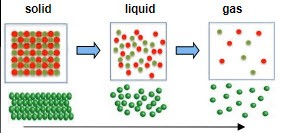

Which of the following correctly describes the entropy changes of the water molecules and the universe when a sample of water freezes?
A
B
C
D

A small S value indicates the system has _______
more order
more randomness
Given the change of phase:
CO2(g) —> CO2(s)
As CO2(g) changes to CO2(s), the entropy of the system
decreases
increases
remains the same
Identify whether the following result in an increase or decrease in entropy:
3 moles of gas (on reactant side) --> 6 moles of gas (product)
increase
decrease
The entropy will usually increase when
a molecule is broken into two or more smaller molecules
a reaction occurs that results in an increase in the number of moles of gas
a solid changes to a liquid
all of these
Your enthalpy is +20 and your entropy is +5. Which temperature will give a spontaneous reaction?
0
4
8
Your enthalpy is high and negative but your entropy is also negative. What type of temperature would you want to get a spontaneous reaction?
low
high
Which combination of ΔH and ΔS NEVER has a spontaneous reaction?
+ΔH and +ΔS
+ΔH and -ΔS
-ΔH and -ΔS
-ΔH and +ΔS
At what temperature would a given reaction become spontaneous if ΔH =+119kJ and ΔS=+263J/K.mol
455 K
-2210 K
382 K
-363 K
6. The formation ½ A2 + 2 B2 + C --> CAB4 has an enthalpy of formation of -104 kJ and a change in entropy of -60.8 J/K at 30 °C. What is the free energy and spontaneity of the reaction?
-85.6 kJ, spontaneous
-18.3 kJ, not spontaneous
+18.3 kJ, spontaneous
+85.6 kJ, not spontaneous
enthalpy is driving force when
exothermic
endothermic
increase in entropy
decrease in entropy
If a reaction occurs, then delta G is
negative
positive
can't tell
0
What is the definition of solubility?
What is a solute?
A type of musical instrument
A substance that is dissolved in a solution
What is a solvent?
A substance that reacts with a solute
A substance that it dissolves in usually water


How many grams of KClO3, are soluble in 200g of water at 30ºC?
5 grams
100 grams
10 grams
20 grams
The correct mathematical expression for finding the molar solubility (X) of Sn(OH)2 is:
2(X)3 = Ksp
108(X)5 = Ksp
4(X)3 = Ksp
8(X)3 = Ksp

In a redox reaction, the species that is reduced will ___ electrons, becoming more _____ charged.
lose; negatively
lose; positively
gain; positively
gain; negatively
A precipitation reaction must...
Have a solid ionic product from aqueous reactants
Have only gaseous products from gaseous reactants
Have only aqueous products from aqueous reactants
What does Gibbs Free Energy tell us?
How much energy is given off by a reaction.
The tendency of a reaction to become "random"
How spontaneous a reaction is.
What information do we need to perform a calculation of Gibbs Free Energy?
Enthalpy of the reaction.
Entropy of the reaction.
The temperature of the reaction in Kelvin.
All of the above are needed.
Which sample has the lowest entropy?
HINT - Look at the phase of each chemical....
1 mole of KNO3(l)
1 mole of KNO3(s)
1 mole of H2O(l)
1 mole of H2O(g)
Which phase change represents a decrease in entropy?
solid to liquid
gas to liquid
liquid to gas
solid to gas
What is the symbol for entropy?
H
G
S
E
Which of these reactions shows a DECREASE in entropy?
CaCO3(s) → CaO(s) + CO2(g)
3O2(g) → 2O3(g)
2NH3(g) → 3H2(g) + N2(g)
C6H6(l) → C6H6(g)
Free energy is represented by the letter
F
E
G
S

