wayground logo

Free Printable Worksheets

Font size

S
M
L
XL
Worksheets

geometry midterm #1

Total questions: 85

Worksheet time: 2hrs 3mins

Name
Class
Date
1.
Which of the following are congruence transformations?
a)
Rotations
b)
Translations
c)
Reflections
d)
All Three
2.
Which of the following is an acceptable explanation why transformed figures are congruent to the original figures.
a)
The figures are actually NOT congruent.
b)
It depends on whether you translated, rotated, or reflected.
c)
Side lengths and angles measures stay the same when transformed.
d)
The figures look the same.
3.
Name the vertical angle to
∠h.
a)
∠f
b)
∠i
c)
∠g
d)
∠j
4.
Name a pair of angles that are vertical.
a)
Angles 4 and 5
b)
Angles 7 and 9
c)
Angles 8 and 9
d)
Angles 5 and 7
5.
Name a pair of angles that form a linear pair.
a)
Angles 1 and 2
b)
Angles 2 and 4
c)
Angles 5 and 8
d)
Angles 9 and 10
6.
An example of coplaner points
a)
D, E, B
b)
C, B, A
c)
M, E, C
d)
A, F, E
7.
M is the midpoint of PQ. M(2,1), and P(2,5), find Q.
a)
Q(4,6)
b)
Q(0,-4)
c)
Q(2,-3)
d)
P(2,6)
8.
Find the endpoint of the segment with endpoint (4, 12) and midpoint (-1, 13)
a)
(-6, 14)
b)
(-4, -12)
c)
(13, -1)
d)
(5, 13)
9.

Determine whether the conjecture is true or

false. Give a counterexample if false.


Given:

Two angles are supplementary.

Conjecture:

They are both acute angles.

a)

False; either both are right or they are adjacent.

b)

False; they must be vertical angles.

c)

False; either both are right or one is obtuse.

d)

True

10.
Name a line parallel to FG
a)
EF
b)
DC
c)
AD
d)
FB
11.
What are supplementary angles?
a)
Angles that add up to 180°
b)
Angles that add up to 90°
c)
Angles that are equal to each other
d)
Angles that are opposite of each other when lines intersect
12.
What are vertical angles?
a)
Angles that are adjacent to each other
b)
Angles that add up to 180°
c)
Angles that are opposite of each other when lines intersect
d)
Angles that add up to 90°
13.
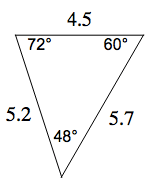
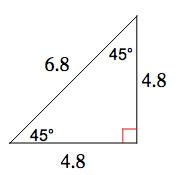
Name this triangle.
a)
Right, Isosceles
b)
Scalene, acute
c)
Isosceles, acute
d)
Equilateral, obtuse
14.
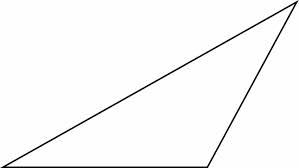
What kind of triangle is this?
a)
Acute
b)
Right
c)
Sparkly
d)
Obtuse
15.
A line is named by...
a)
Any 2 points on the line, or a lowercase script letter.
b)
Any 3 points on the line.
c)
Any 1 point on the line.
d)
Any 3 points on the line, or a uppercase script letter.
16.
A plane is named by...
a)
Any 1 point on the plane.
b)
Any 3 collinear points on the plane or a lowercase script letter.
c)
Any 3 non-collinear points on the plane or an uppercase script letter.
d)
All points on the plane that aren't part of a line.
17.
Give another name for line k.
a)
Line BC
b)
Line BCE
c)
Line ED
d)
Line k is the only name, there isn't another name.
18.
Given ray EF is the angle bisector of <TEA. Which is FALSE?
a)
m<TEF = 87
b)
m<TEA = 87
c)
m<FEA = 43.5
d)
m<TEF = m<FEA
19.
The complement of 40is
a)
900
b)
400
c)
500
20.
The supplement of 1200 is
a)
1000
b)
600
c)
200
21.
If ∆ABC ≅∆DEF, which of the following is not a pair of congruent angles?
a)
A and D
b)
A and E
c)
E and B
d)
F and C
22.
If ∆ABC ≅∆DEF, what side is congruent to CA?
a)
FE
b)
DE
c)
FD
d)
DF
23.
Which of the following statements correctly describes perpendicular lines?
a)
Coplanar but do not intersect
b)
Coplanar and intersect at 90 degree angle
c)
Coplanar and intersect at either obtuse or acute angles
d)
Not coplanar
24.
Which of the following correctly describes parallel lines?
a)
Not coplanar
b)
Coplanar and intersect at 90 degree angle
c)
Coplanar and do not intersect
d)
Not coplanar and intersect
25.
If ∠DEF and ∠HIJ are a linear pair, which of the following is not always true?
a)
They are adjacent.
b)
They are complementary.
c)
They are supplementary.
d)
They are on a line together.
26.
Which pattern follows the rule below?   Rule: Start with 5 and multiply by 3 each time until there are 4 numbers.
a)
5, 10, 15, 20
b)
  5, 15, 45, 135
c)
5, 15, 50, 125
d)
5, 15, 45, 125
27.
Which pattern follows the rule below?
Rule: Start with 10 and add 6 each time until there are 8 numbers
a)
10, 16, 22, 27, 34, 40, 46, 52
b)
10, 16, 22, 28, 33, 39, 45, 51
c)
10, 16, 22, 28, 34, 40, 46, 52
d)
10, 16, 21, 27, 33, 39, 45, 51
28.
What is the rule for this pattern?
1st term:32
2nd term:36
3rd term:40
a)
4x+28
b)
4x+32
c)
x+4
d)
4x
29.
How would you describe this pattern's rule?
1st term:16 
2nd term:11
3rd term: 6
4th term: 1
a)
16 - 5n
b)
21-5n
c)
n-5
d)
-5n
30.
What comes next?
a)
The next term will have 16 blocks
b)
The next term will have 15 blocks.
c)
The next term will have 14 blocks.
d)
This is the end of the pattern.
31.
Complete the conjecture.  Think of examples to help.
The product of any two odd numbers is _____________
a)
even
b)
odd
c)
zero
d)
positive
32.
Complete the conjecture.  Think of examples to help.
The difference of any two odd numbers is _______
a)
even
b)
odd
c)
zero
d)
positive
33.
Complete the conjecture.  Think of examples to help.
The sum of an odd number and an even number is ________________
a)
even
b)
odd
c)
zero
d)
positive
34.
Used to prove that a conjecture is false.
a)
Counterexample
b)
Inductive Reasoning
c)
Concluding statement
d)
Conjecture
35.
Which number is a counterexample to the following statement? : 
All numbers that are divisible by 2 are divisible by 4
a)
0
b)
12
c)
28
d)
42
36.
The type of reasoning where a person makes  conclusions based on observations and patterns is called...
a)
Inductive reasoning
b)
Deductive reasoning
c)
Conjecture
d)
Experiments
37.
What is a conjecture?
a)
A statement believed to be true based on observations.
b)
An example which disproves an hypothesis.
c)
the performance of tricks that are seemingly magical
38.
Name that shape. 
a)
square
b)
square
rhombus
c)
quadrilateral
parallelogram
rhombus
d)
quadrilateral
parallelogram
square
39.
Name that shape.
a)
quadrilateral, rectangle
b)
quadrilateral, rectangle, square
c)
quadrilateral, parallelogram, rectangle
d)
quadrilateral, parallelogram, rectangle, square
40.
If a quadrilateral has 4 equal sides, then it is a square. 
a)
TRUE
b)
FALSE
41.
A _______________ is a quadrilateral with two sets of parallel sides.
a)
trapezoid
b)
parallelogram
c)
kite
d)
triangle
42.
A __________________ is a quadrilateral with two sets of parallel sides and 4 right angles
a)
trapezoid
b)
parallelogram
c)
rectangle
d)
square
43.
A ___________ is a quadrilateral with two sets or parallel sides and 4 congruent (equal) sides. 
a)
trapezoid
b)
rhombus
c)
parallelogram
d)
rectangle
44.
A quadrilateral with two sets of parallel sides, 4 right angles, and 4 congruent (equal) sides is a __________________.
a)
trapezoid
b)
parallelogram
c)
rectangle
d)
square
45.
A square is a rectangle.
a)
Never
b)
Sometimes
c)
Always
46.
A parallelogram is rectangle.
a)
Never
b)
Sometimes
c)
Always
47.
Which statement explains why a rectangle is a parallelogram?
a)
They both are rhombuses.
b)
They are both quadrilaterals.
c)
They both have two pairs of parallel sides.
d)
They are both quadrilaterals with four right angles.
48.
Which figure is NEVER a parallelogram?
a)
rhombus
b)
square
c)
triangle
d)
rectangle
49.
Which two figures can always be described as quadrilaterals with all sides congruent?
a)
square and rhombus
b)
square and rectangle
c)
rhombus and parallelogram
d)
rectangle and parallelogram
50.
Which statement is true?
a)
A rhombus is never a square.
b)
A rhombus is always a square.
c)
A rhombus is never a rectangle.
d)
A rhombus is always a parallelogram.
51.
Which statement is true about trapezoids?
a)
All trapezoids are quadrilaterals.
b)
All quadrilaterals are trapezoids.
c)
All trapezoids are rectangles.
d)
All trapezoids are squares.
52.
Which would be the best classification for the triangle shown?
a)
right isosceles
b)
obtuse scalene
c)
obtuse isosceles
d)
acute scalene
53.
Which would be the best classification for the triangle shown?
a)
acute isosceles
b)
equiangular scalene
c)
equiangular isosceles
d)
equiangular equilateral
54.
Which would be the best classification for the triangle shown?
a)
acute isosceles
b)
right scalene
c)
acute scalene
d)
obtuse scalene
55.
Which would be the best classification for the triangle shown?
a)
right isosceles
b)
obtuse scalene
c)
obtuse isosceles
d)
right scalene
56.

Which of the following is a counterexample to the following conjecture? If  x2 = 4x^2\ =\ 4 , then x = 2

a)

x = 4

b)

x = -2

c)

x = 2

d)

x = -4

57.

Use the picture to write the correct Segment Addition statement.

a)

AB + BC = AC

b)

BC + BA = BC

c)

BA + AC = BC

d)

AB + BC = AC

58.

Find the length of DE

a)

58

b)

6

c)

36

d)

61

59.
XY=
a)
15
b)
17
c)
6
d)
7
60.
What does the word BISECT mean?
a)
To cut something into more than five pieces.
b)
It is a plane with two sets of wings.
c)
A shape that has three sides. 
d)
To cut something into two congruent pieces or in half.
61.

Find MK.

a)

6

b)

4

c)

14

d)

8

62.
a)
8
b)
12
c)
-4
d)
-8
63.

Calculate m∠ABC.

a)

45°

b)

60°

c)

105°

d)

15°

64.
What is another name for ∠H
a)
∠KGH
b)
∠LGH
c)
∠LHG
d)
∠K
65.

∠1 and ∠2 form a linear pair.

If m∠1 = (5x + 9)° and m∠2 = (3x + 11)°, find the measure of each angle.

a)

m∠1 = 110° and m∠2 = 70°

b)

m∠1 = 109° and m∠2 = 71°

c)

m∠1 = 70° and m∠2 = 110°

d)

m∠1 = 71° and m∠2 = 109°

66.

∠K and ∠L are complementary angles.

If m∠K = (3x + 3)° and m∠L = (10x -- 4)°, find the measure of each angle.

a)

m∠K = 24° and m∠L = 66°

b)

m∠K = 66° and m∠L = 24°

c)

m∠K = 40° and m∠L = 50°

d)

m∠K = 30° and m∠L = 60°

67.

 Find  HIW\angle HIW  if  HIJ = 164°\angle HIJ\ =\ 164\degree  and  WIJ = 140°\angle WIJ\ =\ 140\degree  

a)

 HIW = 304°\angle HIW\ =\ 304\degree  

b)

 HIW=16°\angle HIW=16\degree  

c)

 HIW=40°\angle HIW=40\degree  

d)

 HIW=24°\angle HIW=24\degree  

68.

 ECD=122°\angle ECD=122\degree  and  BCE=36°\angle BCE=36\degree . Find the measure of  BCD\angle BCD  . 

a)

 BCD=158°\angle BCD=158\degree  

b)

 BCD=86°\angle BCD=86\degree  

c)

 BCD=58°\angle BCD=58\degree  

d)

 BCD=144°\angle BCD=144\degree  

69.

A line containing  \cdot F

a)

 DB\overleftarrow{D}\overrightarrow{B} 

b)

 DE\overleftarrow{D}\overrightarrow{E}  

c)

 EC\overleftarrow{E}\overrightarrow{C}  

d)

 ED\overleftarrow{E}\overrightarrow{D}  

e)

plane MM  

70.

3 non - collinear points

a)

B, E, A

b)

D, A ,F

c)

D, F, E

d)

C, E, B

71.

3 coplanar points

a)

B, E, A

b)

D, A ,F

c)

D, F, E

d)

E, A, F

72.

intersection of l and m

a)

\cdot H

b)

\cdot E

c)

plane Q

d)

FE\overleftarrow{F}\overrightarrow{E}

e)

\cdot D

73.

intersection of plane ABC and plane ABE

a)

BC\overleftarrow{B}\overrightarrow{C}

b)

BE\overleftarrow{B}\overrightarrow{E}

c)

AB\overleftarrow{A}\overrightarrow{B}

74.

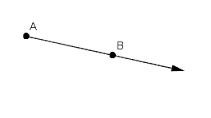
What is the name of this ray?

a)

AB\overrightarrow{AB}

b)

BA\overrightarrow{BA}

c)

ABC\overrightarrow{ABC}

d)

AC\overrightarrow{AC}

75.

2 rays that share the same endpoint and extend infinitely in opposite directions are called...

a)

long lines

b)

twin rays

c)

opposite rays

d)

sweet baby rays

76.

What angle relationship is pictured?

a)

Alternate Interior Angles

b)

Supplementary Angles

c)

Vertical Angles

d)

Corresponding Angles

77.
What is the Angle Relationship?
a)
Alternate Interior
b)
Alternate Exterior
c)
Corresponding
d)
Same Side Interior
78.
What is the angle relationship?
a)
Alternate Interior
b)
Alternate Exterior
c)
Corresponding
d)
Same-Side Interior
79.

Select the figure that means r || t.

a)
b)
c)
d)
80.

Which could be used to prove the lines are parallel?

a)

Converse of Vertical Angles

b)

Converse of Alternate Interior Angles Theorem

c)

Converse of Corresponding Angles Postulate

d)

Cannot be proved parallel

81.
Line l and m are cut by transversal n.  Which statement proves that line l is parallel to line m?
a)
∠2 ≅ ∠3
b)
∠2 ≅ ∠6 
c)
m∠7 + m∠8 = 180°
d)
m∠3 + m∠5 = 90°
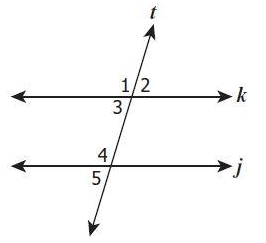
82.
Which of the following relationship proves that j is parallel to k?
a)
∠3 and ∠4 are supplementary
b)
∠4 and ∠5 are supplementary
c)
∠1 ≅ ∠3
d)
∠2 ≅ ∠3
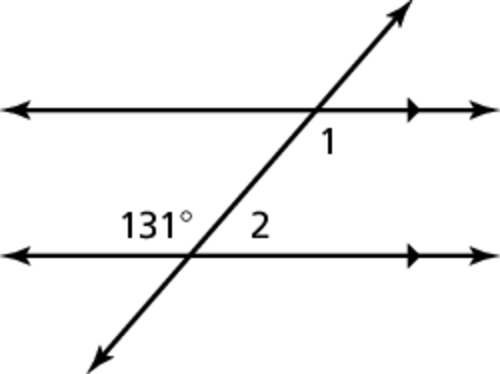
83.

Find  m1.m\angle1.  

a)

 131°131\degree  

b)

 180°180\degree  

c)

 49°49\degree  

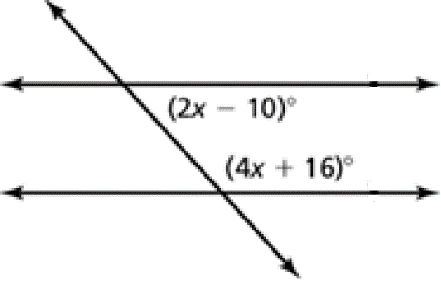
84.

Which is the correct equation to solve for x?

a)

2x10=4x+162x-10=4x+16

b)

2x10+4x+16=1802x-10+4x+16=180

85.
a)

119

b)

61

c)

71

d)

109