
 Worksheets
AP Calc - IVT, EVT, MVT
Total questions: 39
Worksheet time: 1hrs 26mins
Name
Class
Date
1.
TRUE OR FALSE? If f is continuous on [-1,1], f(-1)=4 and f(1)= -2, then there is a zero between -1 and 1.
a)
TRUE
b)
FALSE
c)
CANNOT BE DETERMINED
2.

What is the limit?
a)
DNE
b)
2/3
c)
1/4
d)
Infinity
3.
Find the vertical asymptotes and holes of
y = (x+3) / (x-1)(x+3)
y = (x+3) / (x-1)(x+3)
a)
Holes: None;
VA: x = 1, -3
VA: x = 1, -3
b)
Holes: x = -3;
VA: x = 1
VA: x = 1
c)
Holes: x = -3, 1
VA: None
VA: None
d)
Holes: x = 1
VA: x = -3
VA: x = -3
4.

Which of the following best describes the continuity at x = 5?
a)
Maximum
b)
Minimum
c)
Vertical Asymptote
d)
Hole
5.
When f'(x) changes from positive to negative, there is(are) ...
a)
a maximum.
b)
a minimum.
c)
no extrema.
6.
When f'(x) changes from negative to positive, there is(are) ...
a)
a maximum.
b)
a minimum.
c)
no extrema.
7.

Use the sign chart for f'(x).
There is(are) ...
There is(are) ...
a)
a local maximum at x = -2.
b)
a local maximum at x = 4.
c)
local maxima at x = -2 and x = 4.
d)
no extrema.
8.

Use the sign chart for f'(x) and the table of f(x). There is ...
a)
a local maximum at (-10,5).
b)
an absolute minimum at (-2,0).
c)
a local minimum at (20,7).
d)
all of the above
9.

Does this function have a minimum, maximum, both or neither?
a)
Minimum
b)
Maximum
c)
Both
d)
Neither
10.

Determine the minimum or maximum of the following function.
a)
Min: -3
b)
Max: -3
c)
Min: 3
d)
Max: 3
11.
Find the critical value(s) of
f(x) = x2 + 2x + 1.
f(x) = x2 + 2x + 1.
a)
x = -1
b)
x = 2
c)
x = -1, 0
d)
x = 0
12.
Find the absolute maximum value of
g(x) = 3x3 + 6x2 on [-1, 1].
g(x) = 3x3 + 6x2 on [-1, 1].
a)
Abs max of 8 when x = 1, abs min of -5/3 when x = -4/3
b)
Abs max of 9 when x = 1, abs min of -5/3 when x = -4/3
c)
Abs max of 9 when x = 1, abs min of 0 when x = 0
d)
Abs max of 9 when x = 1, abs min of -1 when x = -1
13.

How many extrema are in the picture?
a)
2
b)
3
c)
4
d)
5
14.
If (a,b) is a local minimum of the continuous and differentiable function f, then what will be true about f'(a)?
a)
It's positive
b)
It's negative
c)
It's zero
d)
Cannot be determined
15.

Answer the relative minimum.
a)
-1
b)
0
c)
1.5
d)
-1 and 1.5
16.
Answer the relative maximum.
a)
-1
b)
0
c)
1.5
d)
-1 and 1.5
17.
What is the average rate of change of the function below over the indicated interval?
f(x) = x2 - 3x - 28, [-4,7]
f(x) = x2 - 3x - 28, [-4,7]
a)
0
b)
11
c)
6
d)
66
18.
What is the average rate of change of the function below over the indicated interval?
f(x) = 12√(x), [1,16]
f(x) = 12√(x), [1,16]
a)
12 / 5
b)
1
c)
0
d)
36
19.

Over what interval(s) is f(x) increasing? (Be careful this is a graph of f'!)
a)
(-∞, -3) ∪ (1, ∞)
b)
(-3, 1)
c)
(-5, 0) ∪ (2, ∞)
d)
(-5, ∞)
20.

At what x-value( s) does f( x) have a minimum? (Be careful this is a graph of f'!)
a)
x = -3
b)
x = 1
c)
x = 5
d)
x = -3 and x = 5
21.
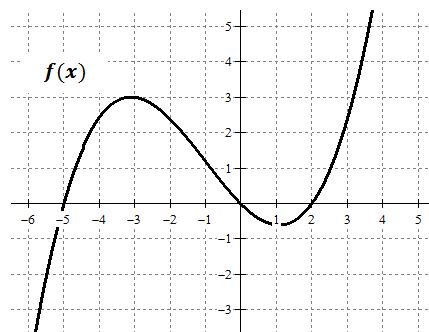
Over what interval(s) is f(x) decreasing?
a)
(-3, 1)
b)
(-∞, -5) ∪ (0, 2)
c)
(-∞, -3) ∪ (1, ∞)
d)
(-5, 0) ∪ (2, ∞)
22.
If (a,b) is a local maximum, then what will be true about f''(a)?
a)
It's positive
b)
It's negative
c)
It's zero
d)
Cannot be determined
23.
If (a,b) is a local minimum, then what will be true about f''(a)?
a)
It's postive
b)
It's negative
c)
It's zero
d)
Cannot be determined
24.
The concavity of a function is described by its _______________.
a)
first derivative
b)
second derivative
c)
third derivative
d)
expression
25.
For a function g(x), g''(3)=-8 indicates that g(x) is ____________ at x=3.
a)
increasing
b)
decreasing
c)
concave up
d)
concave down
26.

Identify the interval from the derivative graph where the function is concave down
a)
(-1,1) & (3,4)
b)
(-2,4)
c)
(-3,-1) & (1,3)
d)
(-2,1) & (1,4)
27.

Identify the interval from the derivative graph where the function is concave up.
a)
(-1,1) & (3,4)
b)
(-3,-2)
c)
(-2,-1)
d)
(-3,-1) & (1,3)
28.

Given the following graph of f', the derivative of f. For what x-value does f have a relative minimum?
a)
x=-1 and x=4
b)
x=-3
c)
x=1
d)
x=3
29.
Find the x-coordinate of the inflection point of f(x)=6x2-x3.
a)
-2
b)
0
c)
2
d)
None
30.
Find where f(x)=6x2-x3 is concave up.
a)
x<2
b)
x>2
c)
x< -2
d)
x> -2
31.
Find where f(x)=6x2-x3 is decreasing.
a)
(-4,0)
b)
(0,4)
c)
x<0 or x>4
d)
x<-4 or x>0
32.
Find the x-coordinate of the relative max of f(x) = 6x2- x3
a)
-4
b)
0
c)
4
d)
None
33.
Find the interval(s) where f(x)=6x2-x3 is increasing.
a)
(-4,0)
b)
(0,4)
c)
(-∞, 0)∪(4, ∞)
d)
(-∞, -4 )∪(0, ∞)
34.

When is the velocity decreasing?
a)
0 < t < 60
b)
40 < t < 60
c)
15 < t < 40
d)
−40 < t < 0
35.
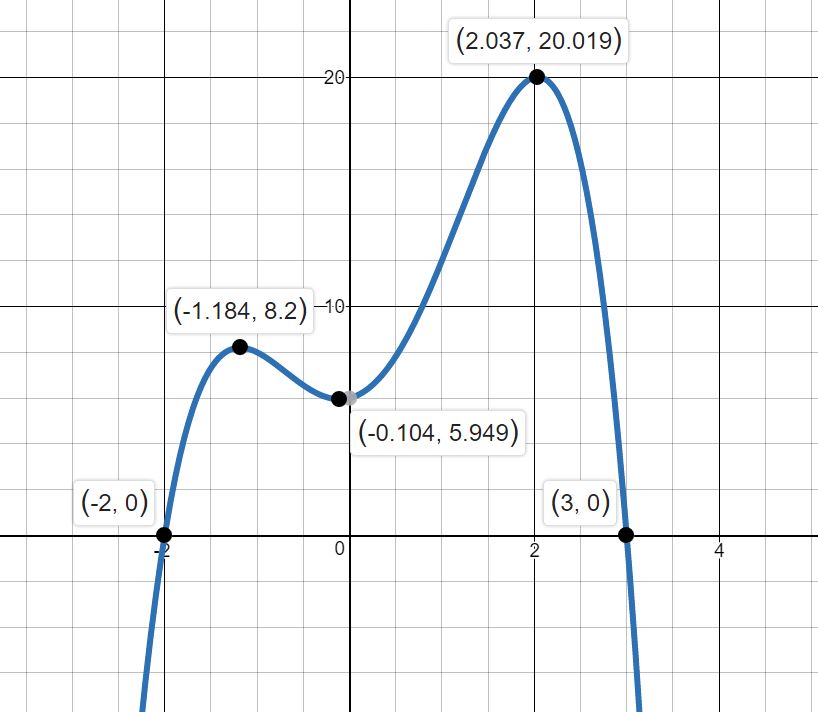
The function has an absolute minimum.
a)
True
b)
False
36.
The function has an relative maximum.
a)
True
b)
False
37.

Which of the following best describes the continuity at x = 5?
a)
Continuous
b)
Removable Point Discontinuity
c)
Infinite Discontinuity
d)
Jump Discontinuity
38.

Assume this is a graph of f. What can you say about its first and second derivative from x=1 to x=5?
a)
f'(x) > 0 and f''(x) > 0
b)
f'(x) < 0 and f''(x) < 0
c)
f'(x) > 0 and f''(x) < 0
d)
f'(x) < 0 and f''(x) > 0
39.

How many horizontal tangents would p(x) have?
a)
3
b)
2
c)
1
d)
4
100 %

