wayground logo

Free Printable Worksheets

NEW

Font size

S
M
L
XL
Worksheets

Biology QA 1 Review

Total questions: 45

Worksheet time: 43mins

Name
Class
Date
1.
The part of the experiment that does not contain the independent variable. Used for comparison.
a)
Control Group
b)
Experimental Group
c)
Results
d)
Data
2.
What are all the things that are kept the same in an experiment?
a)
controls
b)
data
c)
constants
d)
independent variables
3.

Research Question: Does the type of gasoline put in a car effect how fast the car can go. What is the independent variable?

a)

Type of gasoline

b)

which car the gas is put into

c)

how fast the car can drive

d)

how much gas is put into the car

4.
An experiment is performed on plants to see how different liquids affect plant growth. Each plant in the experiment is given a different liquid; water, apple juice, or milk. Each plant has the same amount of soil, sunlight, and listens to the same music. In this investigation, the independent variable is ...
a)
The type of plant
b)
The amount of sunlight
c)
The type of music
d)
The type of liquid
5.
Mr. S normally uses praise as a reward to train his dog. He wants to know the best way to train his dog, so he sets up an experiment to find out if there is a better way to get his dog to respond to commands. What is his dependent variable?
a)
Type of reward
b)
Praise
c)
Type of dog
d)
Amount of time the dog follows commands
6.
Walker is testing which fertilizer will grow the tallest grass.  The height of the grown grass is the __ variable.
a)
constant (same)
b)
independent (changes)
c)
dependent (measured)
7.
A claim is ______________________________.
a)
a kind of shellfish often used in chowder. 
b)
a fact.
c)
a statement or conclusion that answers the original question or problem
d)
a bad thing to make about something.
8.
Evidence is ___________________
a)
A statement or conclusion that answers a question
b)
Scientific data that supports the claim
c)
A justification that connects the claim to the evidence
d)
Not vital when using an argument
9.
Reasoning is __________________.
a)
A statement of conclusion that answers the original question/problem
b)
Scientific data that supports the claim
c)
A justification that connects the evidence to the claim
d)
Empirical Evidence
10.
Air is matter. We found that the weight of the ball increases by .5lbs each time we pumped more air into it. This shows that air has weight, one of the characteristics of matter.
Which sentence is the claim?
a)
Air is matter.
b)
We found that the weight of the ball increases by .5lbs each time we pumped more air into it.
c)
This shows that air has weight, one of the characteristics of matter.
11.
Air is matter. We found that the weight of the ball increases by .5lbs each time we pumped more air into it. This shows that air has weight, one of the characteristics of matter.
Which sentence is the evidence?
a)
Air is matter.
b)
We found that the weight of the ball increases by .5lbs each time we pumped more air into it.
c)
This shows that air has weight, one of the characteristics of matter.
12.
Air is matter. We found that the weight of the ball increases by .5lbs each time we pumped more air into it. This shows that air has weight, one of the characteristics of matter.
Which sentence is the reasoning?
a)
Air is matter.
b)
We found that the weight of the ball increases by .5lbs each time we pumped more air into it
c)
This shows that air has weight, one of the characteristics of matter.
13.
An amoeba is a unicellular organism. Which characteristic of life is this?
a)
All living things use energy
b)
All living things contain cells
c)
All living things respond to their environment
d)
All living things grow
14.
Over three years, Tim's height has increased from 5'4" to 5'11".
a)
All living things contain cells
b)
All living things maintain homeostasis
c)
All living things use energy
d)
All living things grow
15.
An adult hydra is producing its offspring through budding.
a)
All living things use energy
b)
All living things reproduce
c)
All living things contain cells
d)
All living things grow
16.
Which is NOT a characteristic that all living organisms share? 
a)
Ability to reproduce 
b)
Ability to grow 
c)
Ability to respond to their environment 
d)
Ability to dominate an ecosystem 
17.

Which of the following is asexual reproduction?

a)

two sets of genetic information; unique offspring

b)

one set of genetic information; identical offspring

18.

Unicellular is

a)

1 cell

b)

2 cells

c)

many cells

19.
Maintaining a stable internal environment.
a)
Homeostasis
b)
Metabolism
c)
Stimulus
d)
DNA
20.
Which is true of prokaryotic and eukaryotic cells?
a)
Prokaryotic cells are larger than eukaryotic cells.
b)
Eukaryotic cells do not have nuclei, and prokaryotic cells do have nuclei.
c)
Prokaryotic cells lack membrane-bound organelles, and eukaryotic cells contain membrane-bound organelles.
d)
Eukaryotic cells are simpler than prokaryotic cells.
21.

Is this a prokaryote or a eukaryote?

a)

prokaryote

b)

Eukaryote

22.

All of the following are examples of lipids except

a)

oil

b)

fats

c)

candle wax

d)

starches

23.

Lipids are

a)

used by the body to store energy

b)

made of chains of amino acids

c)

stores hereditary information

d)

dissolves in water

24.

Two types of nucleic acids

a)

DNA and ABC

b)

ATP and PQB

c)

DNA and RNA

d)

RNA and CPR

25.

What do carbohydrates do?

a)

stores hereditary information

b)

provides energy

c)

we do not use carbohydrates

d)

used for long term energy storage

26.

Monomers of carbohydrates

a)

amino acids

b)

nucleotides

c)

monosaccharides

d)

proteins

27.

Monomers of proteins

a)

sugars

b)

nucleic acids

c)

fatty acids

d)

amino acids

28.

Monomers of nucleic acids

a)

amino acids

b)

nucleotides

c)

sugars

d)

fatty acids

29.

DNA stores

a)

energy

b)

hereditary information

c)

fat

d)

carbohydrates

30.

How do enzymes speed up chemical reaction?

a)

Increasing activation energy

b)

Decreasing activation energy

c)

Increasing deactivation energy

d)

Decreasing deactivation energy

31.
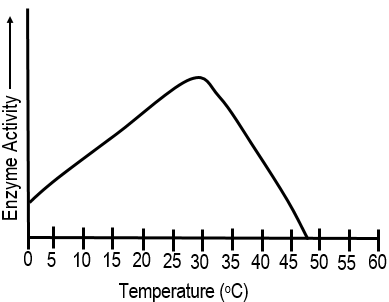
Based on the graph, what is the optimal temperature for this enzyme? 
a)
15oC
b)
40oC
c)
30oC
d)
35oC
32.
Which is NOT true?
a)
Enzymes speed up chemical reactions.
b)
Enzymes react best at a specific temperature.
c)
Enzymes only control ONE type of reaction.
d)
Enzymes are made of fatty acids.
33.
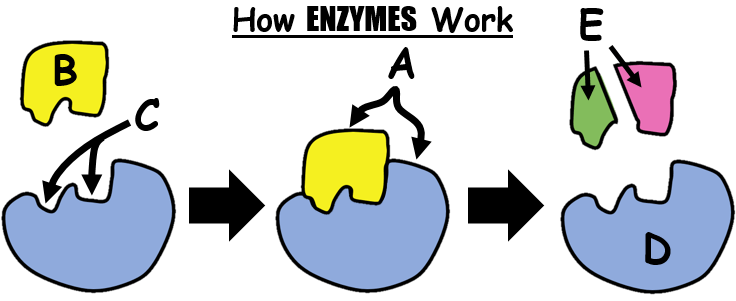
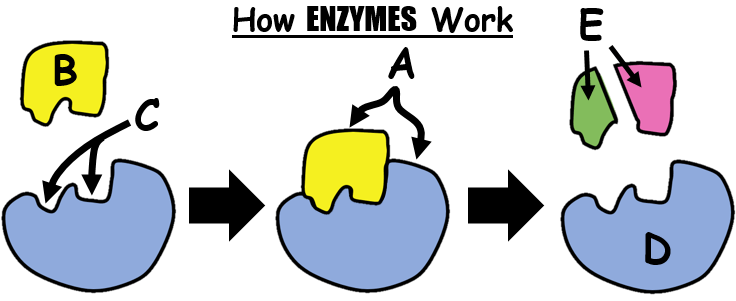
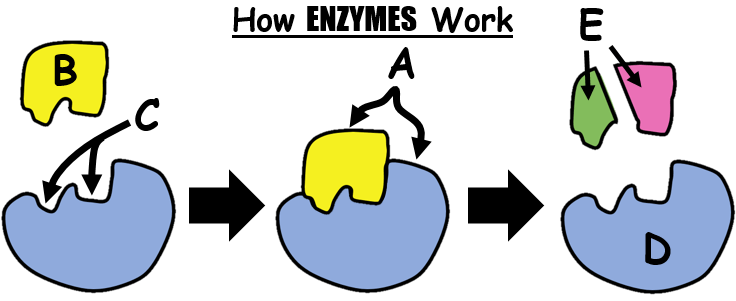
Letter D...
a)
active site
b)
enzyme
c)
substrate
d)
products
34.
Letter B...
a)
active site
b)
enzyme
c)
substrate
d)
products
35.
Letter C...
a)
active site
b)
enzymes
c)
substrate
d)
products
36.
Letter E...
a)
active site
b)
enzyme
c)
substrate
d)
products
37.
Dominant alleles are represented by a:
a)
Male gene
b)
lowercase letter
c)
recessive trait
d)
capital letter
38.
Aa is
a)
homozygous
b)
heterozygous
39.
Aa, DD, bB, yy are all examples of
a)
genotypes
b)
phenotypes
40.
Which of the following genotypes is homozygous dominant?
a)
A
b)
Aa
c)
AA
d)
aa
41.
Which of the following genotypes is heterozygous?
a)
Bb
b)
BB
c)
bb
d)
B
42.
In a flowering plant species, red flower color (R) is dominant over white flower color (r). What is the genotype of any red-flowering plant resulting from this species?
a)
rr
b)
R
c)
RR
d)
RR or Rr
43.
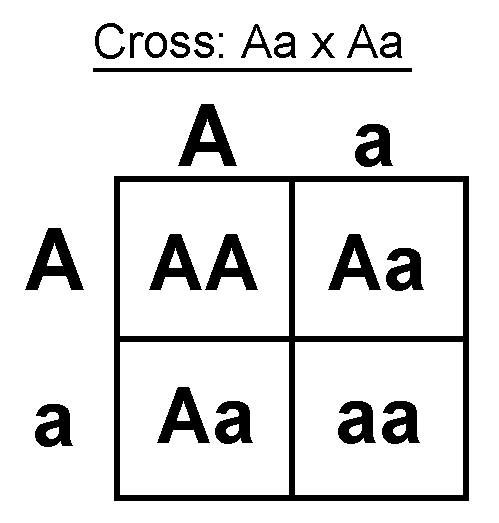
What is the phenotype of the offspring? (A-Brown hair; a-blond hair) 
a)
50 % Brown Hair and 50% Blond Hair 
b)
25 % Brown Hair and 75% Blond Hair 
c)
75 % Brown Hair and 25% Blond Hair 
d)
0% Brown Hair and 100% Blond Hair 
44.
How many degrees of freedom will be present?
a)
4
b)
5
c)
6
d)
7
45.

Observed in the wild are 10 circles, 20 squares and 30 triangles. The ratio for this particular population is 2:3:5

observed: 10 circles expected: 12

observed 20 squares expected : 18

observed 30 triangles expected: 30

Chi square = 5.96

Would you accept or reject?

a)

accept

b)

reject