
 Worksheets
AP Big Idea 3
Total questions: 60
Worksheet time: 4hrs 47mins
Name
Class
Date
1.
Enzyme that unwinds the DNA
a)
ligase
b)
DNA Polymerase
c)
primase
d)
helicase
2.
Seals the Okazaki fragments together
a)
DNA Polymerase
b)
ligase
c)
helicase
d)
primase
3.
Adds nucleotides to the newly synthesized strand of DNA
a)
DNA polymerase I
b)
DNA polymerase III
c)
Primase
d)
Ligase
4.
repetitive sequences of DNA on the ends of chromosomes (TTAGGG)
a)
telomeres
b)
telomerase
c)
Okazaki fragments
d)
primer
5.

The table shows the results of measuring the percentages of the four bases in the DNA of several different organisms. Some of the values are missing from the table. Based on Chargaff’s rule, the percentages of guanine bases in chicken DNA should be approximately what?
a)
28.8%
b)
19.9%
c)
21.5%
d)
13.4%
6.
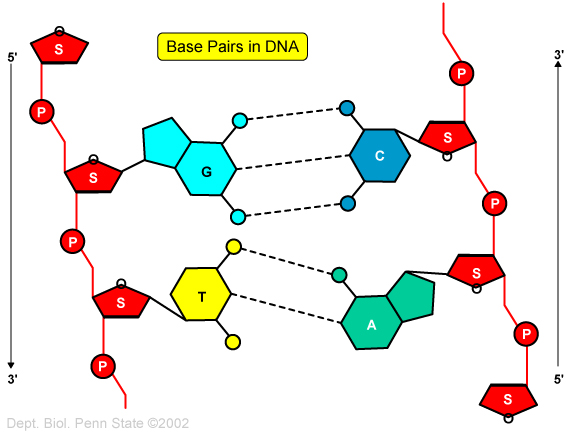
Nitrogenous bases are joined by which type of bond?
a)
polar bonds
b)
ionic bonds
c)
covalent bonds
d)
hydrogen bonds
7.
A biochemist isolates, purifies, and combines in a test tube a variety of molecules needed for DNA replication. When she adds some DNA to the mixture, replication occurs, but each DNA molecule consists of a normal strand paired with numerous segments of DNA a few hundred nucleotides long. What has she probably left out of the mixture?
a)
DNA ligase
b)
nucleotides
c)
DNA polymerase III
d)
Okazaki fragments
8.
If a DNA molecule is 18% Guanine which of the following is correct
a)
18% cytosine, 32% adenine, 32% thymine
b)
32% cytosine, 18% adenine, 32% thymine
c)
18% cytosine, 64% adenine, 64% thymine
d)
32% cytosine, 32% adenine, 18% thymine
9.
What is meant by the description "antiparallel" regarding the strands that make up DNA?
a)
The twisting nature of DNA creates nonparallel strands.
b)
One strand is positively charged and the other is negatively charged.
c)
The 5' to 3' direction of one strand runs counter to the 5' to 3' direction of the other strand.
d)
Base pairings create unequal spacing between the two DNA strands
10.
What is the role of DNA ligase in the elongation of the lagging strand during DNA replication?
a)
It catalyzes the lengthening of telomeres.
b)
It synthesizes RNA nucleotides to make a primer.
c)
It unwinds the parental double helix.
d)
It joins Okazaki fragments together.
11.
In E. coli, there is a mutation in a gene called dnaB that alters the DNA helicase that normally acts at the origin. Which of the following would you expect as a result of this mutation?
a)
Replication will occur via RNA polymerase alone.
b)
The DNA will supercoil.
c)
No replication fork will be formed.
d)
No proofreading will occur.
12.
What is the function of telomeres on a DNA strand?
a)
They are used as a recognition site for DNA helicase to bond & begin "unzipping" the strand for replication.
b)
They bond the Okazaki fragments together forming a continuous replication of DNA on the lagging strand.
c)
When cell continually replicate, the DNA gets shorter so by adding telomeres to the ends of DNA, they extend the life of a cell.
d)
They help untangle the DNA strand prior to DNA helicase's arrival to unzip the DNA strand, readying it for replication.
13.
Replication in prokaryotes differs from replication in eukaryotes for which of the following reasons?
a)
Prokaryotic chromosomes have a single origin of replication, whereas eukaryotic chromosomes have many.
b)
Prokaryotic chromosomes have histones, whereas eukaryotic chromosomes do not.
c)
The rate of elongation during DNA replication is slower in prokaryotes than in eukaryotes.
d)
Prokaryotes produce Okazaki fragments during DNA replication, but eukaryotes do not.
14.
Which description of nucleotide triplets best represents a codon?
a)
a triplet separated spatially from other triplets
b)
a triplet that has no corresponding amino acid
c)
a sequence of tRNA at the 3' end
d)
a triplet in the same reading frame as an upstream AUG
15.
Which of the following does not occur in prokaryotic gene expression but does occur in eukaryotic gene expression?
a)
mRNA, tRNA, and rRNA are transcribed
b)
RNA polymerase binds to the promotor
c)
a poly-A tail is added to the ends of the mRNA
d)
Transcription can begin as soon as translation has begun even alittle
16.
Transcription in eukaryotes requires which of the following in addition to RNA polymerase?
a)
the protein product of the promotor
b)
start and stop codons
c)
ribosomes and tRNA
d)
several transcription factors
17.
RNA polymerase moves in which direction along the DNA?
a)
5' to 3'
b)
3' to 5' along the template strand
c)
3' to 5' along nontemplate(coding) strand
d)
5' to 3' along the template strand
18.
What is a ribozyme?
a)
enzyme that uses RNA as a substrate
b)
RNA with enzymatic activity
c)
an enzyme that catlyzes the association between the large and small ribosomal subunits
d)
an enzyme tha synthesizes RNA primers during DNA replication
19.
When the spliceosome binds to a pre-mRNA transcript, where does it typically attach?
a)
to the exons
b)
to the 5'UTR
c)
to the 3'UTR
d)
at certain sequences along an intron
20.
What is the anticodon on the tRNA that binds to mRNA codon for the DNA coding sequence AAA?
a)
TTT
b)
UUU
c)
UUA
d)
AAA
21.
Which of the following events in translation is the first to occur in eukaryotes?
a)
elongation of the polypeptide
b)
base pairing of activated methionine-tRNA to AUG of the messenger RNA
c)
binding of the larger ribosomal subunit to smaller ribosomal subunits
d)
the small subunit of the ribosome recognizing and attaching to the 5'cap
22.
What is the effect of a nucleotide-pair substitution that results in a nonsense mutation in a gene?
a)
it changes an amino acid in the encoded protein
b)
It has no effect on the amino acid sequence of the encoded protein
c)
it introduces premature stop codon into the mRNA
d)
it alters the reading frame of the mRNA
23.
Which is the best description of a gene?
a)
a DNA sequence that is expressed to form a functional product; either RNA or polypeptide
b)
a DNA subunit that codes for a single complete protein
c)
a DNA-RNA sequence combination that results in an enzymatic product
d)
a descrete unit of hereditary information that consists of a sequence of amino acids
24.

In transcription of DNA where is the promotor located?
a)
at the 3'end of the newly made RNA
b)
to the right of the template strand
c)
to the left of the template strand
d)
In the middle of the template strand
25.
Type of point mutation that has no change on the protein being made.
a)
Nonsense Mutation
b)
Missense
c)
Silent Mutation
26.
DNA molecule segment is : TTACGCAAG
The mutated DNA segment is TTACGCAAC. This is an example of ___ mutation.
The mutated DNA segment is TTACGCAAC. This is an example of ___ mutation.
a)
Base Substitution
b)
Base Insertion
c)
Base Inversion
d)
Translocation
27.
Which of the following would result in a frameshift mutation?
a)
Insertions only
b)
Substitution only
c)
Deletion only
d)
Insertions and Deletions
28.
ATTTGAGCC- Original
ATTGAGCC - Mutated
The example above is an example of a
ATTGAGCC - Mutated
The example above is an example of a
a)
Insertion- Frameshift
b)
Deletion- Substitution
c)
Deletion -Frameshift
d)
All of the above
29.
A gene has 27 bases. A frameshift occurs after the 21st base. How many amino acids are affected?
a)
6
b)
3
c)
2
d)
21
30.
The two types of folding in the secondary structure are.....
a)
alpha-helix & beta-pleated sheets
b)
polypeptide & nucleotide
c)
globular & fibrous
31.

What amino acid is represented by the codon UUA?
a)
Phenylalanine
b)
Tyrosine
c)
Leucine
d)
Stop codon
32.
What is the role of the spindle during mitosis?
a)
It divides the cell in half.
b)
It duplicates the DNA.
c)
It breaks down the nuclear membrane.
d)
It helps separate the chromosomes.
33.
If an organism’s diploid number is 12, its haploid number is
a)
6.
b)
12.
c)
24.
d)
3.
34.
Assume that prophase begins with eight chromatids in the nucleus of a cell. When telophase ends, how many chromosomes w ill be
present in each new nucleus?
present in each new nucleus?
a)
8
b)
46
c)
16
d)
4
35.
Cells that are in a nondividing state are in which phase?
a)
G1
b)
G2
c)
S
d)
G0
36.
Which of the following is a protein maintained at constant levels throughout the cell cycle that
requires cyclin to become catalytically active?
requires cyclin to become catalytically active?
a)
Cdk
b)
cyclin
c)
protein kinase
d)
MPF
37.
Proteins that are involved in the regulation of the cell cycle, and that show fluctuations in
concentration during the cell cycle, are called
concentration during the cell cycle, are called
a)
kinetochores.
b)
cyclins.
c)
centrioles.
d)
proton pumps.
38.
Asexual reproduction results in identical offspring unless which of the following occurs?
a)
Natural selection
b)
Cloning
c)
Crossing over
d)
Mutation
39.
Which of the following happens at the conclusion of meiosis I?
a)
The chromosome number per cell is conserved.
b)
Sister chromatids are separated.
c)
Homologous chromosomes are separated.
d)
Four daughter cells are formed.
40.
Chiasmata are what we see under a microscope that let us know which of the following is occurring?
a)
Crossing over
b)
Anaphase II
c)
Meiosis II
d)
e. Separation of homologs
41.
You have in your possession a microscope slide with meiotic cells on it and a light microscope.
What would you look for if you wanted to identify metaphase I cells on the slide?
What would you look for if you wanted to identify metaphase I cells on the slide?
a)
Tetrads lined up at the center of the cell
b)
A synaptonemal complex
c)
Separated sister chromatids at each pole of the cell
d)
A visible nuclear envelope
42.
A mutation that does NOT alter the protein production is called a
a)
deletion mutation
b)
inversion mutation
c)
silent mutation
d)
transverse mutation
43.

When an area of a chromatid is exchanged with the matching area on a chromatid of its homologous chromosome, _________________ occurs
a)
crossing over
b)
mutagenesis
c)
hybridization
d)
fertilization
44.
The chromosomes that pair up during meiosis, are called __________ chromosomes.
a)
heterozygous
b)
asexual
c)
homologous
d)
genes
45.
Which part of the cell cycle does NOT include a checkpoint
a)
Synthesis
b)
Growth one
c)
Growth two
d)
mitosis
46.
Which best describes the role of p53 protein in the cell cycle
a)
it makes sure organelles are properly replicated
b)
it makes sure that the cytoplasm is equally divided
c)
it make sure DNA is free of errors
d)
It makes sure the DNA is copied
47.
Which statement describes an effect of an abnormally high level of a growth hormone on the regulation of the cell cycle?
a)
The cell would be more likely to enter Go phose
b)
The cell would be more likely to enter the S phase
c)
The cell would bypass all normal cell cycle checkpoints
d)
the cell would develop cancer
48.
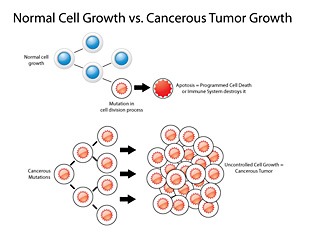
Cancer is best and fully described by ...
a)
Uncontrolled cell growth
b)
Cells which grow abnormally and no longer function correctly
c)
Cells which have lost the ability to reproduce
d)
Cells which create abnormal tissues
49.

During the cell cycle, the resting phase is ...
a)
G0
b)
G1
c)
G2
d)
S
50.

Which phrase best describes cancer?
a)
absence of cyclins
b)
multiple gene mutations
c)
uncontrolled cell growth
d)
precesnce of genetic defects
51.
The spreading of cancerous cells is called
a)
metastasis
b)
carcinogenesis
c)
angiogenesis
d)
homeostasis
52.
The longest phase of the cell cycle
a)
prophase
b)
interphase
c)
metaphase
d)
mitosis
53.

In which phase of mitosis is the cell?
a)
Prophase
b)
Metaphase
c)
Anaphase
d)
Telophase
54.

To which type of organism would this life cycle belong?
a)
plant
b)
fungi
c)
algae
d)
animal
55.
Trisomy is a genetic disorder that ________
a)
has three sets of chromosomes
b)
has three copies of a particular chromosome
c)
that is curable
d)
none of the above
56.
Cells are anchorage dependent.
a)
Regular cells
b)
Cancer cells
57.
Cell growth is not inhibited by contact with other cells.
a)
Regular cells
b)
Cancer cells
58.

What correctly describes the DNA content in the S phase?
a)
normal amount
b)
double amount
c)
increasing
d)
decreasing
59.
Which of the following can activate a protein by transferring a phosphate group to it?
a)
cAMP
b)
G protein
c)
protein phosphatase
d)
protein kinase
60.
Division of the cytoplasm of the cell
a)
S-phase
b)
Gap 1
c)
Cytokinesis
d)
Anaphase
100 %

