wayground logo

Free Printable Worksheets

NEW

Font size

S
M
L
XL
Worksheets

Classification & Phylogeny

Total questions: 34

Worksheet time: 34mins
Name
Class
Date
1.
Which of the following organisms are LEAST closely related?
a)
organisms that share a domain
b)
organisms that share a family 
c)
organisms that share a genus 
d)
organisms that share a species 
2.
The scientific name for an organism is made from the:
a)
class and family name
b)
genus and species name
c)
domain and kingdom name
d)
kingdom and phylum name
3.

The 8 levels of classification, from most broad to most specific.

a)

Domain, Genus, Family, Order, Class, Phylum, Kingdom, Species

b)

Domain, Species, Kingdom, Genus, Phylum, Family, Class, Order

c)

Domain, Kingdom, Phylum, Class, Order, Family, Genus, Species

d)

Order, Kingdom, Species, Domain, Phylum, Family, Class, Genus

4.
Who first proposed binomial nomenclature as a way of classifying organisms?
a)
Carl Linnaeus
b)
Carl's Jr.
c)
Charles Darwin
d)
Henry Groseclose
5.
Cells that do not have a true nucleus are called....
a)
eukaryote
b)
prokaryote
c)
unicellular
d)
multicellular
6.
Cells that have a true nucleus are called....
a)
eukaryotes
b)
prokaryotes
c)
unicellular
d)
multicellular
7.
Which organisms are closely related? 
a)
American badger and leopard
b)
coyote and gray wolf
c)
european otter and leopard
d)
coyote and american badger
8.
Organisms in this smallest taxonomic group share many characteristics.
a)
domain
b)
kingdom
c)
species
d)
class
9.
Which organisms are most closely related?
a)
Equus caballas (Horse) & Equus burchellii (Zebra)
b)
Cyanea artica (Jellyfish) &
Ctenodiscus crispatus (Mud Starfish)
c)
Naja naja (cobra) & Glycine max (soya bean)
d)
Ophiocomina nigra (black brittle star) & Brassica nigra (black mustard)
10.
The science of describing, classifying, and naming living things is called:
a)
Geology
b)
Biology
c)
Taxonomy
d)
Chemistry
11.
An organism made up of more than one cell would be called:
a)
multicellular
b)
unicellular
c)
heterotroph
d)
autotroph
12.
An example of an unicellular organism would be:
a)
monkey
b)
bacteria
c)
spider
d)
human
13.
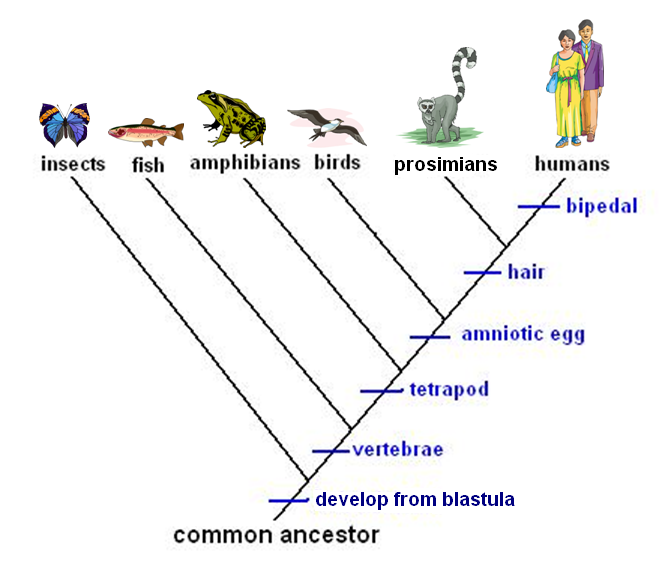
Which organisms pictured on the cladogram have hair?
a)
prosimians only
b)
prosimians and humans
c)
humans only
d)
prosimians and birds
14.
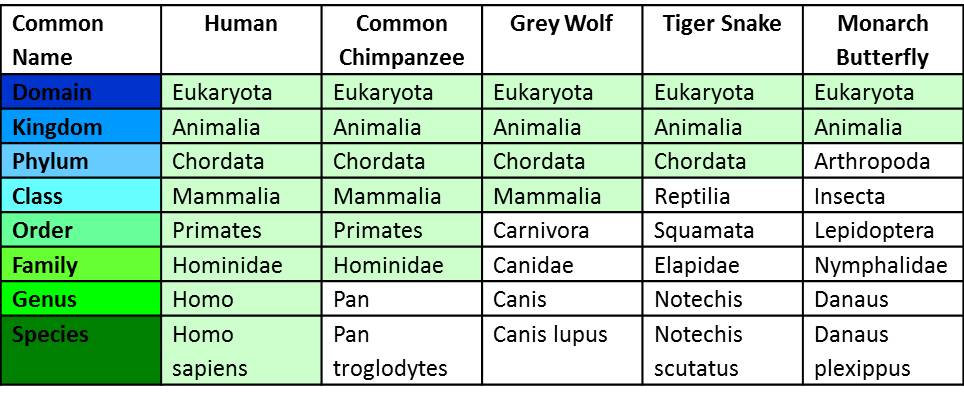
Which organism in the table is least closely related to the chimpanzee?
a)
human
b)
grey wolf
c)
tiger snake
d)
monarch butterfly
15.

Members of this kingdom are always multicellular and heterotrophic.

a)

Plantae

b)

Protista

c)

Animalia

d)

Achaebacteria

16.
What kingdom do unicellular, prokaryotic organisms that live in extreme environments?
a)
Animal
b)
Archaebacteria
c)
Eubacteria
d)
Plant
17.

I am prokaryotic and am found everywhere that's not extreme. What kingdom do I belong to?

a)

Eubacteria

b)

Archaebacteria

c)

Fungi

d)

Protista

18.

I'm motile (I can move) and have no cell walls. What kingdom do I belong to?

a)

Animalia

b)

Archaebacteria

c)

Eubacteria

d)

Plantae

19.
This organism is multicellular, heterotroph, that has a cell wall made of chitin.  What kingdom does it belong in?
a)
fungi
b)
plantae
c)
animalia
d)
eubacteria
20.
This organism is found in pond water.  It has a nucleus, is microscopic, unicellular and can perform photosynthesis.  What kingdom does it belong in?
a)
protista
b)
eubacteria
c)
archaebacteria
d)
plantae
21.
This organism is multicellular, autotroph, that has a cell wall made of cellulose.
a)
animalia
b)
plantae
c)
fungi
d)
eubacteria
22.

An early classification system had two groups: Plants and Animals. What is wrong with that system?

a)

It is too specific

b)

It is too scientific

c)

It is too broad

d)

It is too fancy

23.
What do viruses need to reproduce?
a)
they need genetic material
b)
They need a host cell
c)
They need  bacteria
d)
They need insulin
24.
Reasons that viruses are considered to be nonliving is because
a)
They are not cellular
b)
They cannot reproduce on their own
c)
They cannot make proteins
d)
all of the above
25.
Viruses are...
a)
prokaryotic
b)
eukaryotic
c)
non-living
d)
endospores
26.
Viruses 
a)
have many cells
b)
are misfolded proteins
c)
are a protein coat around genetic material
d)
endospores
27.

Aristotle made the mistake of using ____________ to classify organisms.

a)

morphology

b)

habitat

c)

cell type

d)

behavior

28.

Linnaeus is known as the Father of Taxonomy because

a)

we still use his system today

b)

his system didn't work very well

c)

he was older than Aristotle

d)

he had many children

29.

Modern Classification (Phylogeny) adds what to Linnaeus's taxonomic criteria?

a)

evolutionary relationships & DNA (biochemical characters)

b)

habitat type

c)

fewer categories than Linnaeus

d)

a naming system called binomial nomenclature

30.

Which kingdom is known as "The Junk Drawer"?

a)

Kingdom Animalia

b)

Kingdom Plantae

c)

Kingdom Protista

d)

Kingdom Eubacteria

31.

What makes the Protist Kingdom (Kingdom Protista) different from all other kingdoms?

a)

It's the only eukaryotic kingdom

b)

Its members aren't very similar to one another

c)

It is the only unicellular kingdom

d)

It's the only kingdom that has viruses

32.

Which kingdom sometimes has a cell well?

a)

Kingdom Protista

b)

Kingdom Plantae

c)

Kingdom Animalia

d)

Kingdom Fungi

33.

Members of these 2 kingdoms can never make their own food:

a)

animal & fungi

b)

animal & plant

c)

fungi & protist

d)

archaebacteria & eubacteria

34.

The endosymbiotic theory is a way of explaining

a)

how eukaryotic cells evolved from prokaryotic cells

b)

how prokaryotic cells came from eukaryotic cells

c)

how mitochondria & chloroplasts are really the same thing

d)

how prokaryotic cells got their nucleus