
 Worksheets
Chapter 4.3: Population Growth
Total questions: 20
Worksheet time: 10mins
Name
Class
Date
1.
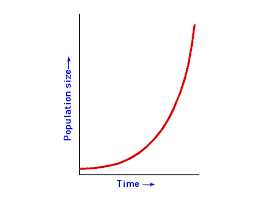
What type of growth is shown in the diagram?
a)
exponential growth
b)
logistic growth
c)
predator-prey cycle
d)
boom-bust curve
2.
Largest number of individuals of a population that the environment can support...
a)
carrying capacity
b)
population density
c)
limiting factor
d)
survivorship curve
3.
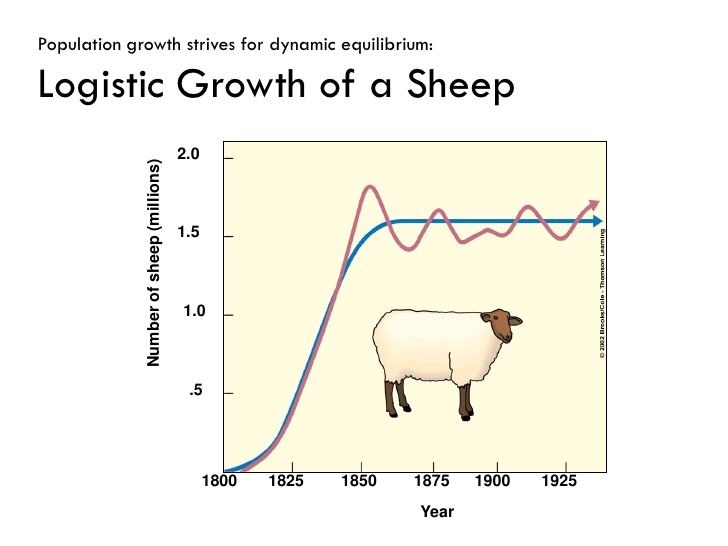
What is the carrying capacity for this sheep population?
a)
1.8 million
b)
1.25 million
c)
1.6 million
d)
1.o million
4.
Type of growth that occurs when disease and parasites are present...
a)
exponential
b)
J-shaped
c)
predator-prey
d)
logistic
5.

If a disease destroying barley plants in a field swept through an ecosystem, what would happen to the barley eating bird population in the the field ?
a)
The bird population would stay the same
b)
The bird population would infinitely increase
c)
The bird population would decrease
6.

What point on the graph represents the carrying capacity?
a)
A
b)
B
c)
C
d)
D
7.

Will competition increase/decrease the carrying capacity of an ecosystem for the animal in competition?
a)
Decrease
b)
Increase
8.

If the amount of food or resources available increases, the carrying capacity for an animal:
a)
Stays the same
b)
Increases
c)
Decreases
d)
Fluctuates
9.
Which limiting factor is density independent?
a)
competition
b)
disease
c)
natural disasters
10.
The graph of logistic growth can be described as...
a)
S-shaped
b)
J-shaped
c)
U-shaped
11.
An environmental factor such as predation, disease, and competition that depends on the number of members in a population per unit
a)
dispersion
b)
density- independent factor
c)
density- dependent factor
12.
Individuals of a population who exit an area.
a)
Immigration
b)
Emigration
c)
Mitigation
d)
Lingation
13.
Individuals of a population who move into an area.
a)
Immigration
b)
Emigration
c)
Litigation
d)
Mastication
14.
If the number of births in a population is the same as the number of deaths in a population, what will happen to the growth of the population?
a)
It will increase
b)
It will decrease
c)
It will stay the same
d)
It don't matter
15.
If the number of births is greater than the number of deaths in a population, what will happen to the growth of the population?
a)
It will increase
b)
It will decrease
c)
It will stay the same
d)
It don't matter
16.
The number of births in a population during a certain time period.
a)
Birth Rate
b)
Death Rate
17.
The number of deaths in a population during a certain time period.
a)
Birth Rate
b)
Death Rate
18.

Refer to the diagram of the survivorship curve.
Which curve best describes an organism that invests a lot of energy in parenting?
Which curve best describes an organism that invests a lot of energy in parenting?
a)
A
b)
B
c)
C
d)
this is not a survivorship curve
19.
Which of the following terms describes the time from an organism is born to produce their own offspring?
a)
gestation time
b)
population size
c)
population distribution
d)
generation time
20.
Which of the following terms describes the time it takes an organism to develop from an embryo to being born?
a)
gestation time
b)
population size
c)
population distribution
d)
generation time
100 %

