

wayground logo

Free Printable Worksheets

Font size

S
M
L
XL
Worksheets

Geometric Transformations Practice Test

Total questions: 67

Worksheet time: 2hrs 31mins

Name
Class
Date
1.

Name the transformation.

a)

Translation

b)

Reflection

c)

Rotation

d)

Dilation

2.

When you translate, you ______ a number to x and y.

a)

Add or subtract

b)

Multiply or divide

c)

Add or multiply

d)

Subtract or divide

3.
Write a rule for the translation.
a)
 (x -1, y  + 2)
b)
 (x -2, y  + 1)
c)
 (x +2, y  - 1)
d)
(x +1, y  -  2)
4.
Identify the transformation from ABC to A'B'C'.
a)
90o clockwise rotation
b)
90o counter clockwise rotation
c)
Reflection across the y-axis
d)
Reflection across the x-axis
5.
Identify the transformation from ABCD to A'B'C'D'.
a)
Translation
b)
Reflection across the y-axis
c)
Reflection across the x-axis
d)
90o counter clockwise Rotation
6.
Apply the following rule to the point (-5,6):
(x,y)-->(y,-x)
a)
(-5,-6)
b)
(5,-6)
c)
(6,5)
d)
(-6,5)
7.
Identify the transformation from A to D.
a)
90o Clockwise Rotation
b)
180o Rotation
c)
270o Clockwise Rotation
d)
360o Rotation
8.
Which rule would dilate shows a scale factor of 4
a)
(x, y) → (y, x)
b)
(x, y) → (x + 4, y + 4)
c)
(x, y) → (x, -y)
d)
(x, y) → (4x, 4y)
9.

What is the rule for the dilation pictured below?

a)

(x, y) → (½x, ½y)

b)

(x, y) → (x + 2, y + 2)

c)

(x, y) → (2x, 2y)

d)

(x, y) → (2x, 3y)

10.
A triangle has vertices with coordinates (2,0), (3, -1) and (-2,-5). If the triangle is dilated by a scale factor of 3 with the origin as the center of dilation, what are the coordinates of the vertices of the image?
a)
(5,3), (6,2), (1,-2)
b)
(6,0), (9,-3), (-6,-15)
c)
(2/3,0), (1,-1/3), (-2/3,-5/3)
d)
(-1,-3), (0,-4), (-5,-8)
11.
What is the sequence of transformations?
a)
Reflect over the y then reflect over the x
b)
Reflect over the x then reflect over the y
c)
Translate 4 units then rotate 90˚
d)
Rotate 90˚ then reflect over the x
12.
Which of the following describes the sequence of transformations shown?
a)
Reflect across the x-axis and then rotate -90 degrees around the origin
b)
Rotate -90 degrees around the origin and then translate down.
c)
Reflect across the x-axis and then reflect across the y-axis.
d)
Translate up and then rotate 90 degrees about the origin.
13.
What sequence of transformations will get you from shape 1 to shape 2 to shape 3 in three steps?
a)
Rotation, then Dilation, then Reflection
b)
Translation, then Reflection, then Rotation
c)
Reflection, then
Dilation, then Rotation
d)
Dilation, then Translation, then Reflection
14.
Dilate Point B by a scale factor of 1/2
a)
(1.5,-4)
b)
(-1.5,1)
c)
(-1,-1.5)
d)
(-2,-2)
15.

Choose the correct transformations

a)

rotate 90 degrees counter-clockwise around the origin, and then reflect over the x-axis

b)

right 1, down 4, and then reflection over the y-axis

c)

right 6, and then reflection over the x-axis

d)

reflection over the line y=x, and then translate up 4, right 2

16.

Choose the correct transformations

a)

rotate 90 degrees counter-clockwise around the origin, and then reflect over the x-axis

b)

right 1, down 4, and then reflection over the y-axis

c)

right 6, and then reflection over the x-axis

d)

reflection over the line y=x, and then translate up 4, right 2

17.

Choose the correct transformations

a)

rotate 90 degrees counter-clockwise around the origin, and then reflect over the x-axis

b)

right 1, down 4, and then reflection over the y-axis

c)

right 6, and then reflection over the x-axis

d)

reflection over the line y=x, and then translate up 4, right 2
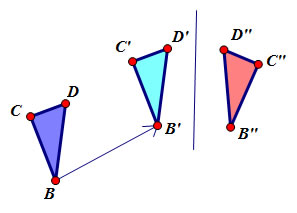
18.
What sequence of transformations will get you from shape BCD to shape B"C"D" in two steps?
a)
Rotation, then Rotation
b)
Rotation, then Dilation
c)
Reflection, then Rotation
d)
Translation, then Reflection
19.
Describe the transformations that map ABC onto A"B"C"
a)
translate 5 up and 1 left then reflect over y
b)
translate 5 down and 1 left, then reflect over y
c)
reflect over y=x then translate left 8
d)
reflect over x then rotate 90 clockwise
20.
Name the series of transformations that maps ABC onto DEF
a)
reflect over x then translate left 6 up 1
b)
reflect over y then translate down 6 left 1
c)
translate right 6 down 1, then reflect over x
d)
rotate 90 clockwise then reflect over y
21.

Choose the correct scale factor:

a)

2

b)

3

c)

1/3

d)

1/2

22.
What is an isometry?
a)
A transformation that changes the preimage size.
b)
A transformation that translates the image.
c)
A transformation that preserves the preimage shape and size, such as, a reflection, translation, and rotation.
d)
A transformation that morphs the preimage to a new shape.
23.
What is the rule for the following reflection? 
a)
Reflection across       y = −2
b)
Reflection across        x = −2
c)
Reflection across            x = 2
d)
Reflection across          y = 2
24.
How many lines of symmetry does this shape have?
a)
1
b)
2
c)
3
d)
4
25.
How many lines of symmetry does this shape have?
a)
0
b)
1
c)
2
d)
4
26.
Identify the angles of rotation that maps the image to itself.
a)
multiples of 72°
b)
multiples of 180°
c)
multiples of 144°
d)
multiples of 45°
27.

How many lines of symmetry does this shape have?

a)

1

b)

2

c)

3

d)

4

28.

Identify the angles of rotation that maps the image to itself.

a)

multiples of 120°

b)

multiples of 180°

c)

multiples of 90°

d)

multiples of 60°

29.
What are the angles of rotation for an octagon?
a)
multiples of 45
b)
multiples of 51.4
c)
multiples of 60
d)
multiples of 72
30.
Identify the smallest angle of rotation that maps the image to itself.
a)
180°
b)
360°
c)
90°
d)
No rotational symmetry
31.
What is(are) the angle(s) of rotation needed to rotate this octagon onto itself?
a)
45, 135 
b)
90, 180 
c)
both a and b 
d)
none of the above
32.
The rule for dilation is  
(x, y) --> _
a)
(kx, ky)
b)
(x, -y)
c)
(-x, y)
d)
(x+a, y+b)
33.
The rule for reflection over the x-axis is  
(x, y) --> _
a)
(-x, y)
b)
(x, -y)
c)
(y, x)
d)
(-y, -x)
34.
The rule for reflection over the y-axis is  
(x, y) --> _
a)
(-x, y)
b)
(x, -y)
c)
(y, x)
d)
(-y, x)
35.
The rule for rotation of 90 degrees counterclockwise is  
(x, y) --> _
a)
(y, -x)
b)
(-y, x)
c)
(x, -y)
d)
(-x, y)
36.
The rule for rotation of 180 degrees is  
(x, y) --> _
a)
(-y, x)
b)
(-x, -y)
c)
(y, -x)
d)
(-y, -x)
37.
The rule for rotation of 270 degrees counterclockwise is  
(x, y) --> _
a)
(y, x)
b)
(-y, x)
c)
(y, -x)
d)
(x, -y)
38.
The rule for rotation of 90 degrees clockwise is  
(x, y) --> _
a)
(y, -x)
b)
(-y, x)
c)
(x, -y)
d)
(-x, y)
39.

Which rule describes the action of the coordinates when a figure is reflected over the line y = x?

a)

(x, y)→(-y, -x)

b)

(x, y)→(-x, y)

c)

(x, y)→(-x, -y)

d)

(x, y)→(y, x)

40.

Which rule describes the action of the coordinates when a figure is reflected over the line y = -x?

a)

(x, y)→(y, x)

b)

(x, y)→(-y, -x)

c)

(x, y)→(-x, -y)

d)

(x, y)→(y, -x)

41.

A transformation that does not change the size or shape of a pre-image (pre-image and image are congruent) is called

a)

isometry

b)

reflections

c)

rotations

d)

dilation

42.
Which is NOT an Isometry?
a)
Relection
b)
Dilation
c)
Rotation
d)
Translation
43.
Identify the smallest angle of rotation that maps the image to itself.
a)
90°
b)
180°
c)
45°
d)
60°
44.
A rigid motion creates figures that are ____________.
a)
congruent
b)
different sizes
c)
similar
d)
larger
45.
Which transformation is NOT a rigid motion (the size changes)?
a)
reflection
b)
rotation
c)
dilation
d)
translation
46.
A rigid motion ...
a)
preserves size and location
b)
preserves shape and location
c)
preserves size and shape
d)
makes the figure larger
47.

What are the series of rigid motions that would map ∆ABC onto ∆A''B''C''?

a)

a reflection followed by a rotation

b)

a reflection followed by a translation

c)

a translation followed by a rotation

d)

a translation followed by a reflection

48.

Which transformation will map the right triangle onto itself?

a)

90 degree rotation

b)

180 degree rotation

c)

270 degree rotation

d)

none of the above choices

49.

Which of the following transformation will map the regular pentagon onto itself?

a)

x axis reflection

b)

y axis reflection

c)

90 degree rotation

d)

180 degree rotation

50.

Which of the following transformation will map the trapezoid onto itself?

a)

x axis reflection

b)

reflection across green line

c)

rotation 90 degrees about (2,-1)

d)

reflection across the blue line

51.

Which of the following transformation will map the regular pentagon onto itself?

a)

reflection across blue line

b)

reflection across green line

c)

108 degree rotation about the origin

d)

216 degree rotation about the origin

52.

Which of the following transformation will map the trapezoid onto itself?

a)

reflection across the blue line

b)

90 degree rotation about the center point

c)

180 degree rotation about the center point

d)

270 degree rotation about the center point

53.

Which transformation will map the rectangle onto itself?

a)

90 degree rotation about the center point

b)

180 degree rotation about the center point

c)

reflection across the x axis

d)

reflection across the bue line

54.

Which of the following transformations will not map the regular hexagon onto itself?

a)

270 degree rotation about the origin

b)

x axis reflection

c)

y axis reflection

d)

reflection over the blue line

55.

Which Transformation will map the trapezoid onto itself?

a)

180 degree rotation about the origin

b)

180 degree rotation about (-4.5, 3.5)

c)

reflection across the blue line

d)

reflection across the green line

56.

Which transformation will map the parallelogram onto itself?

a)

reflection x axis

b)

reflection y axis

c)

refection across the green line

d)

none of these above

57.

Select each answer choice that will map the regular polygon onto itself?

a)

36 degree rotation

b)

90 degree rotation

c)

180 degree rotation

d)

252 degree rotation

e)

270 degree rotation

58.

Select each answer choice that will map the regular polygon onto itself

a)

x axis reflection

b)

y axis reflection

c)

reflection across the green line

d)

none of thee above

59.

which transformation will map the regular octagon onto itself?

a)

30 degree rotation about the center

b)

45 degree rotation about the center

c)

120 degree rotation about the center

d)

225 degree rotation about the center

e)

270 degree rotation about the center

60.

Which transformation will map the figure onto itself?

a)

90 degree rotation about the center

b)

180 degree rotation about the center

c)

270 degree rotation about the center

d)

none of the above

61.

Which of the following will map the figure onto itself?

a)

90 degree rotation about the center point

b)

180 degree rotation about the center point

c)

270 degree rotation about the center point

d)

none of the above

62.

Which of the following regular polygons would not be mapped onto itself by a 180 degree rotation about its center?

a)

Square

b)

Pentagon

c)

Hexagon

d)

Octagon

63.

Which transformation will map an image onto itself?

a)

A translation 3 units right and 3 units up

b)

A rotation 360o clockwise

c)

A reflection over the y-axis followed by a translation 3 units down

d)

A dilation followed by a 90o clockwise rotation

64.

When performing 2 reflections over parallel lines (as shown in the diagram) what is the resultant transformation?

a)

1 Reflection

b)

1 Rotation

c)

1 Translation

d)

1 Dilation

65.

When performing 2 reflections over non-parallel lines (as shown in the diagram) what is the resultant transformation?

a)

1 Reflection

b)

1 Rotation

c)

1 Translation

d)

1 Dilation

66.
Which answers are showing a reflection?
a)
a and c
b)
b and c
c)
c and d
d)
a and d
67.
a)
A
b)
D
c)
B
d)
C
