
 Worksheets
Math 3 Unit 1 Review
Total questions: 65
Worksheet time: 2hrs 20mins

What function family do this belong to?
Power/Polynomial
Trigonometric
Exponential/Logarithm
Absolute Value

What function family do I belong to?
Power/Polynomial
Rational
Exponential/Logarithmic
Absolute Value

What is the parent function for f(x)?
f(x) = 2x
f(x) = x2
f(x) = sin(x)
f(x) = ∣x∣

What family of function is this?
Absolute Value
Power/Polynomial
Reciprocal/Rational
Trigonometric

What is the parent function?
y = xn
y = log(x)
y = x1
y = cos(x)

What function family does f(x) belong to?
Polynomial/Power
Rational
Exponential/Logarithmic
Absolute Value

Determine which function the graph represents.
polynomial
rational
exponential
absolute value
piecewise function
Which functions are exponential? (Check all that apply)
y=4x
y=31x−6
y=2x−6
y=x2

Which type of function is the graph?
Absolute Value
Rational
Exponential/Logarithmic
Power/Polynomial

Which graph represents
y = |x + 3| − 4 ?
Graph A
Graph B
Graph C
Graph D

What is the range of the function graphed?
(-∞, ∞)
(-∞, 2] and [2, ∞)
[2, ∞)
(-∞, 2]

What is the domain of the function graphed?
(-∞, ∞)
[-5, ∞)
[-5, -4]
[-4, ∞)

Name the y-intercept(s) of the function in the graph.
(-1, 0) and (4, 0)
(-2, 0)
(0, -2)
(0, 4) and (0, -1)

Name the x-intercept(s) in the graph.
(-4, 0) and (2, 0)
(-2, 0)
(0, -2)
(0, -4) and (0, 2)
Which function increases throughout
the interval -2 < x < 2?


Name the interval(s) where the function is decreasing? Click all that apply.
-∞ < x < -1
-1 < x < 1
-2 < x < 2
1 < x < ∞

Which of the following describes an end behavior of the function graphed? Select all that apply.
As x → -∞, y → -∞
As x → -∞, y → +∞
As x → +∞, y → -∞
As x → +∞, y → +∞

Which function family is represented in this graph?
Trigonometric
Absolute Value
Polynomial/Power
Rational

As
x→∞, f(x) → ∞
−∞
Increasing Interval(s): (Choose all that apply)
(−∞, 2)
(2, −4.67)
(4.67, ∞)
(−∞, 0)
(0, −9.48)

Decreasing Interval(s): (Choose all that apply)
(−∞, 0)
(−∞, 3)
(3, 5)
(5, ∞)
(−4, ∞)
As x→−∞, f(x)→
∞
−∞

Does this parabola have a maximum or minimum?
Maximum
Minimum
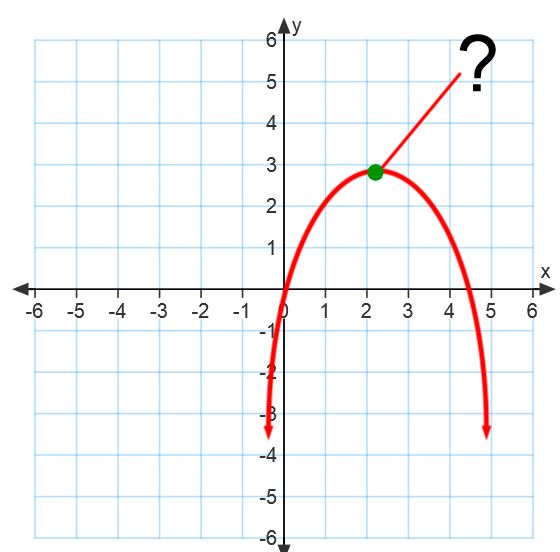

What is the maximum value (y-value only)?
5
0
-5
2

What is the minimum value (y-value only)?
-3
-5
-1
0


On which interval(s) is the given function increasing?
(-∞, 2) U (-2, ∞)
(-2, 2) U (-2, ∞)
(-∞, -2) U (0.5, ∞)
(0, 2) U (0.5, ∞)

How would you describe the behavior of this function on the domain interval (-1, 1)?
increasing
decreasing
constant

Where is the function increasing and decreasing?
increasing (-∞,∞) and decreasing nowhere
increasing nowhere and decreasing (-∞,∞)
increasing (1,∞) and decreasing (-∞,1)
increasing (-1,∞) and decreasing (-∞,-1)


Which 2 function families have asymptotes?
Reciprocal/Rational
Exponential/Logarithmic
Power/Polynomial
Absolute Value
Trigonometric


Match the graph with the correct equation.


A house painter charges $12 per hour for the first 40 hours he works, $18 for the ten hours after that, and $24 for all hours after that.
How much does he earn for a 70 hour week?
$1020
$1140
$840
He works for free!
Describe the transformation that occurred.
h(x) = f(x) + 2
up 2 units
left 2 units
Vertical Strech
right 2 units
Describe the transformation that occurred
g(x) =2f(x)
Up 2 units
vertical compression
vertical stretch
Right 2 Units


62.5
-30
10
-5
22
Describe the transformation that occurred
p(x) = f(x + 3)
Right 3 units
Vertical Stretch
Up 3 units
Left 3 units
Describe the transformation that occurred
h(x) = 1/5f(x)
Up 5 Units
vertical compression
vertical stretch
Down 5 Units
y=(x-2)3+4
Given h(x)=−2x2+1 , describe the transformations from the parent function.
reflect in the x-axis, vertically stretched by a factor of 2 and translate 1 unit up
reflect in the x-axis, vertically compressed by a factor of 2 and translate 1 unit up
reflect in the x-axis, vertically stretched by a factor of 2 and translate 1 unit right
reflect in the y-axis, vertically stretched by a factor of 2 and translate 1 unit left
f(x) = 3 Ix+8I
-8 ≤ x < 8
[3, 5]
(-63, -62)

x < 8
x < 3 or x ≥ 5


Solve for x.
x ≥ -13 and x ≤ -3
-13 < x < -3
x < -13 and x ≤ -3
x > -13 or x < -3
−2|−2r − 4| = -12
{5,1}
{-5,-1}
{5}
No Solution
How many solutions does the following equation have?
0 = -6|9v - 7|
no solution
one solution
two solutions

