wayground logo

Free Printable Worksheets

Font size

S
M
L
XL
Worksheets

Periodic Trends

Total questions: 186

Worksheet time: 6hrs 14mins

Name
Class
Date
1.
Which has the greater EN: 
Cl or Al?
a)
Cl
b)
Al
2.
Which has the greater EN: 
N or C?
a)
C
b)
N
3.
Which has the greater EN: 
H or F?
a)
H
b)
F
4.
Which of the following will have a larger radius than Zinc?
a)
Gallium
b)
Aluminum
c)
Magnesium
d)
Strontium
5.
Which of the following will have a higher electronegativity than arsenic (As)?
a)
Carbon (C)
b)
Neon (Ne)
c)
Antimony (Sb)
d)
Germanium (Ge)
6.
Which of the following will have a lower ionization energy than Scandium (Sc)?
a)
Helium (He)
b)
Titanium (Ti)
c)
Calcium (Ca)
d)
Magnesium (Mg)
7.
As atoms of elements in group 16 are considered in order from top to bottom, the electronegativity of each successive element....
a)
decreases
b)
increases
c)
remains the same
d)
none of the above
8.
Which atom has the largest atomic radius?
a)
potassium
b)
rubidium 
c)
francium
d)
cesium
9.
As you move down the periodic table atoms get bigger.  This is because ____________.
a)
The atoms have more mass.
b)
The atoms have more protons.
c)
The atoms have more energy levels
d)
The atoms have more nuetrons
10.
As you move across the periodic table atoms tend to get smaller because, ______________.
a)
the atoms have more mass.
b)
the atoms have less mass
c)
the atoms have more protons.
d)
the atoms have less electrons.
11.
Atoms that have a high electronegativity, _______________.
a)
give up their electrons more easily.
b)
hold on to their electrons more tightly.
c)
have more electron shells.
12.
Electronegativity is...
a)
how good an atom is at attracting electrons
b)
the ability of an atom to lose electrons
c)
the energy required to remove an electron from a specific atom
d)
how easy it is to make friends. 
13.
Ionization energy is...
a)
the energy required to add an electron to a specific atom
b)
how much energy it takes to remove an electron from an atom
c)
the energy required to shield the outer electrons from the nucleus
d)
a measure of the ability of an atom to attract electrons
14.
Metals are good conductors of heat and electricity.
a)
true
b)
false
15.
The atom with the largest atomic radius in Group 18 is - 
a)
Ar
b)
He
c)
Kr
d)
Rn
16.
Metals have the largest - 
a)
atomic radius and electronegativity
b)
electronegativity and ionization energy
c)
atomic radius only
d)
ionization energy and atomic radius
17.
Which statement correctly and completely identifies a trend?
a)
Atomic radius decreases across a period and increases down a group.
b)
Electronegativity decreases across a period and decreases down a group.
c)
Ionization energy increases across a period and increases down a group.
d)
Ionic radius increases across a period and increases down a group.
18.
The element with the largest electronegativity in the halogens is - 
a)
At
b)
F
c)
Cl
d)
Br
19.
The element with the lowest electronegativity in Period 3 is - 
a)
Na
b)
Cl
c)
Ar
d)
Mg
20.
The electronegativity of Cl is the highest in Period 2.  Why?
a)
Cl is the largest and has the greatest effective nuclear charge
b)
Cl is the smallest and has the lowest effective nuclear charge
c)
Cl is the largest and has the lowest effective nuclear charge
d)
Cl is the smallest and has the greatest effective nuclear charge
21.
Which periodic group has the smallest atomic radius?
a)
Alkali metals
b)
Halogens
c)
Noble Gases
d)
Transition metals
22.
Based on electronegativity trends in the periodic table, which of the following is the most likely value for the electronegativity of silicon?
a)
2.44
b)
1.23
c)
2.22
d)
2.03
23.
Atomic radius generally increases as we move __________.  
a)
down a group and from right to left across a period 
b)
up a group and from left to right across a period 
c)
down a group and from left to right across a period 
d)
up a group and from right to left across a period 
24.
Electronegativity __________ from left to right within a period and __________ from top to bottom within a group.
a)
decreases, increases 
b)
increases, increases
c)
increases, decreases 
d)
stays the same, increases
25.

Which of the following will have a larger radius than Zinc?

a)

Gallium

b)

Aluminum

c)

Magnesium

d)

Strontium

26.

Which of the following will have a higher electronegativity than arsenic (As)?

a)

Carbon (C)

b)

Neon (Ne)

c)

Antimony (Sb)

d)

Germanium (Ge)

27.

Which of the following will have a lower ionization energy than Scandium (Sc)?

a)

Helium (He)

b)

Titanium (Ti)

c)

Calcium (Ca)

d)

Magnesium (Mg)

28.
As atoms of elements in group 16 are considered in order from top to bottom, the electronegativity of each successive element....
a)
decreases
b)
increases
c)
remains the same
d)
none of the above
29.
Which atom has the largest atomic radius?
a)
potassium
b)
rubidium 
c)
francium
d)
cesium
30.
As you move across the periodic table atoms tend to get smaller because, ______________.
a)
the atoms have more mass.
b)
the atoms have less mass
c)
the atoms have more protons.
d)
the atoms have less electrons.
31.
Atoms that have a high electronegativity, _______________.
a)
give up their electrons more easily.
b)
hold on to their electrons more tightly.
c)
have more electron shells.
32.
Electronegativity is...
a)
how good an atom is at attracting electrons
b)
the ability of an atom to lose electrons
c)
the energy required to remove an electron from a specific atom
d)
how easy it is to make friends. 
33.
Ionization energy is...
a)
the energy required to add an electron to a specific atom
b)
how much energy it takes to remove an electron from an atom
c)
the energy required to shield the outer electrons from the nucleus
d)
a measure of the ability of an atom to attract electrons
34.
Metals have the largest - 
a)
atomic radius and electronegativity
b)
electronegativity and ionization energy
c)
atomic radius only
d)
ionization energy and atomic radius
35.
The element with the largest electronegativity in the halogens is - 
a)
At
b)
F
c)
Cl
d)
Br
36.

The element with the lowest electronegativity in Period 3 is -

a)

Na

b)

Cl

c)

Ar

d)

Mg

37.

The electronegativity of Cl is the highest in Period 3. Why?

a)

Cl is the largest and has the greatest effective nuclear charge

b)

Cl is the smallest and has the lowest effective nuclear charge

c)

Cl is the largest and has the lowest effective nuclear charge

d)

Cl is the smallest and has the greatest effective nuclear charge

38.
Which periodic group has the smallest atomic radius?
a)
Alkali metals
b)
Halogens
c)
Noble Gases
d)
Transition metals
39.

A measure of the size of an atom, and is generally defined as the distance from the nucleus to the outermost electron orbit

a)

chemical reactivity

b)

atomic radius

c)

energy levels

d)

orbit

40.
The core of an atom where most of the mass of an atom exists; contains protons and neutrons
a)
nucleus
b)
electron shell
c)
proton
d)
electron
41.
The minimum energy required to remove an electron from the ground state of an atom
a)
electron configuration
b)
energy levels
c)
ionization energy
d)
ionic bond
42.
A negatively charged subatomic particle that exists in various energy levels outside the nucleus of an atom
a)
neutron
b)
electron
c)
proton
d)
subatomic particle
43.
The tendency of an atom to attract electrons and acquire a negative charge
a)
electronegativity
b)
charge
c)
bonding ability
d)
electron configuration
44.
The energies of electrons as they orbit the nucleus of an atom
a)
energy levels
b)
orbits
c)
shells
d)
electron area
45.
An electron that resides in the outermost shell, or principal quantum level, of an atom
a)
periodic trend
b)
electron shell
c)
ionic radius
d)
valence electron
46.

In which of the following atoms is the 2s orbital closest to the nucleus? (Bonus question, worth 2 marks.)

a)

S

b)

Cl

c)

P

d)

Si

e)

They are the same distance in all of these atoms.

47.
Atomic Radius is...
a)
the relative size of the atom's nucleus
b)
the relative size of the atom's electron cloud
c)
the energy required to shield the outer electrons from the nucleus
d)
a measure of the ability of an atom to attract electrons
48.
As you move down the periodic table atoms get bigger.  This is because ____________.
a)
The atoms have more mass.
b)
The atoms have more protons.
c)
The atoms have more energy levels
d)
The atoms have more nuetrons
49.
As you move across the periodic table atoms tend to get smaller because, ______________.
a)
the atoms have more mass.
b)
the atoms have less mass
c)
the atoms have more protons.
d)
the atoms have less electrons.
50.
Which atom has the largest atomic radius?
a)
potassium
b)
rubidium 
c)
francium
d)
cesium
51.
The atom with the largest atomic radius in Group 18 is - 
a)
Ar
b)
He
c)
Kr
d)
Rn
52.
Which periodic group has the smallest atomic radius?
a)
Alkali metals
b)
Halogens
c)
Noble Gases
d)
Transition metals
53.
Which of the following will have a lower ionization energy than Scandium (Sc)?
a)
Helium (He)
b)
Titanium (Ti)
c)
Calcium (Ca)
d)
Magnesium (Mg)
54.
Which of the following will have a higher ionization energy than arsenic (As)?
a)
Gallium (Ga)
b)
Neon (Ne)
c)
Antimony (Sb)
d)
Germanium (Ge)
55.
Which of the following will have a higher electronegativity than arsenic (As)?
a)
Carbon (C)
b)
Neon (Ne)
c)
Antimony (Sb)
d)
Germanium (Ge)
56.
As atoms of elements in group 16 are considered in order from top to bottom, the electronegativity of each successive element....
a)
decreases
b)
increases
c)
remains the same
d)
none of the above
57.
What electron configuration matches an oxygen atom?
a)
1s22s22p63s2, 3p64s23d104p5
b)
1s22s22p4
c)
1s22s22p6
d)
1s22s22p63s23p64s23d1
58.
What atom matches this electron configuration?
1s22s22p63s2
a)
Neon
b)
Magnesium
c)
Aluminum
d)
Potassium
59.
How many electrons does Si contain? (click to see image)
a)
14
b)
28
c)
2
d)
4
60.
How many electrons can the first energy level hold?
a)
1
b)
2
c)
8
d)
0
61.
The electron configuration of an atom is 1s22s22p6.  The number of electrons in the atom is 
a)
3
b)
6
c)
8
d)
10
62.
What do you start electron configuration with?
a)
1s2
b)
1d10
c)
1f14
d)
1p6
63.
There are 4 different types of subshells s,p,d,f
a)
true
b)
false
64.
How many electrons can the d sublevel hold?
a)
8
b)
10
c)
2
d)
4
65.
Electrons occupy orbitals of lowest energy first is part of what electron configuration rule?
a)
Hund’s Rule
b)
Aufbau Principle
c)
Pauli Exclusion Principle
66.
What is this element? 
1s22s22p63s23p64s23d104p6
a)
Argon
b)
Krypton
c)
Selenium
d)
Bromide
67.
The atom with the largest atomic radius in Period 4 (row 4) is - 
a)
K
b)
Kr
c)
Fe
d)
Fe
68.
The element with the smallest ionization energy in Period 6 is - 
a)
Rn
b)
Cs
c)
Os
d)
Tm
69.
As you move across the periodic table atoms tend to get smaller because, ______________.
a)
the atoms have more mass.
b)
the atoms have less mass
c)
the atoms have more protons.
d)
the atoms have less electrons.
70.
Families all have similar 
a)
Names
b)
atomic numbers
c)
atomic masses
d)
properties
71.
Which has the greater Electronegativity: 
N or C?
a)
C
b)
N
72.
Which atom has the largest atomic radius?
a)
potassium
b)
rubidium 
c)
francium
d)
cesium
73.
Fluorine is the most reactive nonmetal.
a)
true
b)
false
74.
Put the following elements in order of decreasing ionization energy:
O, Te, Po, S.
a)
O, S, Po, Te
b)
O, S, Te, Po
c)
O, Te, Po, S
d)
O, Po, Te, S
75.
Put the following elements in order of increasing atomic radius:
Rb, Na, K, Fr.
a)
Rb, Na, K, Fr
b)
K, Rb, Fr, Na
c)
Fr, K, Na, Rb
d)
Na, K, Rb, Fr
76.
Which of the following statements is true about the atomic radii of magnesium and sulfur?
a)
Magnesium has a smaller atomic radius than sulfur
b)
Magnesium has a larger atomic radius than sulfur
c)
Magnesium has the same atomic radius as sulfur
77.
The vertical columns of the periodic table are called -
a)
groups.
b)
rows.
c)
periods.
d)
transition.
78.
Which orbital block corresponds to transition metals in the periodic table?
a)
s
b)
p
c)
d
d)
f
79.
Which metal on the periodic table is the most reactive?
a)
Cu
b)
Fe
c)
Rb
d)
Fr
80.
Who was the first to organize the periodic table based on increasing atomic mass
a)
Mendeleev
b)
Moseley
c)
Newton
d)
Schrodinger
81.
Which of the following has the largest atomic mass?
a)
Li
b)
K
c)
Cl
d)
Ca
82.
Which of the following has the highest Ionization energy?
a)
Li
b)
K
c)
Cl
d)
Ca
83.
What is the electron configuration for "S"
read carefully
a)
1s2,2s2,2p6,3s2,3p6
b)
1s2,2s2,3s2,3p4
c)
1s2,2s2,2p6,3s2,3p4
84.

How many orbitals can be in each sublevel?

a)

2, 4, 6, 8

b)

2, 8, 18, 32

c)

2, 6, 10, 14

d)

1, 3, 5, 7

85.

How many electrons can fit in the first 4 energy levels?

a)

2, 8, 8, 18

b)

2, 8, 18, 32

c)

8, 8, 16, 32

d)

8, 18, 32, 40

86.

What are the sublevels named?

a)

1, 2, 3, 4

b)

s, p, d, f

c)

s, p, b, t

d)

2, 4, 6, 8

87.

Within an orbital, do electrons have the same or opposite spins?

a)

same

b)

opposite

88.

As you get higher in energy levels, which of the following is TRUE?

a)

distance from the nucleus decreases

b)

energy decreases

c)

size of the orbital increases

89.

When electrons in an atom have gained energy, what state is the atom in?

a)

ground state

b)

excited state

c)

inert state

d)

w

90.

What shape are p orbitals?

a)

sphere

b)

dumbell

c)

double dumbell

91.

how many orientations can a p sublevel have around the nucleus?

a)

1

b)

3

c)

5

d)

7

92.

how many sublevels are there in the second energy level

a)

1

b)

2

c)

3

d)

4

93.

where are the metals located on the periodic table?

a)

right of the staircase

b)

on the staircase

c)

left of the staircase

94.

What ion is most likely to form from an atom in the alkali earth metal family?

a)

+1

b)

+2

c)

+3

d)

-1

95.

In which direction does electronegativity increase?

a)

up and to the right

b)

up and to the left

c)

down and to the right

d)

down and to the left

96.

In which direction does atomic radius increase?

a)

up and to the right

b)

down and to the right

c)

up and to the left

d)

down and to the left

97.

in which direction does ionization energy increase?

a)

up and to the right

b)

down and to the right

c)

up and to the left

d)

down and to the left

98.

What family does fluorine belong to?

a)

alkali metals

b)

halogens

c)

noble gases

d)

alkali earth metals

99.

What is the electronegativity for noble gases?

a)

very high

b)

very low

c)

in the middle

100.
The atom with the largest atomic radius in Period 4 (row 4) is - 
a)
K
b)
Kr
c)
Fe
d)
Fe
101.
The element with the smallest ionization energy in Period 6 is - 
a)
Rn
b)
Cs
c)
Os
d)
Tm
102.
As you move down the periodic table atoms get bigger.  This is because ____________.
a)
The atoms have more mass.
b)
The atoms have more protons.
c)
The atoms have more energy levels
d)
The atoms have more nuetrons
103.
Which element has a larger radius?
a)
P
b)
Sb
104.
Which element has a lower electronegativity value?
a)
Zr
b)
Ag
105.
Which element is smaller in size?
a)
Ba
b)
Cr
106.
Which element requires more energy to ionize?
a)
Sn
b)
Ne
107.
Which element is less electronegative?
a)
Nb
b)
Sr
108.
Which element is more electronegative?
a)
C
b)
F
109.
Which element has a higher ionization energy?
a)
I
b)
Cl
110.
Which element has a larger radius?
a)
Fr
b)
K
111.
Which element has a lower electronegativity value?
a)
Si
b)
S
112.
Which element is smaller in size?
a)
Li
b)
Be
113.
Which element requires less ionization energy to remove an electron?
a)
O
b)
S
114.
Which element is more electronegative?
a)
Mg
b)
Sr
115.
The electron configuration of an element is 1s2 2s2 2p4. How many more electrons does the element need to satisfy the octet rule?
a)
2
b)
3
c)
1
d)
8
116.
Which of the following could have the electron configuration 1s22s22p63s23p6
1.Cl-
2. K+
3. Al3+
a)
1 only
b)
2 only
c)
1 and 2
d)
1, 2, and 3
117.
Which of these sequences do not show the correct trend in ionization energy?
a)
Al<Si< P<Cl
b)
Be<Mg<Ca<Sr
c)
I<Br<Cl<F
d)
Na<Mg<Al<Si
118.
From the following elements, which has the highest electronegativity?
a)
Na
b)
Mg
c)
Si
d)
Cl
119.
What is the electron configuration for Arsenic?
a)
1s2 2s2 2p6 3s2 3p6 4s2 4p3
b)
1s2 2s2 2p6 3s2 3p6 4s2 3d10 4p6
c)
1s2 2s2 2p6 3s2 3p6 4s2 3d10 4p3
d)
1s2 2s2 2p6 3s2 3p6 4s2 4d10 4p3
120.
The atomic radius of sodium is 190 pm. The atomic radius of rubidium is 265 pm. What is the atomic radius of potassium?
a)
Smaller than 190 pm
b)
not enough information
c)
Greater than 265 pm
d)
Between 190 and 265 pm
121.
The octet rule states that chemical compounds tend to form so that each atom has an octet of electrons in
a)
its p orbitals
b)
its d orbitals 
c)
its highest occupied energy level
d)
the 1s orbital
122.
The electron notation for aluminum is-
a)
1s2 2s2 2p6 3s2 2d1.
b)
1s2 2s2 2p9.
c)
1s2 2s2 2p6 3s2 3p1.
d)
1s2 2s2 2p3 3s2 3p3 3d1.
123.
Which element has a noble gas configuration of [Ne] 3s2 3p3?
a)
Magnesium
b)
Phosphorus
c)
Aluminum
d)
Sulfur
124.
Which element has a noble gas configuration of [Ne] 3s2 3p3?
a)
Magnesium
b)
Phosphorus
c)
Aluminum
d)
Sulfur
125.
What is the electron configuration for nitrogen? 
a)
1s2 2s3 2p2
b)
1s2 2s2 2p3
c)
1s2 2s2 2p2 3s1
d)
1s2 2s3 2p1
126.
Which element has a noble gas (core) configuration of [Xe] 6s2?
a)
Tungsten
b)
Mercury
c)
Cesium
d)
Barium
127.
Which element has the following electron configuration: [Ar] 4s2 3d10 4p4?
a)
Bromine
b)
Gold
c)
Iodine
d)
Selenium
128.
The orbitals shown correspond to which elements?
a)
Nitrogen, Argon, Sodium
b)
Phosphorus, Neon, Sodium
c)
Nitrogen, Neon, Sodium
d)
Phosphorus, Argon, Sodium
129.
Which pair of elements and/or ions have the same electron configuration (isoelectronic)?
a)
Na+1 & Cl-1
b)
Be & Ne
c)
K+1 & Ar
d)
P & K
130.
Which element has the electron configuration, 1s2 2s2 2p6 3s2 3p6 4s23d10?
a)
Phosphorus
b)
Zinc
c)
Potassium
d)
Copper
131.
Which element requires the LEAST amount of energy to remove the most loosely held electron from a gaseous atom in the ground state?
a)
Gold
b)
Bromine
c)
Lithium
d)
Beryllium
132.
The orbital notation shown represents an element in which block and period?
a)
Block-s and Period 2
b)
Block-p and Period 3
c)
Block-s and Period 4
d)
Block-d and Period 3
133.
What is the trend of atomic radius? 
a)
Atomic radius decreases from Titanium to Zinc
b)
Atomic Radius increases from Barium to Beryllium
c)
Atomic radius decreases from Nickel to Gold
d)
Atomic Radius increases from Chromium to Fluorine
134.
Sodium (Na) has an ionization energy of 495 kJ/mol. Chlorine (Cl) has an ionization energy of 1251 kJ/mol. Which of the following is a possible explanation for the trend?
a)
Ionization energy increases down the periodic table and decreases across the periodic table.
b)
Sodium has a smaller atomic radius than chlorine. It takes less energy for an electron to be added to the outer energy level on sodium than the outer energy level on chlorine.
c)
Each electron on an atom has a set amount of energy. Since chlorine has more electrons, then it will have more ionization energy than sodium.
d)
Chlorine has strong attractive forces between the nucleus and the electrons. It takes more energy to remove an electron from chlorine than sodium.
135.
Which statement describes the general trends in electronegativity and metallic properties across Period 3 moving from left to right? 
a)
Electronegativity increases and metallic properties decrease.
b)
Electronegativity decreases and metallic properties increase.
c)
Both electronegativity and metallic properties increase.
d)
Both electronegativity and metallic properties decrease.
136.
What element has the following electron configuration [Kr] 5s2 4d5?
a)
Technetium
b)
Iron
c)
Ruthenium
d)
Mangenese
137.
The electron configuration of the Fe+2 ion is characterized by which of the following statements?
1. A completed octet
2. Partially filled 3d orbitals
3. An empty 4s orbital
a)
1 only
b)
3 and 1
c)
2 and 3
d)
2 only
138.
When an atom of Potassium loses an electron, the atom becomes a --
a)
positive ion with a radius smaller than the radius of the atom.
b)
negative ion with a radius larger than the radius of the atom.
c)
negative ion with a radius smaller than the radius of the atom.
d)
positive ion with a radius larger than the radius of the atom.
139.
The electron configuration of an atom is 1s22s22p6.  The number of electrons in the atom is 
a)
3
b)
6
c)
8
d)
10
140.
What atom matches this electron configuration?
[Xe] 6s25d9
a)
Mercury
b)
Gold
c)
Platinum
d)
Thallium
141.
How many valence electrons does Si contain? (click to see image)
a)
14
b)
28
c)
2
d)
4
142.
How many electrons can the first energy level hold?
a)
1
b)
2
c)
8
d)
0
143.
An orbital can at most hold how many electrons?
a)
1 electron
b)
2 electrons
c)
3 electrons
d)
4 electrons
144.
The electron configuration of an atom is 1s22s22p6.  The number of valence electrons in the atom is 
a)
3
b)
6
c)
8
d)
10
145.
What atom is represented here?
a)
Carbon
b)
Nitrogen
c)
Oxygen
d)
Fluorine
146.
What is the highest occupied energy level?
a)
1
b)
2
c)
3
d)
4
147.

Which symbol below represents the proper ion of magnesium?

a)

Mg+1

b)

Mg2+

c)

Mg-1

d)

Mg2-

148.
When an atom gains a valence electron, it becomes a(n) _____________ ion.
a)
positive
b)
negative
c)
neutral
d)
polyatomic
149.
When an atom loses a valence electron, it becomes a(n) _____________ ion.
a)
positive
b)
negative
c)
neutral
d)
polyatomic
150.
Atoms that gain & lose electrons are called _________
a)
ions
b)
isotopes
c)
radioactive
d)
corrosive
151.

What is the charge of an atom that has lost three electrons?

a)

-3

b)

-2

c)

+3

d)

+2

152.
What is the charge of an atom that has gained one electron?
a)
-1
b)
-2
c)
+1
d)
+2
153.
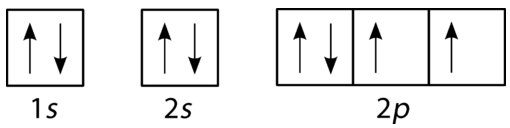
This orbital diagram represents:  
a)
C
b)
B
c)
N
d)
O
154.
This orbital diagram represents:  
a)
C
b)
B
c)
N
d)
O
155.
What is incorrect about this orbital diagram?
a)
Both arrows in the 2p box should be pointing up
b)
There is nothing incorrect with this diagram
c)
In the there should only be 1 orbital in the first 2p box and one in the 2nd 2p box
d)
All the arrows should be pointing up.
156.
Which element is pictured?
a)
neon
b)
fluorine
c)
magnesium
d)
argon
157.
How many electrons can the d sublevel hold?
a)
14
b)
10
c)
2
d)
6
158.
How many electrons can the s sublevel hold?
a)
14
b)
10
c)
2
d)
6
159.
How many electrons can the p sublevel hold?
a)
14
b)
10
c)
2
d)
6
160.
Which element is pictured?
a)
neon
b)
fluorine
c)
magnesium
d)
argon
161.
There are 4 different types of subshells s,p,d,f
a)
true
b)
false
162.
Electrons occupy orbitals of lowest energy first is part of what electron configuration rule?
a)
Hund’s Rule
b)
Aufbau Principle
c)
Pauli Exclusion Principle
163.
According to the octet rule most elements need _______ valence electrons.
a)
2
b)
8
c)
6
d)
18
164.
How many electrons should Oxygen have around its Lewis dot model?
a)
5
b)
6
c)
7
d)
8
165.
This is the correct dot diagram for sodium (Na)
a)
true
b)
false
166.
This is a correct dot diagram for oxygen (O)
a)
true
b)
false
167.
This is a correct dot diagram for magnesium (Mg)
a)
true
b)
false
168.

How many valence electrons should Lithium have in its Lewis dot model?

a)

1

b)

2

c)

3

d)

4

169.

How many valence electrons should Magnesium have in its Lewis dot model?

a)

1

b)

2

c)

3

d)

4

170.

Hydrogen needs _____ electrons in its valence shell to be stable.

a)

4

b)

6

c)

8

d)

2

171.

How many valence electrons do elements in Group 2 have?

a)

12

b)

4

c)

1

d)

2

172.

This could be the dot diagram of

a)

Mg

b)

Cl

c)

C

d)

O

173.

Chlorine needs _____ electrons in its valence shell to be stable.

a)

4

b)

6

c)

8

d)

2

174.

Which of the following shows a correct Lewis dot structure?

a)
b)
c)
d)
175.

Which of these is correct?

a)
b)
c)
176.
This could be the dot diagram of
a)
Be
b)
B
c)
C
d)
Ne
177.
An element with five valence electrons is
a)
phosphorus
b)
oxygen
c)
beryllium
d)
rubidium
178.
This could be the dot diagram of
a)
P
b)
Ar
c)
Na
d)
B
179.
This could be the dot diagram of 
a)
Ne
b)
Si
c)
Al
d)
Be
180.
How many valence electrons does carbon (C) have?
a)
3
b)
4
c)
5
d)
6
181.
Which of these elements has 8 valence electrons?
a)
P
b)
Be
c)
O
d)
Ar
182.
This is a correct dot diagram for oxygen (O)
a)
true
b)
false
183.

What is the charge of an ion in group 17?

a)

+7

b)

-7

c)

+1

d)

-1

184.

What is the charge of an ion in group 15?

a)

+5

b)

-5

c)

+3

d)

-3

185.
What is the charge for an ion in group 1?
a)
+1
b)
-7
c)
-1
d)
+7
186.
Which of these elements has 3 valence electrons?
a)
Al
b)
N
c)
Li
d)
F