wayground logo

Free Printable Worksheets

Font size

S
M
L
XL
Worksheets

Unit 2 Test

Total questions: 50

Worksheet time: 35mins

Name
Class
Date
1.

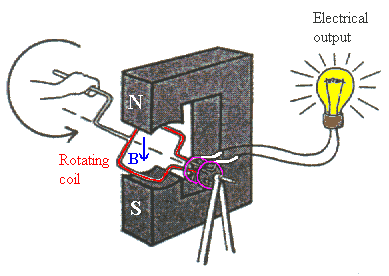
Results between electric currents and magnetic fields interact with each other.

a)

Electromagnetism

b)

Solenoid

c)

Electric Motor

d)

Electromagnetic Induction

2.

What scientist discovered the connection between electricity and magnetism in 1820?

a)

Albert Einstein

b)

Thomas Edison

c)

Nikolai Tesla

d)

Hans Christian Oersted

3.

A coil of wire that acts like a magnet is known as what?

a)

Electromagnet

b)

Motor

c)

Solenoid

d)

Battery

4.

Based on your reading, what are some uses for magnets?

a)

To lift metal object

b)

To start cars

c)

To measure current

d)

To open doors.

5.

What object did Oersted use to explain that current generated a magnetic field?

a)

Copper

b)

Compass

c)

Car

d)

Cooler

6.

A simple motor has a coil or loop called a what?

a)

Battery

b)

Brush

c)

Armature

d)

Commutator

7.

What does an electric motor do with energy?

a)

Converts Mechanical Energy to Electrical Energy

b)

Converts Thermal Energy to Electrical Energy

c)

Converts Solar Energy to Mechanical Energy

d)

Converts Electrical Energy to Mechanical Energy

8.

Transformers use induction to increase or decrease the voltage of alternating current. What are two types of transformers?

a)

Step-Up Transformers

b)

Left-Step Transformers

c)

Step-Down Transformers

d)

Step-Right Transformers

9.

Which of the following things are necessary for a simple motor to work?

a)

Permanent Magnet

b)

Armature

c)

Battery

d)

Brush

e)

Commutator

10.

What does the acronym "LHC" mean?

a)

Large Hadron Collider

b)

Large Huey Coke

c)

Large Heavy Cow

d)

Large Helium Collision

11.
What kind of magnet can be turned on and off? (Man-made magnet)
a)
refrigerator magnet
b)
electromagnet
c)
magnetite
d)
iron
12.
How do like poles interact with each other? (north to north)
a)
They repel each other.
b)
They attract each other.
c)
Throw a toaster into a bathtub.
d)
No relationship.
13.
Choose the best option to complete this gap:
A magnetic field is the ________ around a magnet in which the magnetic force acts.
a)
pole
b)
electron
c)
area
d)
iron
14.
When you put the poles of two magnets together they will either attract or repel each other.  Which of these sentence is correct?
a)
If the two poles are the same the magnets repel each other.
b)
If the two poles are the same the magnets attract each other.
c)
If the two poles are different the magnets repel each other.
15.
What is an electromagnet?
a)
a magnet that creates an electric current
b)
a device that created electricity 
c)
a magnet that creates kinetic energy
d)
a device that creates a magnet
16.
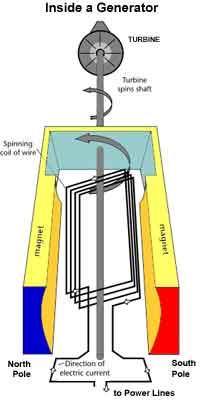
A turbine is used to ________ the magnet in a generator.
a)
rotate
b)
electrify
c)
attract
d)
repel
17.
What is the flow of electricity?
a)
electric motor
b)
Electric current
c)
Electric eel
d)
electric circuit
18.
What is the PATH for electricity called?
a)
electric current
b)
electric circuit
c)
electric eel
d)
electric motor
19.
What is inside a toy car that turns the wheels?
a)
generator
b)
electric motor
c)
electromagnet
20.
A device that converts electrical energy into kinetic energy
a)
A. electromagnet
b)
B. electromagnetic induction
c)
C. electric motor
d)
D. electromagnetism
21.
A device that converts kinetic energy into electrical energy
a)
A. electric generator
b)
B. electric motor
c)
C. electromagnetic induction
d)
D. electricity
22.
A material in which electrons are not able to move easily 
a)
Circuit 
b)
Insulator 
c)
Resistance 
d)
Conductor
23.
An example of an insulator is:
a)
iron
b)
silver
c)
copper wire
d)
rubber
24.
An example of a conductor is :
a)
a glass paperweight
b)
a plastic cap
c)
a metal screw
d)
a wooden handle
25.
What uses induction to increase or decrease the voltage of alternating current?
a)
Galvonometers
b)
Transformers
c)
Armatures 
d)
Generators 
26.
What does attract mean?
a)
to pull apart
b)
to jump
c)
to come together
d)
to shop
27.
Where is the force of attraction the strongest on a magnet?
a)
at the poles
b)
in the middle
c)
above the magnet
d)
below the magnet
28.
In large generators in power plants, ___________ rotate inside a coil of wire to produce an electric current.
a)
Wind
b)
Water
c)
Magnets
d)
Circuits
29.
Generators are devices that convert _____ energy into _____ energy.
a)
chemical; mechanical
b)
mechanical; electrical
c)
electrical; mechanical
d)
potential; kinetic
30.
What energy do you put IN to a generator?
a)
Mechanical
b)
Electrical
c)
Thermal
d)
Potential
31.
What is created when a wire moves between the poles of a magnet?
a)
A. a ferromagnet
b)
B. a solenoid
c)
C. an electromagnet
d)
D. an electric current
32.
A compass needle responds to a magnetic field, because the compass needle is a
a)
A. generator.
b)
B. motor.    
c)
C. magnet.
d)
D. transformer.
33.
A coil of wire with an electric current in it is called a(n)
a)
A. transformer.
b)
B. electric generator.
c)
C. electric motor.
d)
D. solenoid.
34.
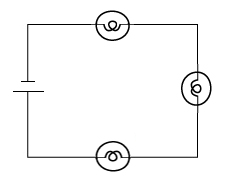
The picture shows an electrical circuit. This circuit is a series circuit because: 
a)
It has 3 light bulbs.
b)
The same current flows through all three light bulbs.
c)
It uses a single battery.
d)
The electrical current is divided between the three light bulbs.
35.
In a parallel circuit if one light bulb goes OUT; then they ALL go out. TRUE OR FALSE?
a)
TRUE
b)
FALSE
36.
When there is only one path for electrons to move through it is called a _____. When one light goes out, they all go out. 
a)
closed circuit
b)
parallel circuit
c)
series circuit
d)
open circuit
37.
This is the symbol for a _____?
a)
switch
b)
light 
c)
battery
d)
wires
38.
What is this symbol for?
a)
light bulb
b)
switch
c)
battery
d)
resistor
39.
Electricity is the flow of _________.
a)
Protons
b)
Neutrons
c)
Electrons
40.
What kind of circuit is this?
a)
Series
b)
Consecutive
c)
Parallel
d)
Training
41.
This instrument can be used to see if materials conduct electricity.  Which of these groups contains items that could all conduct electricity to complete the circuit?
a)
rubber ball, plastic comb, nail
b)
paper clip, penny, screw
c)
cork, dollar bill, tweezers
d)
pencil, eraser, spoon
42.
An object that is positively charged contains all protons and no electrons.
a)
True
b)
False
43.
An object that is negatively charged could contain only electrons with no protons.
a)
True
b)
False
44.
An object that is neutral contains the same number of electrons and protons.
a)
True
b)
False
45.
What would have to happen for an atom to become negatively charged?
a)
Gain protons
b)
Gain electrons
c)
Lose protons
d)
Lose electrons
46.
During a lab a balloon was rubbed with a wooly fabric. This is an example of which type of charging?
a)
conduction
b)
friction
c)
induction
47.
What is The Law of Conservation of Charge?
a)
The strength of the force is determined by the size of the charge.
b)
Electric charge can neither be created nor destroyed
c)
There is an opposite and equal force to all charges
d)
Electric charge is transferred and transformed
48.
the negatively charged particle in an atom. Moves freely. Can be released, shared, or “stolen” from an atom.
a)
proton
b)
neutron
c)
electron
49.
the positively charged particle in an atom. Never leaves the nucleus. Number of protons determines the type of element.
a)
proton
b)
neutron
c)
electron
50.
the neutral particle in an atom. Stays in the nucleus.
a)
proton
b)
neutron
c)
electron