wayground logo

Free Printable Worksheets

Font size

S
M
L
XL
Worksheets

Atmosphere Summative test

Total questions: 81

Worksheet time: 47mins

Name
Class
Date
1.

Layer of gases that surround the earth.

a)

Oxygen

b)

Atmosphere

c)

Ozone

d)

Carbon dioxide

2.

Atmosphere supports life on Earth by protecting it from dangerous

a)

gases

b)

uv rays

c)

electromagnetic radiation

d)

aliens

3.

Atmosphere creates and controls weather

a)

True

b)

False

4.

What gas makes up the majority of our atmosphere?

a)

Argon

b)

Carbon Dioxide

c)

Oxygen

d)

Nitrogen

5.

Nitrogen makes up what percentage of our atmosphere

a)

78%

b)

87%

c)

21%

d)

.17%

6.

Trace gases make up what percentage of the atmosphere?

a)

78%

b)

.17%

c)

21%

d)

.9%

7.

Oxygen makes up what percentage of our atmosphere?

a)

78%

b)

.17%

c)

21%

d)

.03%

8.

Nitrogen can be removed from the atmosphere by

a)

the sun

b)

bacteria

c)

wind

d)

rain

9.

Name the 4 layers of the atmosphere from bottom to top.

a)

Troposphere, Exosphere, Mesosphere, Stratosphere

b)

Troposphere, Mesosphere, Stratosphere, Thermosphere

c)

Troposphere, Stratosphere, Mesosphere, Ionosphere

d)

Troposphere, Stratosphere, Mesosphere, Thermosphere

10.

Which gas is released into the atmosphere by plants as they photosynthesize?

a)

Oxygen

b)

Argon

c)

Carbon Dioxide

d)

Nitrogen

11.

Which gas is removed from the atmosphere by green plants?

a)

Oxygen

b)

Argon

c)

Carbon Dioxide

d)

Nitrogen

12.

Atmospheric pressure_____________ with ___________altitude

a)

Decreases with increased

b)

Increases with decreased

c)

Decreases with decreased

d)

Increases with increased

13.

What is the weight of one square inch column of the atmosphere?

a)

17.4 lb/in2

b)

14.7 lb/in2

c)

19.7 lb/in2

d)

13.4 lb/in2

14.

The density of our atmosphere _____________________ with an increase in altitude

a)

Increases

b)

Gets greater

c)

Decreases

d)

Gets heavier

15.

Which layer protects the earth from meteoroids?

a)

Troposphere

b)

Stratosphere

c)

Mesosphere

d)

Thermosphere

16.

Which layer is the coldest?

a)

Troposphere

b)

Stratosphere

c)

Mesosphere

d)

Thermosphere

17.

The ozone layer is found in this atmosphere layer

a)

Troposphere

b)

Stratosphere

c)

Mesosphere

d)

Thermosphere

18.

This layer is the "heat sphere"

a)

Troposphere

b)

Stratosphere

c)

Mesosphere

d)

Thermosphere

19.

Most weather occurs in this layer.

a)

Troposphere

b)

Stratosphere

c)

Mesosphere

d)

Thermosphere

20.

Space shuttle orbits in this layer.

a)

Troposphere

b)

Stratosphere

c)

Mesosphere

d)

Thermosphere

21.

The Earth's magnetic field traps harmful particles from the sun concentrating them into belts of radiation called____________________________

a)

Ionosphere

b)

Exosphere

c)

Ozoneosphere

d)

Van Allen

22.

Atmospheric pressure can be measured with a

a)

psychrometer

b)

anemometer

c)

barometer

d)

thermometer

23.

How much solar radiation is absorbed by Earth's surface?

a)

20%

b)

30%

c)

49%

d)

5%

24.

Most atmospheric air mass is found in this layer.

a)

Troposphere

b)

Stratosphere

c)

Mesosphere

d)

Thermosphere

25.

This is caused by the unequal heating of the Earth's surface.

a)

Rain

b)

Increased temperatures

c)

Wind

d)

temperature variations

26.

Temperature at which water begins to accumulate on surfaces.

a)

Humidity

b)

Dew point

c)

barometric pressure

d)

water vapor

27.

Clouds are formed by

a)

sublimation

b)

evaporation

c)

condensation

d)

precipitation

28.

Differences in ____________________________ seperate each atmospheric layer from the one above it.

a)

Temperature

b)

air composition

c)

altitude

d)

objects located in each layer

29.

Radio waves bounce off of these and reflect back to Earth.

a)

atoms

b)

protons

c)

neutrons

d)

ions

30.

Satellites orbit the Earth here.

a)

Troposphere

b)

Ionosphere

c)

Exosphere

d)

Ionosphere

31.

What absorbs solar radiation and releases it as heat?

a)

UV rays

b)

Ozone

c)

Oxygen

d)

Exosphere

32.

Very calm layer that allows for undisturbed flight.

a)

Troposphere

b)

Stratosphere

c)

Mesosphere

d)

Thermosphere

33.

This is the lower part of the Thermosphere

a)

Exosphere

b)

Stratosphere

c)

Ionosphere

d)

Mesosphere

34.

The aurora Borealis can be found in this layer.

a)

Troposphere

b)

Stratosphere

c)

Mesosphere

d)

Thermosphere

35.

Water Vapor moves through __________________cycle

a)

Carbon

b)

Water

c)

Solar

d)

Lunar

36.

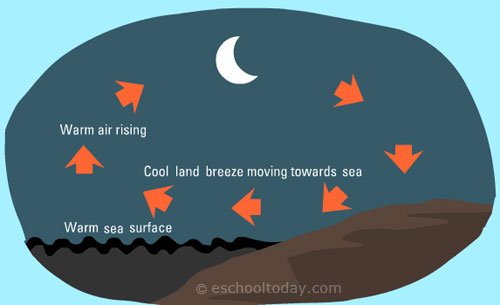
What type of breeze is being displayed in the picture?

a)

Land Breeze

b)

Sea Breeze

c)

Breeze

d)

Warm breeze

37.

This percentage of solar radiation is absorbed by the atmosphere and clouds.

a)

40%

b)

6%

c)

20%

d)

10%

38.

What Boundary is located between the Troposhere and Stratosphere?

a)

Mesopause

b)

Tropopause

c)

Stratopause

d)

Weather Balloons

39.

Low pressure can be associated with _____________________temeratures.

a)

Cooler

b)

Warmer

40.

High pressure can be associated with __________________ temperatures

a)

warmer

b)

cooler

41.
The air in the troposphere has a greater density than the air in any other layer of the atmosphere,
a)
True
b)
False
42.
In which layer of the atmosphere does weather occur?
a)
Mesosphere
b)
Thermosphere
c)
Stratosphere
d)
Troposphere
43.
What is the lowest main layer of Earth's atmosphere?
a)
Thermosphere
b)
Troposphere
c)
Stratosphere
d)
Mesosphere
44.
What is the second lowest main layer of Earth's atmosphere?
a)
Thermosphere
b)
Troposphere
c)
Stratosphere
d)
Mesosphere
45.
What are the 2 most abundant gases in Earth's atmosphere?
a)
carbon dioxide and oxygen
b)
carbon dioxide and nitrogen
c)
nitrogen and oxygen
d)
nitrogen and hydrogen 
46.
Describe how the ozone layer protects the earth.
a)
Absorbs solar radiation, Protects Earth from UV Rays,  and emits heat
b)
Ozone in the lower atmosphere is a pollutant
47.
Which layer has the hottest molecules?
a)
Thermosphere
b)
Mesosphere
c)
Exosphere
d)
Stratosphere
48.
Which layer contains the ionosphere, a layer of charged particles, that interact with solar winds to cause the auroras?
a)
Exosphere
b)
Stratosphere
c)
Thermosphere
d)
Mesosphere
49.
Where is the temperature the highest?
a)
1
b)
2
c)
3
d)
4
50.
Where is the air pressure the greatest?
a)
1
b)
2
c)
3
d)
4
51.
James plans to climb to the top of Mount Everest.  Which of the following statements about his climb will be the most accurate?
a)
Air pressure will rise and the temperature on a thermometer will increase.
b)
Air pressure will fall and the temperature on a thermometer will decrease.
c)
Air pressure will rise and the temperature on a thermometer will decrease.
d)
Air pressure and thermometer will not change.
52.
Which of the following is NOT a reason why the atmosphere is important?
a)
It is made of many layers.
b)
It provides gases living things need.
c)
It provides warm temperatures.
d)
It protects us from UV rays and meteors.
53.
Planes fly in this layer to get out of the weather.
a)
stratosphere
b)
mesosphere
c)
exosphere
d)
thermosphere
54.
Which layer exits into space?
a)
exosphere
b)
thermosphere
c)
troposphere
d)
mesosphere
55.
What causes the temperature to increase in the stratosphere?
a)
Nitrogen
b)
Ozone
c)
Water Vapor
d)
carbon dioxide
56.
What is O3?
a)
Oxygen
b)
Ozone
c)
Oranges
d)
Opposites
57.
What is H2O?
a)
Hydrogen
b)
Water
c)
Happy Oranges
d)
Nitrogen
58.
Which layer of the atmosphere contains the greatest amount of water vapor?
a)
Thermosphere
b)
Troposphere
c)
Mesosphere
d)
Stratosphere
59.
The upper part of the thermosphere is called _________.
a)
Ionosphere
b)
Ozone Layer
c)
Exosphere
d)
Stratosphere
60.
What is the third main layer of Earth's atmosphere?
a)
Thermosphere
b)
Troposphere
c)
Stratosphere
d)
Mesosphere
61.

What is needed for animals and humans to survive?

a)

Oxygen

b)

Carbon Dioxide

c)

Carbon Monoxide

62.
Warm air rises because
a)
It is more dense
b)
It is less dense
63.
According to the graph, What happens to temperature in the stratosphere?
a)
It increases
b)
It decreases
c)
It remains the same
64.
What is happening to temperature from 0 to 10 km in height?
a)
temperature rises as height rises
b)
temperature falls as height rises
c)
the higher you go the warmer it gets
d)
there is no correlation 
65.
The force of a column of air pressing down is called what?
a)
Air Mass
b)
Air Pressure
c)
Air
d)
Heavy
66.
A measure of the amount of water vapor in the air is called what?
a)
Rigidity
b)
Moisture
c)
Humidity
d)
Fog
67.
Do sea breezes typically happen during the day or night?
a)
Day
b)
Night
68.
Do land breezes typically happen during the day or night?
a)
Day
b)
Night
69.
During a land breeze which way does the wind blow?
a)
from the sea to the land
b)
from the land to the sea
70.
During a sea breeze which way does the wind blow?
a)
from the land to the sea
b)
from the sea to the land
71.
Is this a land or a sea breeze?
a)
land breeze
b)
sea breeze
72.
When warm air rises, ______ pressure forms at the surface of the land or sea.
a)
high
b)
some
c)
low
d)
none
73.
Where does the initial source of energy come from that creates winds?
a)
the moon
b)
the sun
c)
the Earth's surface
d)
the rotation of the Earth
74.
Why does warm air rise?
a)
Warm air is more dense than cooler air.
b)
Warm air has more pressure than cooler air.
c)
Warm air is less dense than cooler air.
d)
Warm air has a higher dew point than cooler air.
75.
Why do land breezes occur at night?
a)
Land cools off slower than water, so the air above water is cooler.
b)
Water cools off faster than land, so the air above land is warmer.
c)
Land heats up slower than water, so the air stays cooler during the day.
d)
Water cools off slower than land, so the air above water is warmer.
76.
Which term best describes how the earth's atmosphere is heated?
a)
Spirally
b)
Unevenly
c)
Circularly
d)
Kinetically
77.
In the ___________________________, air is very thin, but still produces friction to cause meteoroids to burn up.
a)
stratosphere
b)
exosphere
c)
thermosphere
d)
mesosphere
78.
Which gas in our atmosphere is most abundant?
a)
Argon
b)
Oxygen
c)
Nitrogen
d)
Carbon Dioxide
79.

what gas do animals exhale?

a)

carbon dioxide

b)

oxygen

c)

nitrogen

d)

methane

80.
How many oxygen atoms does a molecule of ozone contain?
a)
1
b)
2
c)
3
d)
4
81.
This protects us from harmful UV rays from the sun
a)
Troposphere
b)
Stratosphere
c)
Greenhouse Effect
d)
Ozone Layer