
NEW
Font size
S
M
L
XL
 Worksheets
Water Cycle, Ocean Currents, and Wind
Total questions: 39
Worksheet time: 34mins
Name
Class
Date
1.
What causes warm air to rise?
a)
the fact that it's less dense than cold air
b)
The fact that it weighs more than cold air
c)
The fact that it has higher pressure than cold
d)
the fact that its more dense than cold air
2.
What causes wind to blow?
a)
Differences in longitude
b)
Shock waves from clouds
c)
Differences in air temperature and pressure
d)
The rotation of the earth
3.
Which term best describes how the earth's atmosphere is heated?
a)
Spirally
b)
Unevenly
c)
Circularly
d)
Kinetically
4.
What creates the air pressure difference between the equator and the poles?
a)
The length of the seasons
b)
The shape of the earth
c)
the duration of the solar year
d)
The amount of direct sunlight each area receives
5.
When Earth's rotation causes the wind to curve
a)
cloudy
b)
Coriolis effect
c)
high pressure
d)
low pressure
6.
When heat rises cools then sinks
a)
high pressure
b)
convection current
c)
low pressure
d)
stratospheric pressure
7.
Which statement best explains how wind is formed?
a)
Air is warmed by radiation and airflow increases as a result of the warming.
b)
Pressure decreases as a result of frictional contact with earth causing air to flow more freely.
c)
Unequal heating of the land causes air to flow from areas of higher pressure to areas of lower pressure.
8.
Which best describes why wind movement is predictable?
a)
Air moves from areas of low altitude to areas of high altitude.
b)
B. Air moves from areas of high pressure to low pressure.
c)
C. Air moves from areas of low pressure to high pressure.
9.
What causes warm air to rise?
a)
the fact that it's less dense than cold air
b)
The fact that it weighs more than cold air
c)
The fact that it has higher pressure than cold
d)
the fact that its more dense than cold air
10.
Where does the initial source of energy come from that creates winds?
a)
the moon
b)
the sun
c)
the Earth's surface
d)
the rotation of the Earth
11.
The Coriolis effect causes ___________.
a)
the Earth to rotate on its axis
b)
continental deflection
c)
global winds and surface currents to move in a curved path instead of a straight line
d)
global winds and deep ocean currents to move in a curved path instead of a straight line.
12.
When air is heated, it will MOST likely
a)
expand and fall
b)
expand and rise
c)
condense and fall
d)
condense and rise
13.

Cool air has __________ pressure.
a)
low
b)
high
c)
medium
d)
unknown
14.

Temperature differences between the equator and the poles produce giant __________________ in the atmosphere.
a)
clouds
b)
global warming
c)
Greenhouse Effect
d)
convection currents
15.
Warm ocean currents generally come from
a)
The North Pole
b)
The South Pole
c)
The Equator
d)
Both A and B
16.
A horizontal movement of ocean water that is caused by wind and that occurs at or near the ocean's surface.
a)
Gulf Stream
b)
Global Conveyor Belt
c)
Surface Current
d)
Gyre
17.
Deep Ocean currents are a result of
a)
Global Wind Patterns
b)
Earth's Rotation
c)
Density
d)
All of the above
18.
Two types of water currents are
a)
local and global
b)
sea and land
c)
surface and deep
d)
warm and cold
19.
When surface currents meet continents they ___?
a)
Stop moving
b)
Are deflected (change paths)
c)
Continue in the direction they were going
20.
If the Earth did not rotate on its axis, there would be no
a)
Greenhouse effect
b)
Coriolis effect
c)
Global warming
d)
Convection
21.
Where do warm currents get warm?
a)
Antarctica
b)
Equator
22.
Ocean water is more dense than fresh water at the same temperature due to differences in:
a)
Wind patterns
b)
Lifeforms
c)
Currents
d)
Salinity
23.
In general, surface currents that flow from the tropics toward the poles carry ______________ water.
a)
warm
b)
cold
c)
fresh
d)
oxbow lake
24.
What is the water cycle?
a)
the 3 forms of water
b)
the movement of water on, above, or below the surface of the Earth
c)
when water melts
d)
when clouds form
25.

What part of the water cycle does this picture show?
a)
condensation
b)
precipitation
c)
evaporation
26.
Which of these is an example of precipitation?
a)
snow
b)
air
c)
clouds
d)
vapor
27.

What is it called when plants give off water vapor as a waste product?
a)
condensation
b)
evaporation
c)
sublimation
d)
transpiration
28.
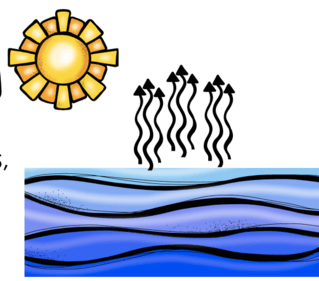
What part of the water cycle does this picture show?
a)
condensation
b)
precipitation
c)
evaporation
29.
Which is the opposite of condensation?
a)
runoff
b)
evaporation
c)
precipitation
d)
transpiration
30.
Snow, sleet, hail, and rain are all examples of ________________.
a)
evaporation
b)
condensation
c)
accumulation
d)
precipitation
31.
When water _________, dew forms.
a)
Melts
b)
Evaporates
c)
Condenses
d)
Precipitates
32.
What is the energy source for the water cycle?
a)
the sun
b)
the earth
c)
water
d)
the moon
33.

When water condenses, the water vapor in the air gets ___________ and changes back into liquid.
a)
cold
b)
hot
c)
warm
d)
solid
34.
When water condenses, the liquid water forms ______________.
a)
water vapor
b)
steam
c)
air
d)
clouds
35.
The first step in the water cycle
a)
evaporation
b)
condensation
c)
precipitation
d)
there is no first step
36.
97% of the Earth's water is located in....
a)
ground wat
b)
the ocean
c)
lakes, rivers, and streams
d)
glaciers
37.
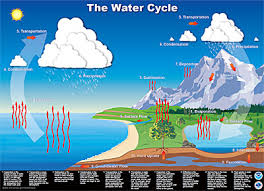
Which stage does ground water try to return to the ocean or soak into the ground?
a)
condensation
b)
evaporation
c)
precipitation
d)
run off
38.

Dew also forms directly onto items, as water droplets. What part of the water cycle is this?
a)
run-off
b)
condensation
c)
evaporation
d)
precipitation
39.
On which kind of day would you expect the most evaporation from the surface of a pond?
a)
sunny and hot
b)
sunny and cold
c)
rainy and hot
d)
rainy and cold
Reset

