
 Worksheets
Unit 3 Honors IPC Electrons and Periodic Table
Total questions: 92
Worksheet time: 2hrs 39mins
The electron configuration of an atom is 1s22s22p6. The number of electrons in the atom is
3
6
8
10
What atom matches this electron configuration?
1s22s22p63s23p64s23d10
Zinc
Copper
Nickel
Germanium
What is the noble gas shorthand electron for Sulfur atom?
[Ar] 3p4
[He] 3s23p4
[Ne] 3s23p4
[Na] 3s23p4
What atom matches this electron configuration?
[Xe] 6s25d9
Mercury
Gold
Platinum
Thallium
What electron configuration matches an oxygen atom?
1s22s22p63s2, 3p64s23d104p5
1s22s22p4
1s22s22p6
1s22s22p63s23p64s23d1
Which of the following has the smallest atomic radius?
K
Na
Li
Cs

How many valence electrons does Si contain? (click to see image)
14
28
2
4
How many electrons can the first energy level hold?
1
2
8
0
An orbital can at most hold how many electrons?
1 electron
2 electrons
3 electrons
4 electrons

What is the highest occupied energy level?
1
2
3
4

What is the highest occupied energy level?
4
5
6
7

Which element is depicted from this orbital diagram
Fluorine
Neon
Chlorine
Argon

Which is associated with more energy?
2p
2s
3p
1s

This orbital diagram represents:
C
B
N
O
How many electrons can an s sublevel hold?
1
2
3
4
How many atomic orbitals are there in the p sublevel?
2
3
4
5
How many atomic orbitals are there in the d sublevel?
3
4
5
6
How many atomic orbitals are there in the f sublevel?
4
5
6
7
Electrons fill energy levels and sublevels of _____ energy first.
lower
higher
Which of the following is a p block element?
Ca
Ar
Re
Au

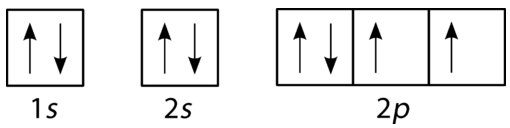


Electronegativity __________ from left to right within a period and __________ from top to bottom within a group.
decreases, increases
increases, increases
increases, decreases
stays the same, increases
Atomic radius generally increases as we move __________.
down a group and from right to left across a period
up a group and from left to right across a period
down a group and from left to right across a period
up a group and from right to left across a period
Vertical columns of elements (these are also known as a "family") - they also have the same number of valence electrons and are known as ________________.
groups
periods
quadrants
rows
Which element would have the same number of energy levels or orbitals as Zinc?
Cadmium
Krypton
Silver
Tin
Rank the following from lowest ioniziation energy to highest ionization energy: C, P, S, As
As, S, P, C
As, C, P, S
P, S, As, C
C, P, S, As
Which has the greatest Electronegativity:
Cl
Al
Br
He
As you move across the periodic table atoms tend to get smaller because, ______________.
the atoms have more mass.
the atoms have less mass
the atoms have more protons and an increased charge
the atoms have less electrons and an increased charge
Electronegativity is...
the ability of an atom to gain an electron
the ability of an atom to lose electrons
the energy required to remove an electron from a specific atom
how easy it is to make friends.
When an electron has its lowest possible energy, the atom is in its _______________
Excited state
transition state
Highest energy state
Ground state
If n = 3, what is the maximum number of electrons that can fit in this shell?
2
8
18
32
Max Planck described packets of energy as
electrons
quanta
ions
protons
An element with the ns2(n-1)d4 configuration would be in what group
16
6
4
unknown
elements with the ns2np2 configuration would be in group
4
2
14
8
The valence electrons for an element with ns2np4 would be
2
4
8
6

The Bohr model depicts
the atom as a small positively charged nucleus surrounded by electrons.
paired and unpaired valence electrons in an atom.
covalent bonds.
valence electrons.
When drawing a Lewis Structure, how do you determine the number of valence electrons?
Atomic Number
Mass Number
Atomic Mass Unit
By the column the element is found
The Lewis Structure is also known as
a Bohr Model.
an electron dot diagram.
valence electron drawings.
a planetary model.

One important difference between Bohr's model and the modern on is that electrons in the modern model are
moving in fixed orbits around the nucleus
moving in an electron cloud
moving in a random motion around the nucleus
not moving

This model added on to previous models by showing electrons existed at certain "energy levels". However it does not accurately show what those levels look like.
The "Bohr Model" of the atom
The "Rutherford Model" of the atom
The "Plumb Pudding Model" of the atom
The "Quantum Mechanical Model" of the atom
Electrons that have not been excited are said to be at:
high level
base line
set state
ground state
Orbital sublevels, or L, represents:
orbital color
orbital shape
electron spin
energy level
With each higher energy level, the electrons are
lower in energy
more stable
weaker
farther from the nucleus
The difference between an orbit and an orbital is:
an orbit is a set path, but an orbital has no dimension
an orbital is a set path, but an orbit cannot be defined
an orbit is a set path, but an orbital is a 3-dimensional region in which electrons may be found with high probability
there is no difference when it comes to electron configurations
Properly pair the l-value is with the orbital shape.
0; f
1; s
3; p
2; d
If l equals 2 then what are the ml values.
-1, 0, 1
2, 1, 0, -1, -2
-2, -1, 0, 1, 2
0, 1, 2, 3
n=3. l=2. ml = -1. ms = +1/2
What electron is this?
3p2
3s1
3d2
3f4
What does the n quantum number represent?
spin
shape
number of orbitals
energy level
Which of the following sub levels correspond to n=3 l=2
2p
3s
3p
3d
3f
In a theoretical g sub-shell which would be next after f, how many electrons would it hold?
20
18
24
36

True or False: The ground state is the highest energy state of an atom.
True
False

The line emission spectrum shown happens when
Electrons transition from lower to higher energy levels.
Electrons transition from higher to lower energy levels.
Electrons exist in fixed energy states.
Atoms emit light when...
electrons move down to lower energy levels
electrons move up to higher energy levels
electrons move in circular orbits around the nucleus
electrons crash into the nucleus
Why do the spectra of individual elements only have certain bands of colors?
they don't have enough electrons
not all of the electrons are changing energy levels
electrons are only allowed to have certain energies
some electrons are moving up levels while some are moving down
Which color has the highest energy?
red
yellow
green
violet


The unknown emissions spectra belongs to the element
Hydrogen
Mercury
Neon
Sodium

The unknown emissions spectra belongs to the element
Hydrogen
Mercury
Neon
Sodium


If an electron moves from n=4 to n=2 it ____
absorbs energy
releases energy

The picture shows an atom in the ground state absorbing energy and the electron jumps to the excited state. Which state has higher energy?
Ground State
Excited State

Each element produces its own pattern of emission spectra lines because each element has its own distinct
Speed of light
Electron configuration
Number of neutrons
None of these

The unknown emissions spectra belongs to the element
Hydrogen
Mercury
Neon
Helium

