Wayground logo

Free Printable Worksheets

Font size

S
M
L
XL
Worksheets

Year 10 Science Exam Revision - Chemistry

Total questions: 38

Worksheet time: 32mins

Name
Class
Date
1.

The atomic number of an elements is the total number of which particles in the nucleus? (It also identifies which element the atom is)

a)

neutrons

b)

protons

c)

electrons

d)

protons and electrons

2.
An atom has 5 protons, 7 neutrons and 5 electrons. What is the mass number of the atom?
a)
5
b)
7
c)
2
d)
12
3.
What is the Atomic Number?
a)
7
b)
6.941
c)
3
d)
6
4.
According to the octet rule most elements need _______ valence electrons.
a)
2
b)
8
c)
6
d)
18
5.
Rows on the period table are called _____ while columns are called _____.
a)
groups, families
b)
groups, periods
c)
periods, groups
d)
families, groups
6.

Which element is in period 3 and group 14?

a)

Silicon

b)

Helium

c)

Mercury

d)

Neon

7.
What is the name of this element?
a)
Helium
b)
Hydrogen
c)
Argon
d)
Silver
8.
What elements generally make an ionic bond?
a)
metal and nonmetal
b)
2 nonmetals
c)
metal
d)
none of the above
9.

This picture most likely depicts the arrangement of atoms in

a)

covalent bonding

b)

Sodium Chloride

c)

metallic bonding

d)

ionic bonding

10.

Which of these is not a characteristic of metals attributed to the bonding and arrangement of atoms?

a)

brittleness

b)

ductility

c)

malleability

d)

electrical conductivity

11.

What characteristic of metallic bonds allows metals to be malleable and ductile?

a)

The tightly held valence electrons in metallic bonds allow the atoms in a metal to move freely.

b)

The strong connection between atoms in metallic bonds allow the bonds to bend without breaking.

c)

The sea of free electrons in metallic bonds allow the atoms to move when stressed without changing the properties of the substance.

d)

The crystal structure of atoms in metallic bonds allows the metal to maintain a constant pattern when force is applied.

12.

Electrons that are free to move in metals are called:

a)

delocalized electrons

b)

lone pairs

c)

bonded electrons

d)

non-valence electrons

13.
Which metal is more reactive than calcium?
a)
magnesium
b)
potassium
c)
silver
d)
aluminum
14.
A displacement reaction will occur when...
a)
a more reactive metal displaces a less reactive metal from its compound.
b)
A less reactive metal displaces a more reactive metal from its compound
c)
Displacement only occurs when two of the same metals are reacted 
d)
Displacement reactions will only occur in metals above iron in the reactivity series
15.

What type of chemical reaction is this?

3Na + AlF3 ----> 3NaF + Al

a)

Acid + Metal Reaction

b)

Decomposition

c)

Displacement Reaction

d)

Double Displacement Reaction

16.
An acid reacts with metal to produce 
a)
Carbon dioxide 
b)
Hydrogen gas
c)
Hydrogen gas and water 
d)
Salt and hydrogen gas 
17.

An acid reacts with a metal oxide to produce

a)

Salt, water and hydrogen gas

b)

Salt, water and carbon dioxide

c)

Limewater

d)

Salt and water

18.

Complete the following reaction:

Hydrochloric acid + sodium carbonate -->

a)

Carbon dioxide + water

b)

sodium chloride + water

c)

Sodium sulfate + water + carbon dioxide

d)

Sodium chloride + water + carbon dioxide

19.
Which ions gain electrons
a)
anions
b)
ions
c)
cations
d)
covalent
20.
Consider the chemical equation CH4 + 2 O2 → CO2 + 2 H2O. In this equation, CH4 is a
a)
product
b)
reactant
c)
displacement
21.

How do covalent bonds form?

a)

Donating & receiving valence e- between atoms.

b)

Opposite slight charges attract each other between compounds.

c)

Scientists are still not sure how they form.

d)

Sharing valence e- between non-metal atoms.
22.
Which of the following is NOT formed by a covalent bond?
a)
K2S
b)
H2O
c)
I2
d)
CO2
23.

Name the hydrocarbon group that has only single carbon-carbon bonds

a)

alkenes

b)

alcohols

c)

alkanes

d)

ethers

24.

Name this compound: C4H10

a)

METHANE

b)

HEXENE

c)

BUTANOIC ACID

d)

BUTANE

25.

What is a saturated hydrocarbon?

a)

A hydrocarbon that contains 46 bonds.

b)

A hydrocarbon that contains only single carbon-carbon bonds

c)

A hydrocarbon that contains double carbon-carbon bonds

d)

A water powered motor

26.
What is an unsaturated hyrocarbon?
a)
A hydrocarbon that contains one or more double or triple bonds
b)
An unhealthy fat molecule
c)
Hydrocarbon that contains only single bonds
d)
A group of organic molecules that includes sugars, starches, and cellulose
27.
What is the IUPAC name of C5H12?
a)
Pentane
b)
Hexane
c)
Butane
d)
Heptane
28.
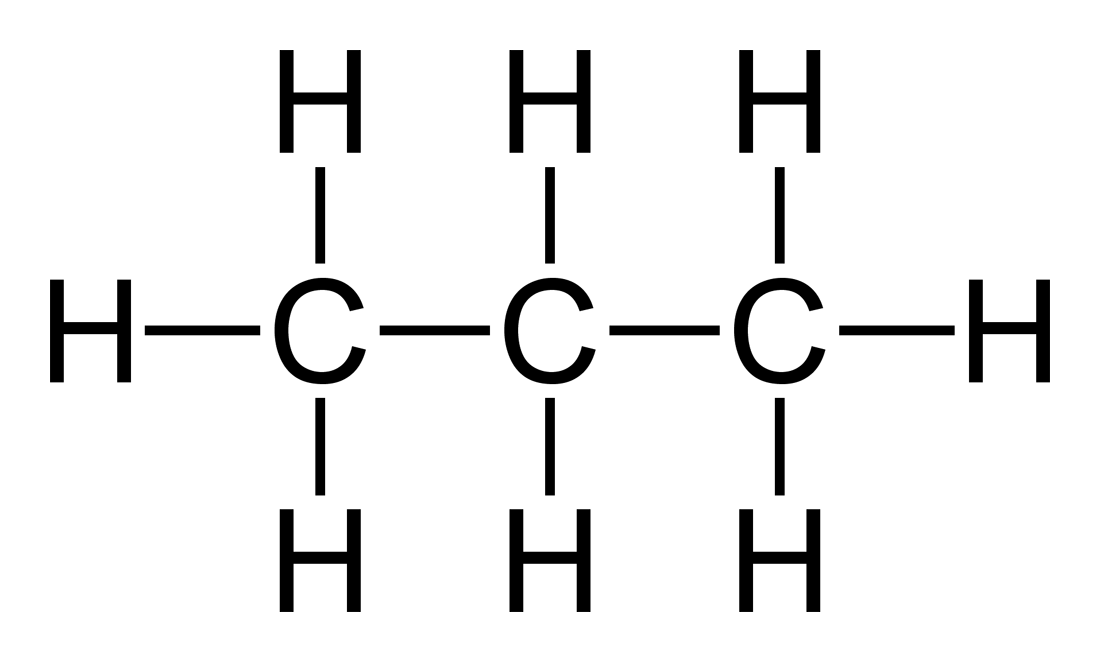
Name this alkane
a)
Methane
b)
Ethane
c)
Propane
d)
Butane
29.
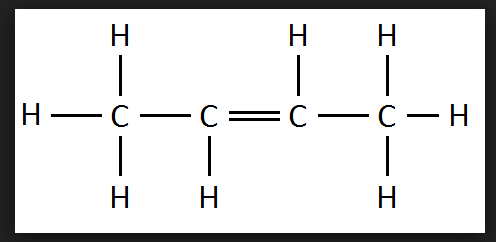
what kind of molecule is this?
a)
alkane
b)
alkene
c)
alkyne
d)
cycloalkane
30.
The molecular formula for Heptane is
a)
C4H10
b)
C8H18
c)
C5H12
d)
C7H16
31.

Macromolecule that is made up of repeated structures called monomers

a)

protein

b)

amino acids

c)

polymer

32.
Formula of ethene is
a)
C2H4
b)
CH3
c)
C4H12
d)
C2H
33.

How many electrons can fit in the first energy level?

a)

2

b)

8

c)

4

d)

16

34.
Which of the following is the correct Lewis dot structure for the molecule fluorine (F2)?
a)
A
b)
B
c)
C
d)
D
35.
What is the correct formula for this molecule?
a)
Si4F
b)
SiF4
c)
SiF
d)
Si4F4
36.

Which of the following is the correct structural formula for CH3Cl? (note, we do not expect you to show the lone pairs in a structural formula)

a)

Option A

b)

Option B

c)

Option C

d)

Option D

37.

Balance this equation.

_C3H8 + _O2 --> _CO2 + _H2O

a)

1,2,1,1

b)

2,1,2,1

c)

1,5,3,4

d)

0,2,0,2

38.
Balance this equation
_Zn+_HCl-->_ZnCl2 +_H2
a)
1,1,2,1
b)
1,1,1,2
c)
1,2,1,1
d)
2,1,1,1