wayground logo

Free Printable Worksheets

NEW

Font size

S
M
L
XL
Worksheets

Changing Nations

Total questions: 50

Worksheet time: 42mins

Name
Class
Date
1.
An increase in the proportion of people living in cities.
a)
Urbanisation.
b)
Citification
c)
population growth
2.
Which of the following factors have contributed to rises in life expectancy?
a)
Improved access to health services, including sanitation.
b)
Improved nutrition.
c)
Improved education
d)
All of the above
3.

the process of social and economic change that takes place as increasing numbers of people move from rural areas (eg farms) to urban areas (eg cities)

a)

urbanisation

b)

urban

c)

push factor

d)

pull factor

4.

a term used to describe an area located outside cities and towns, such as farming or agricultural areas

a)

rural

b)

internal migration

c)

external migration

d)

urban

5.

negative factor that pushes people away from a certain place.

a)

push factor

b)

pull factor

c)

international migration

d)

refugee

6.

positive factor that pulls people to a certain place

a)

pull factor

b)

push factor

c)

internal migration

d)

international migration

7.

the movement of people within a region or country

a)

internal migration

b)

international migration

c)

refugee

d)

population density

8.

the movement of people between countries

a)

international migration

b)

internal migration

c)

temporary migration

d)

permanent migration

9.

the way people are spread over an area (eg. the world)

a)

population distribution

b)

refugee

c)

international migration

d)

urbanisation

10.

The average number of people per square Km

a)

population distribution

b)

population density

c)

urbanization

d)

population rate

11.
More jobs, safety, and freedom are examples of ______________
a)
pull factors
b)
immigration
c)
push factors
d)
net migration
12.

What is urban sprawl?

a)

The sprawl of people from rural areas to urban areas.

b)

The main city centre in an urban area.

c)

The spreading of rural areas into surrounding rural areas to accommodate the need for extra land space due to a rise in ecological footpint.

d)

The spreading of urban areas into surrounding rural areas to accommodate an expanding population.

13.

Basic facilities such as transportation, communications, power supplies and buildings are called;

a)

Services

b)

Infrastructure

c)

Production

d)

Goods

14.
To be a Megacity, the population has to be above
a)
8 million
b)
11 million
c)
15 million
d)
10 million
15.

Which factor influences the low population density in north Africa?

a)

Desert Landscape

b)

High Rainfall

c)

War Areas

d)

Lack of Education

16.

Name a country that has the highest amount of deaths due to air pollution.

a)

Madagascar

b)

Turkey

c)

Indonesia

d)

China

17.

The difference between the population growth in the 30's compared to the 50's is approxmately;

a)

20%

b)

60%

c)

45%

d)

30%

18.

Look at the aerial shot of São Paulo, Brazil. What is this image showing?

a)

Population Distribution

b)

Urban Sprawl

c)

Population Density

d)

Megaregions

19.

The continent with the most growth in megacities will be;

a)

Africa

b)

South America

c)

North America

d)

Asia

20.
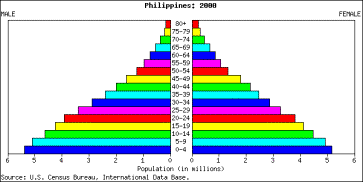
According to the population pyramid of this country, its population is most likely...
a)
growing slowly.
b)
growing rapidly.
c)
decreasing.
d)
not changing.
21.

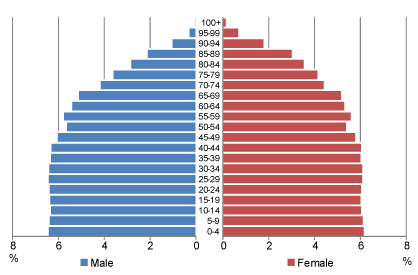
According this population pyramid the population is _______________

a)

growing

b)

getting smaller

c)

staying the same

d)

increasing fast

22.

This pyramid would be typical of a...

a)

developing contry

b)

Industrializing country

c)

Mature Industrial country

d)

Post Industrial country

23.
Which country do you think has the best health care?
a)
1
b)
2
c)
3
24.
Those 0-14 and 65+ are usually classified as?
a)
Dependents
b)
Independents
c)
Working Age
d)
Baby Boomers
25.
Those 15 - 65 are usually classified as?
a)
Dependents
b)
Independents
c)
Facilitators
d)
Baby Boomers
26.

According to this population pyramid, the population is _______________

a)

growing

b)

getting smaller

c)

staying the same

27.
What is a population pyramid?
a)
A type of graph showing the number of males and females in different age groups.
b)
A type of graph showing the number of males in different age groups.
c)
A type of graph showing the number of females  in different age groups.
d)
A type of graph showing the number of males and females in only one age group.
28.
The average number of people living in a square kilometer is called...
a)
urbanization. 
b)
internal migration. 
c)
population density. 
d)
pull factors. 
29.
What kind of growth is this country experiencing?
a)
Exponential Growth
b)
Stable Growth
c)
Declining Growth
30.
Name that population pyramid...
a)
Rapid Growth
b)
Industrialized Country
c)
Declining Growth
d)
Stable Growth
31.
What does an "upside down" population pyramid indicate?
a)
lots of children
b)
lots of middle age people
c)
lots of elderly/older people
d)
lots of teens
32.
a run-down area of a city with inadequate housing and lack of services such as water and sanitation
a)
housing district
b)
slum
c)
historical district
d)
dwelling
33.
reasons for counter-urbanization include
a)
high land prices, pollution, high crime
b)
reinvestment into inner-city areas, gentrification
c)
attractions such as the olympics and new skyscapers
34.
Which is NOT considered a megacity
a)
Hong Kong
b)
Tokyo
c)
Osaka
d)
Shanghai
35.
Which is a negative effect of urban sprawl?
a)
new, affordable homes
b)
more farmland
c)
destruction of habitats
d)
more people pass their geography quiz
36.
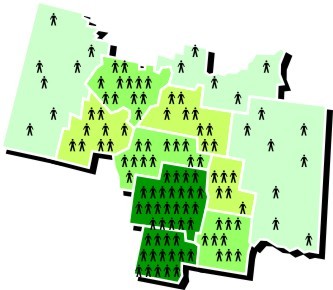
What do the dark spots on this population density map represent?
a)
urban cores
b)
metropolitan areas
c)
Somerset, Wisconsin
d)
public transit systems
37.
Which is a positive effect of urban sprawl?
a)
there are more affordable houses
b)
increased pollution
c)
destruction of habitats
d)
more taco bells (this one's not the right answer, but it is true)
38.

Which of the following is NOT a megacity?

a)

New york

b)

Tokyo

c)

London

d)

Sydney

39.

Declining water and air quality, Carbon emissions and urban sprawl are...

a)

Social consequences

b)

Economic consequences

c)

Environmental consequences

40.

Australia's population is most dense...

a)

On the West coat

b)

On the east coast

c)

In Tropical north Queensland

d)

In the desert

41.

From what point in history did the world's population begin to rapidly increase?

a)

World War 2

b)

Industrial Revolution

c)

French Revolution

d)

the black death

42.

Older housing close to the city centre become socially desirable and are physically upgraded.

a)

Over-urbanisation

b)

Gentrification

c)

Intensification

d)

Ghettoes

43.

Which of the following is not a megacity?

a)

Sao Paulo

b)

Berlin

c)

Mexico City

d)

Manila

44.

What is country number three?

a)

Canada

b)

United States of America

c)

Mexico

d)

Australia

45.

What is country number nine?

a)

Russia

b)

Afghanistan

c)

India

d)

China

46.

What is country number ten?

a)

Russia

b)

Afghanistan

c)

India

d)

China

47.

What is country number sixteen?

a)

Iraq

b)

Canada

c)

Mexico

d)

Brazil

48.
The second S in BOLTSS stands for:
a)
Source
b)
Scale
c)
Sea
d)
Sample
49.
What direction is indicated by the number 7?
a)
northeast
b)
northwest
c)
southeast
d)
southwest
50.
What direction is indicated by the number 2?
a)
north
b)
east
c)
south
d)
west