wayground logo

Free Printable Worksheets

NEW

Font size

S
M
L
XL
Worksheets

Ecology and Population Ecology

Total questions: 74

Worksheet time: 55mins

Name
Class
Date
1.
An organism that produces its own food supply from inorganic compounds is called a(an)
a)
heterotroph
b)
consumer
c)
detritivore
d)
autotroph
2.
What is the original source of almost all energy in most ecosystems?
a)
carbohydrates
b)
sunlight
c)
water
d)
carbon
3.
What is the term for each step in the transfer of energy and matter within a biological community?
a)
energy path
b)
food web
c)
trophic level
d)
food pyramid
4.
What is an heterotroph
a)
An organism that can produce its own form of energy (via the Sun) 
b)
An organism that consumes only plants for energy
c)
Various organisms that consume other organisms for energy
d)
An organism that decomposes other organisms 
5.

What is the major difference between a community and an ecosystem?

a)

A community involves only the biotic, not the abiotic

b)

An ecosystem only includes herbivores and carnivores-- no decomposers

c)

An ecosystem involves the biotic, AND THE abiotic

d)

An ecosystem is just a larger community

6.
What are the major differences between a species and a population
a)
Populations consist of ALL of the individual organisms within a species in a given area/ecosystem that are fertile
b)
Populations are a collection of many different types of species that are not related to each other
c)
Populations are just a larger amount of individuals
d)
Populations are the number of individuals within a species that are identical 
7.
What are the plants in this picture? 
a)
Heterotrophs 
b)
Autotrophs
c)
Carnivores 
d)
Herbivores 
8.
Different populations living and interacting with each other in the same area
a)
Biome
b)
Ecosystem
c)
Community
d)
Niche
9.
Organisms that look similar and can produce fertile offspring
a)
Species
b)
Fish
c)
Community
d)
Trees
10.
The study of how living things interact with one another and with their environment.
a)
Biology
b)
Lithology
c)
Ecology
d)
Farmacology
11.
An area where an organism finds food, shelter and water in a specific arrangement
a)
niche
b)
biosphere
c)
biome
d)
habitat
12.
All of the living and nonliving things in an area that interact with each other are called a/an ______.
a)
community
b)
habitat
c)
population
d)
ecosystem
13.
which symbiosis is this 
a)
parasitism 
b)
mutualism
c)
commensalism
d)
nonalism 
14.
symbiotic relationship in which both organisms benefit
a)
competition
b)
Mutualism
c)
nitrogen fixation
d)
energy pyramid
15.
A living relationship between two species in which one organism is harmed is called...
a)
mutualism
b)
commensalism
c)
parasitism
d)
niche
16.
The amount of energy that usually transfers from one trophic level to the next...
a)
10%
b)
20%
c)
80%
d)
50%
17.
The general name for organisms like animals and fungi that get their energy from eating other organisms.
a)
Producers
b)
Consumers
c)
Detritivores
d)
Carnivores
18.
In this food web, what is the grasshopper?
a)
producer
b)
tertiary consumer
c)
secondary consumer
d)
primary consumer
19.
What is commensalism?
a)
a symbiosis where one species is helped and the other is harmed
b)
a symbiosis where one species is helped and the other is neither helped nor harmed
c)
a symbiosis where both species are helped
d)
a symbiosis between 2 or more organisms
20.
In the energy pyramid here, which organisms have the most energy available?
a)
Producers
b)
Carnivores
c)
Herbivores
d)
Top Predator
21.
An animal that is hunted and eaten for food is a 
a)
predator
b)
prey
22.
An organism's niche is 
a)
the entire role an organism has in the place it lives
b)
the range of temperatures that the organism needs to survive
c)
all the physical and biological factors in the organism's environment
d)
the nutrients that flow from the organism to the environment
23.

What is population density?

a)

number of individuals of a particular species per unit area or volume

b)

growth of a population in which population multiplies by a constant factor at constant time intervals

c)

a condition that can restrict a population's growth

d)

number of organisms in a population that the environment can maintain with no increase or decrease

24.
In this Food Web Pyramid Which type of consumer gets only 10% of the energy stored in plants?
a)
Herbivore
b)
Carnivore
c)
Omnivore
d)
Secondary Consumer
25.
What is the term for each step in the transfer of energy and matter within a biological community?
a)
energy path
b)
food web
c)
trophic level
d)
food pyramid
26.
As you move upward, from level to level, in an energy pyramid, energy _____.
a)
increases
b)
decreases
c)
stays the same
d)
increases exponentially
27.
What factor describes when populations increase because animals are moving into a population?
a)
Emigration
b)
Limiting Factors
c)
Immigration
d)
Exponential Growth
28.
What factor describes when populations decrease because animals are moving out of a population?
a)
Emigration
b)
Limiting Factors
c)
Immigration
d)
Exponential Growth
29.
Logistic growth has 3 phases. In Phase 1, the population grows rapidly. In Phase 2, population grows slowly. In Phase 3, growth stops. What causes growth to stop in the 3rd phase of logistic growth?
a)
Emigration
b)
Immigration
c)
Exponential Growth
d)
Carrying Capacity
30.

Global warming is negatively affecting the polar bear's habitat in the arctic. What do you think will happen to the polar bear's population due to global warming?

a)

The polar bear's population will decrease due to an increase in food supply

b)

The polar bear's population will increase due to an increase in habitat

c)

The polar bear's population will remain the same

d)

The polar bear's population will decrease due to the destruction of their habitat.

31.

Which of the following determines the carrying capacity of an ecosystem?

a)

the most limited resources required for survival

b)

the amount of disease affecting organisms in the ecosystem

c)

the amount of rainfall the habitat receives

d)

the number of predators in the area

32.
What will happen to the population when the death rate is larger than the birth rate?
a)
grow
b)
shrink
c)
stay the same
d)
None of these
33.
Which will add more organisms to a population? 
a)
5 animals die
b)
0 animals are born
c)
3 animals immigrate to the population
d)
2 animals emmigrate from the population
34.
What is the carrying capacity of the following graph?
a)
1000
b)
8000
c)
800
d)
600
35.
Refer to the diagram of the survivorship curve.
Which curve best describes an organism that invests a lot of energy in parenting?
a)
A
b)
B
c)
C
d)
this is not a survivorship curve
36.
Another name for a consumer is a
a)
heterotroph
b)
autotroph
c)
producer
d)
plant
37.

There are 200 monarch butterflies in a lawn measuring 50 square meters. What is the population density?

a)

4 monarch butterflies per square meter

b)

4 monarch butterflies per square kilometer

c)

500 monarch butterflies per square kilometer

38.

Select the best answer that explains the population study method of random sampling

a)

Counting hawks with and without bands on their legs

b)

Counting the number of red maples in a small area or certain quadrants to estimate the number in the entire forest

c)

Counting the number of bird nesting sites in a marked area

39.

Select the best answer that explains the population study method of mark and recapture

a)

Counting hawks with and without bands on their legs

b)

Counting the number of red maples in a small area or certain quadrants to estimate the number in the entire forest

c)

Counting the number of bird nesting sites in a marked area

40.

Select the best answer that defines a limiting factor

a)

a scientist that studies the relationship between organisms and their environments

b)

a scientist that studies living things

c)

Something found in an ecosystem that prevents a population from increasing (i.e. space, food, or water)

41.

What is exponential growth?

a)

a factor that limits a population more as population density increases

b)

growth of a population in which population multiplies by a constant factor at constant time intervals

c)

takes place when two or more species rely on the same limited resource

d)

process of community change resulting from a disturbance

42.

What is primary succession?

a)

change that follows when a disturbance damages an existing community but leaves the soil intact

b)

break down wastes and dead organisms

c)

when a community arises in a lifeless area that has no soil

d)

growth of a population in which population multiplies by a constant factor at constant time intervals

43.

What is secondary succession?

a)

change that follows when a disturbance damages an existing community but leaves the soil intact

b)

when a community arises in a lifeless area that has no soil

c)

organisms that humans move from the species' native locations to new geographic areas, either intentionally or accidentally

d)

convert light energy to the chemical energy of organic compounds

44.

What is a Tertiary consumer

a)

a consumer that eats primary consumers

b)

a consumer that feeds directly on producers

c)

a consumer that eats secondary consumers

d)

the wastes and remains of dead organisms

45.

What is a herbivore?

a)

a consumer that only eats plants

b)

a consumer that only eats meat

c)

a consumer that eats both plants and meat

d)

breaks down dead animals

46.

What is a carnivore

a)

consumer that eats only plants

b)

consumer that eats only meat

c)

consumer that eats both plants and meat

d)

feeding level

47.

what is an energy pyramid?

a)

emphasizes energy loss from one trophic level to the next

b)

represents the biomass in each trophic level in an ecosystem

c)

depicts the number of individual organisms in each trophic level of an ecosystem

d)

the conversion of nitrogen gas to ammonia

48.
In Manhattan, rabbits only grass.  If there is a rapid growth in rabbit population, which of the following scenarios will happen?
a)
The amount of grass will increase, leading to an increase in rabbit population.
b)
The amount of grass will decrease, leading to a decrease in the number of rabbits.
c)
The amount of grass will decrease, leading to an increase in the number of rabbits.
49.
During industrialization in England there was an increase in black smog pollution.  What did this lead to
a)
Increase in the population of black moths and decrease in the population of white moths
b)
Increase in the population of white moths and a decrease in the population of black moths
c)
Increase in the population of black and white moths.
d)
A decrease in the population of white and black moths.
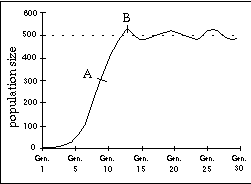
50.
What is the carrying capacity of the graph?
a)
around 500
b)
more than 500
c)
less than 500
d)
around 600
51.
Which of the following is the correct order in a food chain?
a)
Sun --> producer --> herbivores --> carnivores --> scavengers --> carnivores
b)
Producer --> sun --> scavengers --> carnivores
c)
Sun --> consumers --> predators --> parasites --> hosts
d)
Sun --> producer --> herbivores --> carnivores --> scavengers
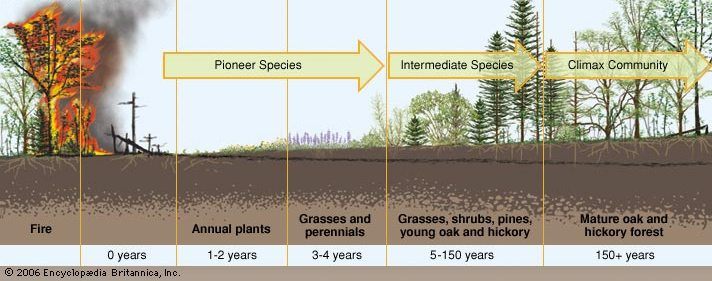
52.
The picture shows what type of succession?
a)
primary
b)
secondary
c)
tertiary
d)
quadanary
53.

If you have a lot of offspring but do not provide parental care you are described as...

a)

K- selected

b)

r- selected

c)

Q- selected

d)

w- Selected

54.
As a population grows, it will most likely stop growing at what size?
a)
Growth limit
b)
Exponential limit
c)
Carrying Capacity
d)
It won't stop growing
55.
Which kind of growth does the human population follow? It is described as a J-shaped curve.
a)
Exponential Growth
b)
Logistic Growth
c)
Outstanding Growth
d)
Minimal Growth
56.
What type of growth is represented behind?
a)
exponential
b)
logistics
c)
a good kind
d)
representative
57.
What is the carrying capacity of the following graph?
a)
1000
b)
8000
c)
800
d)
600
58.
Which kind of dispersion is #1?
a)
clumped
b)
random
c)
uniform
59.

What is Population Density?

a)

All the inhabitants of a particular town, area, or country.

b)

A measurement of population per unit area or unit volume; it is a quantity of type number density.

c)

The number of people, other living organisms, or crops that a region can support without environmental degradation.

d)

factors whose effects on the size or growth of the population vary with the population density.

60.

What is Density-dependent factor?

a)

All the inhabitants of a particular town, area, or country.

b)

A measurement of population per unit area or unit volume; it is a quantity of type number density.

c)

The number of people, other living organisms, or crops that a region can support without environmental degradation.

d)

factors whose effects on the size or growth of the population vary with the population density.

61.

What is Density-independent factor?

a)

Selection occurring when a population is at or near the carrying capacity of the environment. Slow maturation, slow reproduction, slow population growth

b)

a variable that affects a population regardless of the density such as climate

c)

Species that adapt to unstable and unpredictable environment. rapid growth, short life span, and population growth.

62.
Fish dying when the pH goes too high are an example of: 
a)
an abiotic factor limiting an abiotic factor.
b)
an abiotic factor limiting a biotic factor.
c)
a biotic factor limiting an abiotic factor.
d)
a biotic factor limiting a biotic factor.
63.
If the population of a certain predator increases, there is often _______ its prey
a)
a decrease the population of
b)
an increase of the population of 
c)
great news for its prey of
d)
no  impact found on
64.
If a disease destroying barley plants in a field swept through an ecosystem, what would happen to the barley eating bird population in the the field ?
a)
The bird population would stay the same
b)
The bird population would infinitely increase
c)
The bird population would decrease
65.
What would happen if the population of hawks suddenly increased? How would it affect the other organisms in the ecosystem?
a)
The snakes would decrease due to more hawks eating them
b)
All of the population of organisms would increase
c)
The biotic factors in the ecosystem would increase
d)
The hawks predators would decrease
66.

A factor that is more likely to affect crowded population much more than spread out population

a)

Density Dependent Factor

b)

Limiting Factor

c)

Natural Disaster

d)

Density Independent Factor

67.

An example of a density dependent factor

a)

Natural Disaster

b)

Disease

c)

Density Independent Factor

d)

Height of Individuals

68.

Example of a density independent factor

a)

Natural Disaster

b)

Disease

c)

Resource Availability/Competition

d)

Predators

69.

This graph shows the population growth curve for a sparrows in Forsyth County. What is the carrying capacity?

a)

50

b)

200

c)

280

d)

300

70.
What will happen to the population when the death rate is larger than the birth rate?
a)
grow
b)
shrink
c)
stay the same
d)
None of these
71.

As a population of a species increases within a territory, which of the following most likely also increases?

a)

Immigration

b)

Food supply

c)

Carrying capacity

d)

Competition

72.
The major human causes of extinction today are
a)
hunting and destroying habitats.
b)
polluting and introducing non-native species.
c)
Both
d)
Neither
73.
A collection of similar ecosystems
a)
Population
b)
Community
c)
Biome
d)
Ecosystem
74.
The first species to inhabit an area after a disturbance
a)
Pioneer species
b)
Invasive species
c)
Initial Species
d)
Limiting Species