wayground logo

Free Printable Worksheets

Font size

S
M
L
XL
Worksheets

Semester 1 Exam 2022

Total questions: 70

Worksheet time: 48mins

Name
Class
Date
1.

A plant is...

a)

an autotroph

b)

a heterotroph

c)

a primary consumer

d)

a carnivore

2.

A person who eats a chicken that ate grain is a ...

a)

primary producer

b)

primary consumer

c)

secondary consumer

d)

quaternary consumer

3.
In the energy pyramid here, how much of the energy in the producers gets passed to the herbivores?
a)
10%
b)
20%
c)
80%
d)
90%
4.
The diagram represents a pyramid of energy in an ecosystem.  Which level would most likely contain members of the plant kingdom?
a)
A
b)
B
c)
C
d)
D
5.

A species that plays a critical role in the health, maintenance, growth, or definition of an ecosystem.

a)

keystone

b)

invasive

c)

engineer

d)

predator

6.
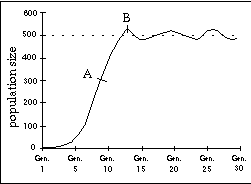
What is the carrying capacity of the graph?
a)
around 500
b)
more than 500
c)
less than 500
d)
around 600
7.
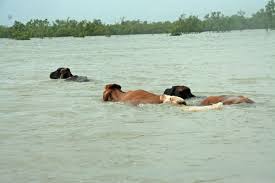
Excessive amounts of rain caused a flood in the southwest United States that resulted in substantial amounts of deaths in the rabbit population? This situation is an example of a density _____________ limiting factor.
a)
density-independent
b)
density-dependent
c)
density- too high
d)
density- too low
8.

Since lynx prey on hares, an increase in the hare population causes an increase in the lynx population.

a)

Density-Dependent: Competition

b)

Density-Independent: Competition

c)

Density-Dependent: Predator-Prey

d)

Density-Independent: Predator-Prey

9.

Adaptations can be:

a)

camouflage

b)

ability to survive cold weather

c)

hunting skills

d)

all of the above

10.

How do you "win" at natural selection?

a)

survive

b)

go extinct

c)

survive & reproduce

11.

What word describes a trait that helps an organism survive in its environment?

a)

natural selection

b)

mutation

c)

camouflage

d)

adaptation

12.

Why are advantageous traits more likely to be passed onto offspring?

a)

Because they are more likely to survive and reproduce.

b)

Because they come from dominant alleles.

c)

Because they come from recessive alleles.

d)

Because the organism knew it needed that trait, survives, and passes it on.

13.

Mutations are a change in what?

a)

DNA

b)

tRNA

c)

protein

d)

rRNA

14.
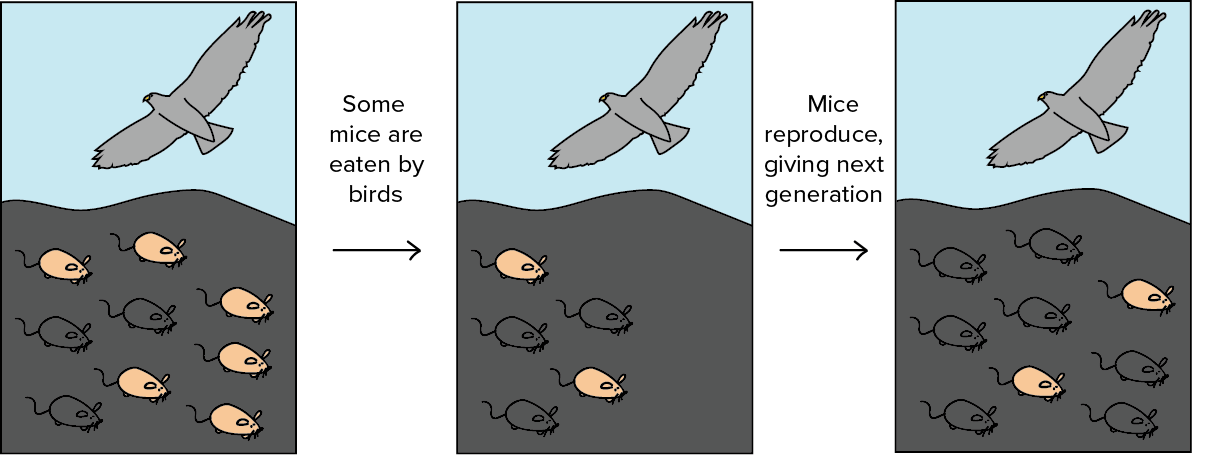
Why is the mouse population changing over time?
a)
The light mice can reproduce more successfully than the dark mice
b)
The hawks eat more dark mice than light mice because the dark mice taste better
c)
The hawks eat more light mice than dark mice because they can see the light mice more easily
d)
The hawks eat more dark mice than light mice because they can see the dark mice more easily
15.
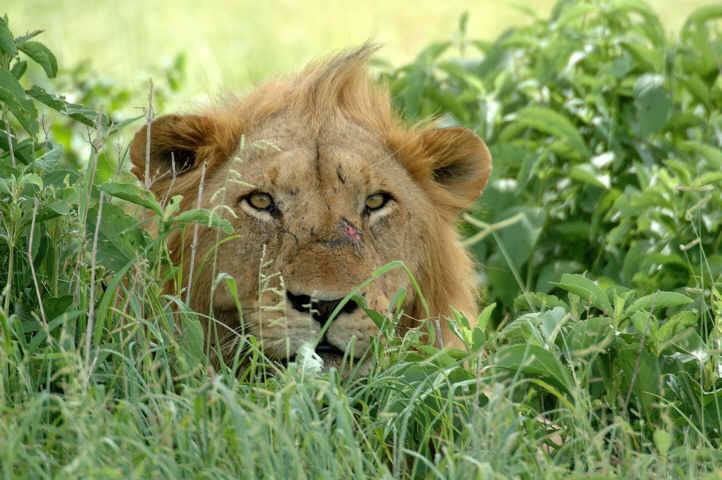
How does the carbon in grass become part of a lion?
a)
The lion eats the grass
b)
Carbon from grass doesn't end up in a lion. 
c)
The carbon ends up in the lion's food chain. 
d)
The lion breathes in carbon given out by the plant
16.

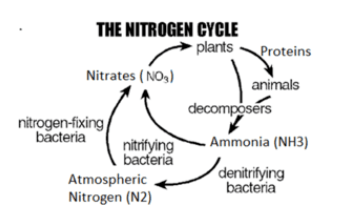
According to this diagram, plants use nitrogen to make _________________________

a)

carbohydrates

b)

cellulose

c)

proteins

d)

unsaturated fats

17.
Homozygous is when...
a)
the alleles are the same
b)
the alleles are different
c)
the alleles are absent
d)
the alleles are present
18.

Why are insertion and deletion (frameshift) mutations so harmful?

a)

They change all of the codons from the mutation on down the line, which changes the amino acid sequence

b)

They insert things that an organism doesn't need.

c)

They often delete things that organisms need.

d)

Insertion and deletions are not any more harmful than substitution mutations.

19.

Which mutation will cause translation to stop?

a)

Mutations 1 and 3 only

b)

Mutation 1 only

c)

Mutation 2 only

d)

Muations 1, 2, 3

20.

In what process is mRNA synthesized?

a)

Transcription

b)

Translation

c)

DNA Replication

d)

Mitosis

21.

How many nucleotides equal 1 amino acid?

a)

1

b)

2

c)

3

d)

4

22.

TRANSCRIBE this DNA sequence: TACGTTACT

a)

AUGCAAUGA

b)

ATGCAATGA

c)

AUGGATUGA

d)

TACGTTACT

23.

When these bond together, they form a protein

a)

Amino Acids

b)

Peptide Bonds

c)

Ribose

d)

Nucleotides

24.
What part of the cell cycle results in the splitting of the new cells?
a)
Interphase
b)
Mitosis
c)
Metaphase
d)
Cytokinesis
25.
What phase is this cell in?
a)
Cytokinesis
b)
Mitosis
c)
Prophase
d)
Metaphase
26.
What phase is this cell in?
a)
Mitosis
b)
Cytokinesis
c)
Prophase
d)
Telophase
27.
What part of the cell cycle is this cell in?
a)
Mitosis
b)
Interphase
c)
Telophase
d)
Cytokinesis
28.
In what phase does chromatin condense to form chromosomes?
a)
Mitosis
b)
Interphase
c)
Prophase
d)
Anaphase
29.
During what phase of the cell cycle is DNA replicated?
a)
G1 phase
b)
S phase
c)
G2 phase
d)
M phase
30.
During what phase of the cell cycle does the cell grow?
a)
G1 phase
b)
S phase
c)
M phase
d)
Cytokinesis
31.
How many daughter cells are produced in mitosis?
a)
1
b)
2
c)
4
d)
6
32.
What is cancer?
a)
The heart does not receive enough blood.
b)
Sudden disruption of blood flow to part of the brain.
c)
Blood filled weak spot.
d)
Uncontrolled growth and spread of abnormal cells.
33.
What is a term for programmed cell death?
a)
apoptosis
b)
necrosis
c)
cell death
d)
doom
34.
In mitosis, the two resulting cells are
a)
different from the starting cell and identical to each other.
b)
different from the starting cell and different from each other.
c)
identical to the starting cell and different from each other.
d)
identical to the starting cell and identical to each other.
35.

Eukaryotic cells spend most of their cell cycle in which phase?

a)

interphase

b)

prophase

c)

metaphase

d)

anaphase

36.

The process by which the cytoplasm of a eukaryotic cell divides to produce two cells is called

a)

mitosis

b)

cytokinesis

c)

binary fission

d)

telophase

37.

Evolution is.....

a)

a quick change in a species

b)

no change in a species

c)

change in a species over time

d)

the interaction of living things and their environment

38.

This is when cells divide so an organism gets bigger.

a)

development

b)

reproduction

c)

growth

d)

evolution

39.

Any factor that restricts the numbers, reproduction, or distribution of a population is (a)

a)

pollutant

b)

limiting factor

c)

primary succession

d)

secondary succession

e)

climax community

40.

The place where an organism lives out its life...

a)

niche

b)

habitat

c)

land

d)

biome

41.

Which would be an abiotic factor for a tree in the forest?

a)

A caterpillar eating its leaves

b)

Wind blowing through its branches

c)

A bird nesting in its branches

d)

Fungus growing on its roots

42.

Which type of heterotroph best describes a snake eating a rat?

a)

Herbivore

b)

Carnivore

c)

Omnivore

d)

Detritivore

43.

Which statement is true about energy in an ecosystem?

a)

Energy for most ecosystems originates from the Sun

b)

Energy most often is released as light from an ecosystem

c)

Energy flows from heterotrophs to autotrophs

d)

Energy levels increase toward the top of the food chain

44.

What does the illustration represent?

a)

A food web

b)

A food chain

c)

An ecological pyramid

d)

A pyramid of energy

45.

Which organism in the illustration is an autotroph?

a)

Frog

b)

Grasshopper

c)

Fox

d)

Grass

46.

Which is a detritivore?

a)

Cat

b)

Mouse

c)

Crayfish

d)

Sunflower

47.
Which organism is a carnivore?
a)
Human
b)
Rabbit
c)
Lion
d)
Opossum 
48.
Carnivores and herbivores are both consumers.   Identify how they are different
a)
Herbivores eat producers and Carnivores eat other consumers
b)
Herbivores eat other consumers and carnivores eat plants
c)
Carnivores eat autotrophs and herbivores eat heterotrophs
d)
There is no difference between carnivores and herbivores.  They are both consumers
49.
The amount of energy that usually transfers from one trophic level to the next...
a)
10%
b)
20%
c)
80%
d)
50%
50.
Water temperature would be an example of ...
a)
A biotic factor
b)
An abiotic factor
51.
Organisms that feed on both living producers and other consumers.
a)
Carnivores
b)
Omnivores
c)
Herbivores
d)
Detritivores
52.
A secondary consumer 
a)
eats primary consumers
b)
eats producers
c)
eats plants
53.
The longest phase of the cell cycle 
a)
prophase
b)
interphase
c)
metaphase
d)
mitosis
54.

Identify the phase of mitosis

a)

prophase

b)

metaphase

c)

anaphase

d)

telophase

55.

Which type(s) of cells replicate frequently?

a)

liver

b)

skin

c)

nerve

d)

bone

56.

Which is Prophase? (These images are not in order)

a)

A

b)

F

c)

C

d)

D

57.

Limiting factors that affect all populations in similar ways, regardless of population size are

a)

tolerant

b)

density dependent

c)

carrying capacity

d)

density independent

58.
Which is NOT a characteristic of all living things?
a)
Sleep
b)
Cells
c)
Reproduction
d)
Grow
59.
As you go to higher trophic levels....
a)
Amount of energy available decreases
b)
Amount of biomass increases
c)
Number of organisms increases
d)
Size of organisms decreases
60.
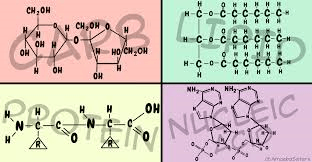
What are the single sugars that are the building blocks of carbohydrates?
a)
monosaccharides
b)
disaccharides
c)
polysaccharides
d)
amino acid
61.
DNA and RNA are examples of 
a)
Carbohydrates
b)
Lipids
c)
Proteins
d)
Nucleic Acids
62.
Waxes, oils and fats are examples of
a)
Carbohydrates
b)
Lipids
c)
Proteins
d)
Nucleic Acids
63.
What elements are common to all 4 biomolecules?
a)
Carbon, hydrogen, nitrogen
b)
Carbon, Nitrogen, Phosphorus
c)
Carbon, Hydrogen, Oxygen
d)
Carbon, Hydrogen, Phosphorus
64.
Building blocks of the body, hair , muscles etc.
a)
protein
b)
nucleic acid
c)
lipids
d)
carbohydrates
65.
Which of the following would provide the most energy in an ecosystem?
a)
Producers
b)
Herbivore
c)
Omnivore
d)
Carnivore
66.
Which of the following is an accurate food chain?
a)
Owl, Grasshopper, Grain
b)
Bird, Fox, Rabbit
c)
Carrot, Rabbit, Fox
d)
Grass, Mice, Bird
67.

Which of the following trophic levels could contain a carnivore?

a)

1st

b)

2nd

c)

3rd

68.
Aa, DD, bB, yy are all examples of
a)
genotypes
b)
phenotypes
69.
Which of these is not part of interphase
a)
G2
b)
G1
c)
M
d)
S
70.
Two foxes try to kill the same rabbit. What type of relationship would this be?
a)
competition
b)
predation
c)
symbiosis
d)
parasitism