
 Worksheets
Quarter 1 Biology Exam Review
Total questions: 70
Worksheet time: 53mins
Name
Class
Date
1.
Which invention from the 17th century allowed for the development of modern cell theory?
a)
x-rays
b)
computers
c)
the light microscope
d)
the scanning electron microscope
2.
Cell theory was first proposed in 1838. Evidence obtained through additional scientific investigations resulted in the current cell theory. Which statement describes a component of the original cell theory that was removed because of the new scientific knowledge?
a)
All living things are made of cells.
b)
All cells come from other preexisting cells.
c)
Cells form through spontaneous generation.
d)
Cells are the basic structural and functional units of life.
3.
Cells are the basic structural and functional units of life.
a)
Plants have cells but animals do not.
b)
They are both made of one or more cells.
c)
They both come from the same kind of cell.
d)
They both come from a non-living organism.
4.
The combined observations of Mattias Schleiden, Theodor Schwann and Rudolph Virchow resulted in the formation of the cell theory. Which of the following is not part of the cell theory?
a)
All cells contain a nucleus.
b)
All cells come from other living cells.
c)
All living organisms are made of one or more cells
d)
Cells are the basic unit of structure and function of all living things.
5.
A plant and an animal are both living things. According to the Cell Theory, what can you conclude about these two very different organisms?
a)
Plants have cells but animals do not.
b)
They are both made of one or more cells.
c)
They both come from the same kind of cell.
d)
They both come from a non-living organism.
6.
Rudolph Virchow's observations helped to disprove was commonly held belief of the time?
a)
evolution
b)
the existence of molecules
c)
spontaneous generation
d)
atomic models
7.
Cell theory states:
a)
All living cells must have a cell wall.
b)
All living cells require glucose for survival.
c)
The basic unit of life is a cell.
d)
All cells contain a nucleus
8.
Which of the following is NOT one of the main components of the cell theory?
a)
cells must contain DNA
b)
all living things are made of cells
c)
cells can only come from other cells
d)
cells are the basic unit of life
9.
Unlike eukaryotes, prokaryotes do not have:
a)
DNA
b)
cytoplasm
c)
cell walls
d)
a membrane bound nucleus
10.
The smallest unit that can perform the basic activities of life is
a)
a cell
b)
a tissue
c)
an organ
d)
an organism
11.

The diagram shows the general structure of an amino acid. Which type of molecule is formed from amino acids?
a)
lipids
b)
proteins
c)
carbohydrates
d)
nucleic acids
12.
You are analyzing a compound in the laboratory. You find that it is made up of carbon, hydrogen, and oxygen in a ratio of two hydrogen atoms for each carbon atom. How will you classify the compound?
a)
lipid
b)
protein
c)
carbohydrate
d)
nucleic acid
13.
Fats, oils and cholesterol are all types of what?
a)
cell membranes
b)
hormones
hormones
hormones
c)
lipids
d)
fatty acids
14.
RNA and DNA are which type of macromolecules?
a)
carbohydrate
b)
lipid
c)
nucleic acid
d)
protein
15.
Many plants have waxy coatings on some surfaces. This coating reduces water loss because it is not water-permeable. This waxy coating is which of the following types of organic molecule?
a)
protein
b)
carbohydrate
c)
nucleic acid
d)
lipid
16.
A sugar, a phosphate group, and a nitrogen base form the building blocks of which organic compound?
a)
carbohydrates
b)
lipids
c)
nucleic acids
d)
proteins
17.
The human body maintains a temperature of around 98.6 degrees at all times. Enzymes are involved in almost every chemical reaction in the body. Which of the following describes the connection between these two statements?
a)
Enzymes function best at a specific temperature.
b)
The body needs to be warm to prevent hypothermia.
c)
The body is kept relatively warm to prevent too much enzyme action.
d)
There is no connection between the two statements.
18.
Like complex carbohydrates, proteins are macromolecules that serve many functions and can be chemically broken down and restructured. Both proteins and complex carbohydrates are which of the following?
a)
polymers of smaller subunits
b)
sequence of sugars
c)
lipids of large molecules
d)
nucleotides of DNA
19.
In living organisms, lipids function mainly as:
a)
Sources of stored energy and transmitters of genetic information
b)
Sources of stored energy and components of cellular membranes
c)
Transmitters of genetic information and catalysts of chemical reactions
d)
Catalysts of chemical reactions and components of cellular membranes
20.

What is the function of macromolecule subunit below?
a)
energy
b)
catalyst
c)
stores genetic information
d)
composes the majority of the cell membrane
21.
Water is essential for life. Its special properties make water the single most important molecule in plant life. Which of the following properties of water enables it to move from the roots to the leaves of plants?
a)
Water expands as it freezes.
b)
Water is an excellent solvent.
c)
Water exhibits cohesive behavior.
d)
Water is able to moderate temperature.
22.
Large bodies of water, such as lakes and oceans, do not quickly fluctuate in temperature. What is the reason for this phenomenon?
a)
Water is an acid.
b)
Water is a versatile solvent.
c)
Water has a high heat capacity.
d)
Water acts as a buffer.
23.
Why does ice stay at the top of oceans instead of sinking to the bottom?
a)
Ice is colder than liquid water.
b)
Ice is less dense than liquid water.
c)
Ice is more dense than liquid water.
d)
Ice is warmer than liquid water.
24.
Water is often called the "universal solvent" because many substances can be dissolved in water. What property of water allows it to be such a versatile solvent?
a)
purity
b)
polarity and cohesion
c)
high heat capacity
d)
expansion upon freezing
25.

Small insects can walk across the surface of calm water. Their feet push the surface of the water down slightly, somewhat like a person walking across a trampoline, but they do not break the surface. What is the best explanation for why this happens?
a)
The insects are light enough so that they do not break the hydrogen bonds holding the water molecules together
b)
The insects actually use their wings to hover slightly above the water's surface and they only skim it with their feet
c)
The insects' feet are non-polar, so they are repelled by the polar water molecules and are pushed away from the water's surface
d)
The insects are small enough to see the individual water molecules, so they are able to step carefully from one molecule to the next
26.
A florist places a bouquet of white carnations in water containing blue dye. After a time, the flowers turn blue. What process helped the carnations to change color?
a)
Specific heat
b)
Surface tension
c)
Cohesion and adhesion of water molecules
d)
Formation of covalent bonds between hydrogen and oxygen molecules
27.
Water makes up approximately 60% of the human body and plays a vital role in regulating body temperature. Which property of water makes it good at regulating temperature?
a)
Water is a good solvent.
b)
Water exhibits strong cohesion.
c)
. Water has an unusual crystalline structure.
d)
Water has a high capacity for heat.
28.
Water has a much higher specific heat than most other covalent compounds. What do you predict might happen if water had a low specific heat instead?
a)
Flooding would occur and animals would be forced to migrate
b)
Harmful organisms living in water would reproduce at a rapid rate
c)
Organisms that are sensitive to changes in temperature would die
d)
Plants would not have enough water to effectively carry out photosynthesis
29.
Many fish and aquatic plants can survive a cold winter because the layer of ice that forms at the top of the lake insulates the water below and prevents the lake from freezing solid. What unique property of water contributes to this effect?
a)
Water absorbs heat when it evaporates and forms a gas
b)
Water expands and becomes less dense when it freezes.
c)
Water molecules completely separate into ions in solutions.
d)
Water forms hydrogen bonds with ions and other polar substances.
30.
Which of the following characteristics of water is not a result of hydrogen bonding?
a)
adhesive strength
b)
capillarity
c)
cohesive strength
d)
All of the above are a result of hydrogen bonding.
31.

Many of the proteins in the human body are enzymes that catalyze chemical reactions. What is the relationship between enzymes and activation energy?
a)
chymotrypsin
b)
pepsin
c)
cholinesterase
d)
papain
32.
Some bacteria live in hot springs. Their cells contain enzymes that function best at temperatures of 70 °C or higher. At the temperature of 50 °C, how will the enzymes in these bacterial cells most likely be affected?
a)
The enzymes will be destroyed by lysosomes
b)
The enzymes will lose their bond structure and fall apart.
c)
The enzymes will require less energy to function than at 70 °C.
d)
The enzymes will not increase the rate of reactions as much as they would at 70 °C.
33.
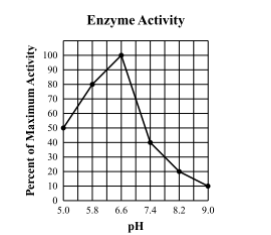
The graph below shows how the activity of an enzyme changes over a range of pH values. Which of the following conclusions can be drawn from this graph?
a)
The optimum pH of the enzyme is 6.6.
b)
The optimum pH of the enzyme is 5.8
c)
The enzyme’s activity continually increases as pH increases from 5.0 to 9.0
d)
The enzyme’s activity is greater around pH of 8.0 than around pH of 5.0.
34.
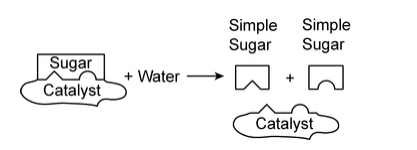
The diagram below illustrates a biochemical process that occurs in organisms. What is another name for the substance labeled "catalyst"?
a)
Enzyme
b)
inorganic compound
c)
Hormone
d)
Antibody
35.
Which of the following best explains why enzymes are necessary for many cellular reactions?
a)
Enzymes supply the oxygen necessary for the reactions
b)
Enzymes change reactants from solid to liquids during the reactions.
c)
The reactions take up too much space in the cell if the enzymes are missing.
d)
The reactions are too slow to meet the needs of the cell if enzymes are missing.
36.
What will most likely happen if an appropriate enzyme is added to a chemical reaction?
a)
The reaction rate will increase.
b)
The equilibrium of the reaction will be maintained.
c)
The reaction rate will decrease.
d)
The reaction will stop.
37.
The human body maintains a temperature of around 98.6 degrees at all times. Enzymes are involved in almost every chemical reaction in the body. Which of the following describes the connection between these two statements?
a)
Enzymes function best at a specific temperature.
b)
The body needs to be warm to prevent hypothermia.
c)
The body is kept relatively warm to prevent too much enzyme action.
d)
There is no connection between the two statements.
38.
The enzyme lactase will break down the sugar lactose into which of the following components?
a)
monosaccharides
b)
nucleic acids
c)
amino acids
d)
phospholipids
39.
As food travels through the digestive system, it is exposed to a variety of pH levels. The stomach has a pH of 2 due to the presence of hydrochloride acid (HCl), and the small intestine has a pH ranging from 7 to 9. HCl converts pepsinogen into pepsin, an enzyme that digests proteins in the stomach. Which of the following most likely happens to pepsin as it enters the small intestine?
a)
It becomes inactive.
b)
It begins to replicate.
c)
It's shape changes to engulf large proteins.
d)
It's activity increases to digest more proteins.
40.

The activity of which enzyme decreases in both acidic and basic environments?
a)
chymotrypsin
b)
pepsin
c)
cholinesterase
d)
papain
41.
There are some similarities between prokaryotic and eukaryotic cells. Which of the following structures is found in both prokaryotic and eukaryotic cells?
a)
lysosome
b)
mitochondrion
c)
nucleus
d)
ribosome
42.
Which type(s) of cells have genetic material that is contained in a nucleus?
a)
bacteria
b)
only animal cells
c)
protists
d)
both plant and animal cells
43.
Which characteristic do most plants have in common?
a)
they are unicellular
b)
they are prokaryotic
c)
they produce seeds
d)
they are autotrophic
44.
Which cell structure is correctly paired with its primary function?
a)
ribosome-protein synthesis
b)
mitochondrion-movement
c)
vacuole-cell division
d)
nucelus-storage of nutrients
45.

The diagram below represents a cell of a green plant. Solar energy is used to produce energy-rich compounds in which structure?
a)
A
b)
B
c)
C
d)
D
46.

The diagram below represents a cell. Which organelle is the site where amino acids are synthesized into proteins?
a)
1
b)
2
c)
3
d)
4
47.

Which of these best completes this concept map?
a)
an animal cell
b)
a prokaryotic cell
c)
a virus
d)
a plant cell
48.
Cells can be classified into two different categories: prokaryotic and eukaryotic. Which of the following information is needed in order to determine if an organism is prokaryotic?
a)
The organism’s color and mass.
b)
The organism’s internal structures.
c)
. If the organism is unicellular or multicellular
d)
The methods the organism uses to feed and move.
49.

Look at the cell membrane model below: What is the name of the macromolecule that makes up the majority of the cell membrane?
a)
nucleotide
b)
lipid
c)
carbohydrate
d)
protein
50.
A specific type of cell is being studied by a scientist. She notices the cell contains a nucleus, lysosomes, a cell membrane and cell wall. What is the correct classification of this cell?
a)
A prokaryotic animal cell
b)
A prokaryotic plant cell
c)
A eukaryotic animal cell
d)
A eukaryotic plant cell
51.
Cells need to bring in molecules to carry out cellular processes. Often, this requires moving the molecules across the cell membrane against the concentration gradient. How do these molecules get into the cell?
a)
passive transport by diffusion
b)
active transport using ATP
c)
passive transport by osmosis
d)
osmosis
52.
A person with swollen gums rinses his mouth with warm salt water, and the swelling decreases. Which of the following has occurred?
a)
The swollen gums have absorbed the saltwater solution.
b)
The saltwater solution lowers the temperature of the water in the gums.
c)
The salt in the solution has moved against the concentration gradient.
d)
The water in the gums has moved out due to the high concentration of salt in the solution.
53.
The cell membrane of the red blood cell will allow water, oxygen, and carbon dioxide to pass through. Because other substances are blocked from entering, this membrane is called
a)
perforated
b)
semi-permeable
c)
non-conducive
d)
permeable
54.

Look at the diagram of a cross-section of a cell membrane below. The cell membrane controls movement of materials into and out of the cell. The following particles are moving from high concentration to low concentration and are using a carrier protein. How would you describe this type of movement across the membrane?
a)
simple osmosis
b)
active transport
c)
simple diffusion
d)
facilitated diffusion
55.

Look at the cross section of a cell membrane of a eukaryotic cell. H+ ions are being pumped from a low concentration to a high concentration. How do you describe this type of transport across the cell membrane?
a)
active transport
b)
passive transport
c)
facilitated diffusion
d)
co-transport
56.
In pure water, a red blood cell from an animal will swell and burst, but a leaf cell from a plant will not. Which structure in the leaf cell is responsible for this difference?
a)
cell membrane
b)
cell wall
c)
mitochondrion
d)
nucleus
57.

The diagram below represents a cell and some molecules in its environment. Which molecule would require the use of energy in order to be brought into the cell?
a)
1
b)
2
c)
3
d)
4
58.
Which activity can occur without the use of energy?
a)
contraction of muscle tissue
b)
protein synthesis in a cell
c)
active transport of minerals
d)
movement of water across a membrane
59.
The diffusion of water across a selectively permeable membrane is called
a)
active transport
b)
facilitated diffusion
c)
osmosis
d)
phagocytosis
60.
During diffusion molecules tend to move
a)
up the concentration gradient
b)
from an area of lower concentration to an area of higher concentration
c)
in a direction that doesn’t depend on concentration
d)
down the concentration gradient
61.

A scientist performs an experiment to see if acids have an effect on the health of a particular type of plant. Three sets of plants were treated with acidic solutions of known pH while the control set was treated with a solution of neutral pH 7.Which is the best conclusion for this experiment?
a)
Acid has no effect on the health of this type of plant.
b)
B. High acidity is helpful to this type of plant.
c)
C. Low acidity is harmful to this type of plant.
d)
High acidity is harmful to this type of plant.
62.

The graph below shows atmospheric carbon dioxide levels since the year 1880.Which of the following conclusions can be drawn from this graph
a)
Atmospheric carbon dioxide levels are responsible for global temperature change.
b)
Atmospheric carbon dioxide levels have been rising at about the same rate for the past century.
c)
Atmospheric carbon dioxide levels have remained the same over the past century.
d)
Atmospheric carbon dioxide levels have been rising at an increasingly higher rate as the past century has progressed.
63.

A research group has discovered that damselflies, a type of dragonfly, are being infected by a particular type of aquatic protozoan. Both young and adult damselflies are not directly infected by the protozoan but contract the infection from the prey they eat. The graph shows the percentage of adult damselflies infected by protozoans during the summer and early fal
a)
Infection in embanked ponds increased during the sampling period.
b)
Protozoans were more common in creek-fed ponds than embanked ponds.
c)
Protozoans reproduce more quickly in embanked ponds than creek-fed ponds.
d)
Infection in creed-fed ponds remained constant throughout the sampling period.
64.
Carmen conducted an experiment to determine if listening to different types of music would affect a person’s pulse. Her hypothesis was that pulse rate would change with different types of music. Each person listened to seven different selections of music for 30 seconds each. Each person’s pulse was taken before the music and then after each 30-second interval of music. The pulses were taken again after the music selections were completed. Based on her experiment, Carmen concluded that a person’s pulse rate changed when the person listened to different types of music. Which component is missing from Carmen’s experiment?
a)
a question
b)
a hypothesis
c)
a control group
d)
a description of the experiment
65.

An osmosis investigation was conducted using chicken eggs to represent cells with semipermeable membranes. The mass of each egg was measured to determine how much water diffused into or out of the eggs. The eggs were first soaked in vinegar to dissolve the shell. Each egg was then placed in one of three different solutions for 24 hours. The table below shows the results of the investigation. Based on this experiment, which of the following should be inferred about cells with semipermeable membranes?
a)
Substances other than water may also cross the cell membrane.
b)
Substances other than water may block pores in the cell membrane.
c)
Water enters the cell when placed in environments of high water concentration.
d)
Water leaves the cell when placed in environments with a low concentration of solutes
66.
In order to be accepted, a scientific theory must be
a)
widely tested and supported by extensive data
b)
based on the results of a single experiment
c)
controversial and cause debate
d)
in line with all previous historical ideas
67.
In an appropriately designed experiment, a scientist is able to test the effect of
a)
a single variable
b)
multiple variables
c)
the hypothesis
d)
scientific observations
68.
Which statement best expresses a basic scientific assumption?
a)
Interpretation of experimental results has provided explanations for all natural phenomena.
b)
If a conclusion is valid, similar investigations by other scientists should result in the same conclusion.
c)
For any conclusion to be valid, the design of the experiment requires that only two groups be compared.
d)
After a scientist formulates a conclusion based on an experiment, no further investigation is necessary.
69.
Conclusions based on an experiment are most likely to be accepted when
a)
they are consistent with experimental data and observations
b)
they are derived from investigations having many experimental variables
c)
scientists agree that only one hypothesis has been tested
d)
hypotheses are based on one experimental design
70.
An experiment was carried out to determine whether drinking caffeinated soda increases pulse rate. The pulse rates of two groups of people at rest were measured. Group A was then given caffeinated soda and group B was given caffeine-free soda. One hour after drinking the soda, the pulse rates were measured. The participants in the experiment were all the same age, and they were all given the same amount of soda. The dependent variable in this experiment is the
a)
type of soda given to each group
b)
amount of soda given to each group
c)
pulse rate of each group
d)
age of participants in each group
100 %

