
 Worksheets
Science 8 Unit A Sec 3.0
Total questions: 71
Worksheet time: 1hrs 17mins
What is pressure?
Somebody convincing you to jump into a pool.
How deep a well is.
Amount of force applied to a given area.
Amount of water in a cup of water.
Force is measure in Newtons.
True
False
Hydraulic systems use natural gas as an enclosed fluid.
True
False
Pneumatic means it uses:
Wood
Gasoline
Air
Water
To find the pressure on an object you need to calculate:
pressure = F/A
pressure = A/F
pressure = F x A
pressure = A x F
A pneumatic system would be found in a dentist drill, air brakes of a big truck, jake hammer and paint sprayers.
True
False
If there is a leak in a hydraulic or pneumatic system, the pressure will increase.
True
False
If a hydraulic system has 1000 N applied to the input piston and has an area of 81 cm2, what is the pressure?
12.35 Pa
12,346 Pa
1235 Pa
123,457 Pa
The viscosity of liquids can be compared by observing their ...
clarity
volume
resistance to flow
resistance to acceleration
In order to increase the speed of flow of oil in a pipeline, the oil should be ...
heated
cooled
expanded
compressed
Which of the following statements best describes the correct difference, in terms of density?
liquids are less dense than gases
gases are less dense than liquids
gases are more dense than solids
liquids are more dense than solids
When your dad or mom start the cold car in the morning, they may mention that the viscosity of the motor oil would be decreased by ...
running the engine
charging the battery
changing the antifreeze
replacing the thermostat
In order to increase the speed of flow of oil in a pipeline, the oil should be ...
heated
cooled
expanded
compressed
Archimedes principle states that 'the buoyant force acting on an object equals ...
the mass of the fluid displaced by the object
the force that holds the object afloat
the weight of the object displaced by the fluid
the weight of the fluid displaced by the object
Your friends collected rocks from a lake to build a perimeter for the fire pit. They noticed that the rocks weren't as heavy while they carried them partially submerged in the water. This is because of the ...
mass of the rock
density of the water
buoyant force of the water
buoyant force of the rock
Gravity is a
force that pushes up
force that pushes down
force that pushes up and down
a force that causes something to float
An object will rise up in a fluid if
Gravity and buoyant force equal
Density of object and fluid is equal
the buoyant force is stronger than gravity
if the density of the object is greater than the fluid
An object will float (hover) in a fluid if
Gravity and buoyant force equal
buoyant force is stronger than gravity
if the density of the object is greater than the fluid
If gravity is super strong
An object will sink in a fluid if
gravity is stronger than buoyant force
buoyant force is stronger than gravity
a fluid can be a gas or a liquid
if the object is solid
What is buoyant force?
A downward pushing force that a fluid pushes on an object
A force that causes an object to sink
A upward pushing force that a fluid pushes on an object
The same as gravity


A bar of copper has a mass of 216g and a volume of 24 cm3. What is the density of copper?
9g/cm3
5184g/cm3
.11g/cm3
322mL

Using the picture, tell me which object is the least dense and why?
The fish because he is in the middle
The cork because it is floating at the top of the water
The rock because it is at the bottom
The cork and the rock because they have the same about of atoms.

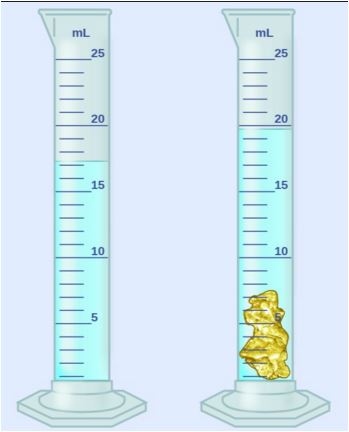
Calculate the density of the object below if it has a mass of 3g. (Hint: you need to find the volume.)
60 g/cm3
3 g/cm3
20 g/cm3
0.05 g/cm3




According to the picture from left to right, which of the answers is correct?
neurally buoyant, positively buoyant, negatively buoyant
negatively buoyant, neutrally buoyant, positively buoyant
positively buoyant, neutrally buoyant, negatively buoyant
neutrally buoyant, negatively buoyant, positively buoyant

How is viscosity & density affected when a fluid is heated?
viscosity increases & density increases
viscosity decreases & density decreases
viscosity decreases & density increases
temperature has no affect on viscosity or density

Which graduated cylinder has the highest viscosity
The graduated cylinder with the ball at 20mL.
The graduated cylinder with the ball at 30mL.
The graduated cylinder with the ball at 40mL.
The graduated cylinder with the ball at 50mL.

At which of these temperatures is the viscosity of the fluid highest? (see graph)
40 °C
60 °C
80 °C
100 °C
Using the particle model of matter, viscosity is described as
the larger the molecules, the higher the viscosity
the greater the distance between the particles, the greater the viscosity
the greater the friction between particles, the greater the viscosity
the faster the particles are moving, the greater the viscosity
The ease with which fluids flow may be described as
viscosity
colloid
buoyancy
density
What is the density of 20 mL of lead that has a mass of 200 g?
10
20
20,4
15.6

If Line C represents the density of distilled water, then Line D could represent the density of
cement block
wood
gold
titanium

What is the density represented by line A
20g/mL
5g/mL
5mL/g
100g/mL
Consider a hot air balloon. Which statement is correct?
when the buoyant force equals the force of gravity, the balloon stops rising
when the balloon is heated, the air particles in the balloon move more slowly
the balloon rises because the buoyant force is less than the force of gravity
as the balloon is heated, it becomes more dense than the surrounding air
According to the Particle Model of Matter, air is a more compressible fluid than a liquid, because
liquid particles are moving at lesser speeds
liquids have more particles per volume
air particles are moving at greater speeds
air has more particles per volume
An average man is 850 N and the area of the shoes he is standing on is 0.0098 m2. What is the approximate pressure he is exerting on the ground?
87,000 N/m2
8,700 N/m2
870 N/m2
87 N/m2

