
 Worksheets
Common Assessment Review
Total questions: 70
Worksheet time: 1hrs 5mins
Name
Class
Date
1.
What level of effort do you plan to give on this final common assessment?
a)
0%
b)
25%
c)
75%
d)
100%
2.
The Law of Conservation of matter states that the total amount of matter ______________ after it undergoes change.
a)
disappears
b)
stays the same
c)
weighs less
d)
explodes
3.
Can matter be created or destroyed?
a)
Yes, it can be created.
b)
Yes, it can be destroyed.
c)
No, matter is always conserved
d)
None of these
4.
The total amount of matter (atoms) before and after a chemical reaction (change), remains the same.
a)
True
b)
False
5.
What is the smallest identifiable unit of an element?
a)
atom
b)
molecule
c)
hydrogen
d)
quark
6.

Which of these shows a balanced chemical reaction, according to the law of conservation?
a)
A
b)
B
c)
C
d)
D
7.
Which of the following is known as a "characteristic property" of water?
a)
density of 1.0 g/mL
b)
boiling point of 100⁰C
c)
temperature in a glass of 20⁰C
d)
both density and boiling point
8.
Which of the following properties of isopropol alcohol is a "characteristic property"? A volume of 50 mL has a freezing point of -89⁰C and is colourless.
a)
volume of 50 mL
b)
freezing point of -89⁰C
c)
colourless
d)
both volume and colourless
9.
The amount of matter in an object is a measure of the object's ________________.
a)
volume
b)
density
c)
mass
d)
solubility
10.
Which of the following is NOT a characteristic property?
a)
Density
b)
Odor
c)
Flammability
d)
Mass
11.
Conduction is heat transfer by -
a)
Touch
b)
Circles
c)
Waves
12.
Convection is heat transfer by-
a)
Touch
b)
Circles
c)
Waves
13.
Radiation is heat transfer by-
a)
Touch
b)
Circles
c)
Waves
14.
In what direction do hot liquids and gasses move?
a)
Side to Side
b)
Down
c)
Up
d)
Back and Forth
15.
What type of material makes the best insulators?
a)
Aluminum
b)
Copper
c)
Styrofoam
d)
Metal
16.
Which example below is an example of conduction?
a)
Boiling macaroni
b)
The attic is warmer than the basement
c)
The Sun heating the Earth
d)
Touching hot sand with your feet
17.
Which example below is an example of convection?
a)
Standing on a hot metal bridge
b)
The attic is warmer than the basement
c)
The Sun heating the Earth
d)
Touching hot sand with your feet
18.
Which example below is an example of radiation?
a)
Standing on a hot metal bridge
b)
The attic is warmer than the basement
c)
The Sun heating the Earth
d)
Touching hot sand with your feet
19.
As you touch a hot stove the heat transfers -
a)
from your hand to the stove
b)
from the stove to your hand
c)
It doesn't transfer
20.
Hot objects begin to cool as-
a)
cooler air is transferred to the hot object.
b)
thermal energy in the object is transferred to the surrounding air.
c)
atoms in the object react with the oxygen in the air.
d)
thermal energy in the object cancels out energy in the air
21.
Heat transfer always goes from-
a)
Cold to Hot
b)
Hot to Cold
c)
Heat doesn't transfer
d)
Freezing to Cold
22.
What happens to particles as they heat up?
a)
They slow down
b)
Nothing
c)
They don't move
d)
They speed up
23.
What happens to particles as they cool down?
a)
They slow down
b)
Nothing
c)
They don't move
d)
They speed up
24.
Energy is the ability _____________.
a)
to do work
b)
to power things
c)
to move objects
d)
to turn on a light
25.
Roller coasters slow down because their energy disappears.
a)
True
b)
False
26.
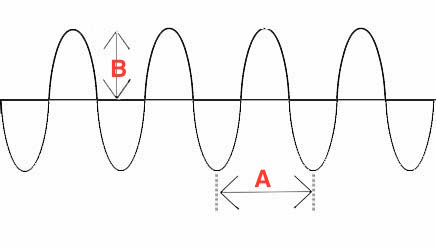
What property of this wave is represented by the letter "A"
a)
amplitude
b)
crest
c)
trough
d)
wavelength
27.
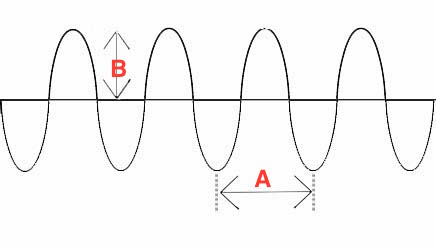
What property of the wave is represented by the letter "B"?
a)
amplitude
b)
crest
c)
trough
d)
wavelength
28.
The highest point on a wave is:
a)
the crest
b)
the trough
c)
the top
d)
the coast
29.
The lowest point on a wave is the:
a)
Amplitude
b)
Crest
c)
Trough
d)
Wavelength
30.
The number of wavelengths that pass a point each per second is:
a)
frequency
b)
period
c)
longitudinal
d)
transverse wave
31.
The type of waves that require medium to pass:
a)
Mechanical Waves
b)
Electromagnetic Waves
32.
When the frequency of a wave increases, what happens to the wavelength?
a)
The wavelength is not directly affected by the frequency of a wave.
b)
The wavelength increases.
c)
The wavelength decreases.
d)
More specific information is needed to form a conclusion about the wavelength.
33.
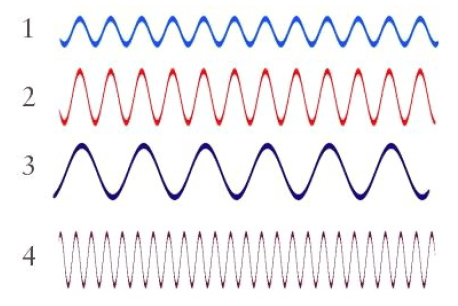
Which wave in the diagram has the greatest frequency?
a)
1
b)
2
c)
3
d)
4
34.
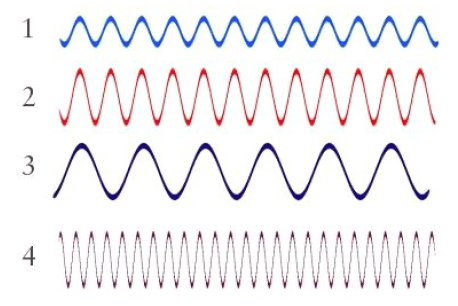
Which wave in the diagram has the greatest wavelength?
a)
1
b)
2
c)
3
d)
4
35.
crest to crest or trough to trough
a)
crest
b)
trough
c)
amplitude
d)
wavelength
36.
When a wave strikes and object and bounces off. (example echo)
a)
medium
b)
refraction
c)
reflection
d)
interference
37.
Sound is caused by?
a)
force
b)
vibrations
c)
instruments
d)
medium
38.
In a transverse wave, particles move...?
a)
back and forth
b)
vertically
c)
up and down
d)
wherever the matter's going
39.
In a longitudinal wave, the particles move...?
a)
back and forth
b)
up and down
c)
vertically
d)
in the direction of the hertz
40.

This is a __________wave
a)
light
b)
sound
c)
surface
d)
all of the above
41.
Waves transfer _______ but not ________.
a)
matter......energy
b)
energy.....matter
c)
speed.....particles
d)
particles.....speed
42.
What do we call the part of a longitudinal wave that is when the waves are squeezed together?
a)
compression
b)
rarefaction
c)
crest
d)
trough
43.
What do we call the part of a longitudinal wave that is spread a part?
a)
compression
b)
rarefaction
c)
crest
d)
trough
44.

A light ray reflects from a mirror. If the ray strikes the mirror at an angle of 30° with the normal, the reflected ray would leave at an angle of ____.
a)
60°
b)
90°
c)
120°
d)
30°
45.
Translucent objects transmit and scatter the light waves that hit them. If you see a color in a translucent object, the object _________________ this color
a)
transmits
b)
reflects
c)
absorbs
d)
none of the above
46.
Different wavelengths of light are seen as
a)
atoms
b)
colors
c)
speeds
d)
sounds
47.
Which property of sound describes your perception of the energy of a sound?
a)
loudness
b)
intensity
c)
pitch
d)
wave speed
48.
What is force?
a)
A push exerted on an object
b)
A push or pull exerted on an object
c)
A pull exerted on an object
d)
Nothing
49.
A force acting in the opposite direction of an object in motion
a)
Gravity
b)
Buoyant
c)
Friction
d)
Normal
50.
Which statement is true about magnetic forces?
a)
Distance does not affect the strength of the force field
b)
The charge of the magnet affects the strength of the force field.
c)
There is an east pole and west pole to every magnet
d)
Distance and the strength of the magnet affect the strength of the force field
51.
Which is a factor that affects the strength of gravitational, magnetic, and electrostatic force fields?
a)
Mass
b)
Volume
c)
Distance
d)
Density
52.

Which planet has the strongest gravitational pull towards the Sun?
a)
Jupiter
b)
Neptune
c)
Mercury
d)
Earth
53.
Distance and mass are two factors that affect
a)
Gravitational Force Fields
b)
Magnetic Force Fields
c)
Electric Force Fields
d)
Electrostatic Force Fields
54.
Surrounding every magnet is a __________ __________.
a)
magnetic field
b)
electrical current
c)
another magnet
55.
Opposite magnetic forces _____ each other.
a)
Attract
b)
Repel
56.
As distance between two objects increase the pull of gravity
a)
Increases
b)
Decreases
c)
Stays the same
57.
How can you explain that we have a stronger gravitational attraction with Earth than the Sun?
a)
The sun has a larger mass
b)
The sun has a smaller mass
c)
Closer to center of sun
d)
Closer to center of Earth
58.
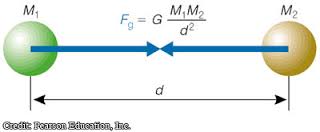
Complete the following statement: The farther away two planets are the _______ the gravitational force between them.
a)
more
b)
same
c)
dosen't matter
d)
less
59.

Jacob has noticed that when he opens his bedroom door, the doorknob hits the wall. He decides to design a device to absorb the force of the opening door. He has identified the problem. What is the next step in his design process?
a)
Evaluate the design.
b)
Identify the criteria and constraints.
c)
Brainstorm solutions.
d)
Sketch a possible prototype.
60.

What is the first step in the Design Process?
a)
Identify the Problem
b)
Construct a Prototype
c)
Develop Possible Solutions
d)
Optimize
61.

During which step of the Design Process would the specific constraints or criteria of the problem be identified
a)
Define
b)
Design Solutions
c)
Construct Prototype
d)
Optimize
62.

In which step of the Design Process would you discuss questions such as: Has the criteria been met? If so, how well? If not, why not? What are the next steps?
a)
Identify the Problem
b)
Optimize
c)
Design Solutions
d)
Construct Prototype
63.

Which word best describes a constraint?
a)
option
b)
opportunity
c)
limitation
d)
goal
64.
The measure of average kinetic energy of all the particles within an object is called ____________.
a)
temperature
b)
conduction
c)
radiation
d)
heat
65.

Energy of motion is also called --
a)
Potential Energy
b)
Thermal Energy
c)
Temperature
d)
Kinetic Energy
66.

Which of the following describes a "hot" gas?
a)
Lots of space and slow particles.
b)
Little space and fast particles.
c)
Lots of space and fast particles.
d)
Little space and fast particles.
67.
When we added MORE thermal energy to the same amount of water---
a)
the temperature decreased more
b)
the temperature increased faster
c)
the temperature stayed the same
d)
the temperature increased the same as when less thermal energy was added
68.
When we added the same amount of thermal energy to 3 different masses of water --
a)
the smallest mass heated up and cooled down the fastest
b)
the smallest mass heated up and cooled down the slowest
c)
each mass heated up and colled down at the same rate
d)
nothing happened because thermal energy does not affect temperature
69.
When we added the same amount of thermal energy to the same mass of an absorber and reflector ---
a)
The temperatures of both increased at the same rate.
b)
The temperatures of each decreased.
c)
The temperature of the reflector increased faster.
d)
The temperature of the absorber increased faster.
70.
When you increase the amount of thermal energy added to a substance --
a)
the average kinetic energy increases
b)
the temperature decreases
c)
the average kinetic energy decreases
d)
the thermal energy stays the same
100 %

