
 Worksheets
Y8 Light & Sound
Total questions: 70
Worksheet time: 49mins

Which items are opaque?
A & C
A,C,E, & F
D, E, & F
A & E


Why do we see objects as white?
They absorb all light
They reflect all the colours of visible light
They absorb some light and reflect some light
Another name for light changing direction is ....
Reflaction
Absorbing
Refraction
mirror

The angle of incidence is _________ the angle of reflection

When light passes through a prism the light changes direction and breaks into the visible spectrum. What color refracts the most ?
Red
Yellow
Blue
Violet
___________ is a form of energy that we can see with our eyes.
shadow
light
energy
reflection

What is a band of colour in a rainbow, or from a light passing through a prism?
Spectrum
Space
Prism
Refraction


If light strikes a mirror at a 50⁰ angle, what angle will it come off of the mirror?
50⁰
70⁰
45⁰
30⁰

What colors are not in the spectrum?
White
Pink
Red
Violet

What happens when light hits an object?
Some of the light reflects in different directions
(scatters)
Some of the light gets absorbed by the object.
Some of the light reflects back to your eye
ALL of them.


Sound moves in a _________.
Transverse wave
Longitudinal wave
circular wave
vacuum


What is volume?
how high or low a sound is
the loudness or quietness of a sound
the number of vibrations per second
vibrations

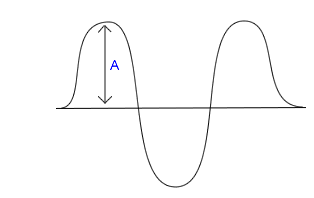
If the distance represented by the letter A were decreased, how would it change the way the sound was heard?
The sound would be higher.
The sound would be lower.
The sound would be quieter.
The sound would be louder.


What is a correct statement about wave 1 and 3?
they are the same
wave 1 has a higher pitch than wave 3
wave 1 has a lower volume than wave 3
wave 1 has a higher volume than wave 3
What is a correct statement about wave 2 and 3?
they are the same
wave 2 has a higher pitch than wave 3
wave 2 has a lower volume than wave 3
wave 2 has a lower pitch than wave 3
What is a correct statement about wave 1 and 2?
they are the same
wave 1 has a higher pitch than wave 2
wave 1 has a higher volume than wave 2
wave 1 has the same pitch as wave 2
To calculate the speed of sound you would need to:
divide the distance the sound travels by the time it takes to arrive
divide the time sound takes to arrive by the distance the sound travels
multiply the distance the sound travels by the time it takes to arrive
take away the distance from the time
Dave watched as his mate put a stick of dynamite in a teddy bear and lit the fuse. Dave was a km away. What happened?
Dave heard the bang, then saw the teddy bear disappear in a puff of stuffing
Dave saw the teddy bear disappear in a puff of stuffing, then heard the bang
Dave saw the teddy bear disappear in a puff of stuffing and heard the bang simultaneously (at the same time)
Dave saw the teddy bear come to life and run away
A ____________________ is a longitudinal wave that is caused by vibrations and travels through a medium.
light wave
sound wave
microwave
water wave
In a ________________________ wave, the particles vibrate in the same direction that the wave travels, or parallel to the wave.
light wave
microwave
water wave
longitudinal wave
What happens to the eardrum when sound hits, causing transmission of sound to the inner ear?
it opens
it grows hair
it refracts the sound
it vibrates
What does the Auditory nerve do?
Carries the message to the brain
Carries the message to the Semi-Circular canal
Send the message to the Eustachian tube
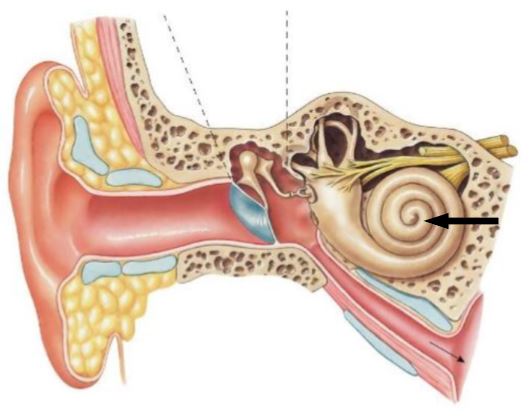
What is this?
Pinna
Hearing Nerve
Cochlea
Ear Drum
Anvil

What can you use to see all the different colors in white light?
A flashlight
A shadow
A camera
A prism

What color is an object that absorbs all the colors in the light spectrum?
A rainbow
White
Black
Invisible

A leaf is green. What does this tell you about the light that is being absorbed?
The light is a UV ray.
The light is not a part of the light spectrum.
All colors are reflected except green.
All colors are absorbed except green
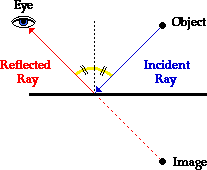
What is the angle of reflection equal to?
The angle of refraction
The angle of incidence
The angle of absorption
The angle of light

What is the angle of incidence?
The angle at which light bends in water.
The angle at which light hits a surface.
The angle at which light is absorbed by an object.
The angle at which light bounces off a surface.

Which part is #4?
pupil
iris
cornea
lens
Which part is #7?
sclera
optic nerve
cornea
retina
What does the optic nerve do?
transmit impulses from retina to brain
helps the eye focus
receives light and sends it to brain
transmits light rays to retina

The picture shows which type of reflection?
Specular
X-ray
Diffuse
Normal

The angle between the reflected ray and the normal (labelled Y on the diagram).
Angle of Incidence
Angle of Reflection
Angle of Normal
Angle of Light

An imaginary line that is drawn at a right angle (90 degrees) to a mirror (Green line)
Reflection Ray
Normal
Incidence Ray
Light Ray

The picture shows which type of reflection?
Diffuse
X-ray
Normal
Specular

If the angle of incidence in the diagram is 80°, the angle of reflection will be:
10°
100°
90°
80°

Given that the angle of incidence = 30 degrees
Which is the correct diagam?
A
B
C
D
Light always travels in a
straight line
wavy line
curved line
zig-zag line

