
 Worksheets
2nd 9-weeks Exam Review
Total questions: 75
Worksheet time: 44mins
Name
Class
Date
1.
Electromagnetic waves are arranged by
a)
SPEED
b)
AMPLITUDE
c)
WAVELENGTH
d)
USEFULNESS
2.
An electromagnetic wave is a wave that
a)
CAN TRAVEL ONLY THROUGH MATTER
b)
CAN TRAVEL ONLY THROUGH EMPTY SPACE
c)
CONSISTS OF CHANGING ELECTRIC AND MAGNETIC FIELDS
d)
IS THE SAME AS SOUND WAVES AND WATER WAVES
3.
Which of these waves do NOT require a medium?
a)
OCEAN WAVES
b)
SEISMIC WAVES
c)
SOUND WAVES
d)
RADIO WAVES
4.
A wave can make a leaf bob up and down on the water, but it cannot move the leaf toward the shore. This is because waves only transfer
a)
MATTER
b)
ENERGY
c)
MEDIA
d)
CREST
5.
An object that is transparent
a)
allows light to pass through it
b)
transmits light but not images
c)
does not transmit light
d)
all of the above
6.
When rays of light hit a smooth surface and bounce back at the same angle, this is called
a)
refraction
b)
reflection
c)
opaque
d)
transparent
7.
Light is bent as it passes from the air into the lens of eyeglasses. This bending is called
a)
reflection
b)
refraction
c)
interference
d)
shifting
8.

Which vocabulary term is used to identify the distance between points C & G?
a)
Amplitude
b)
Crest
c)
Frequency
d)
Wavelength
9.
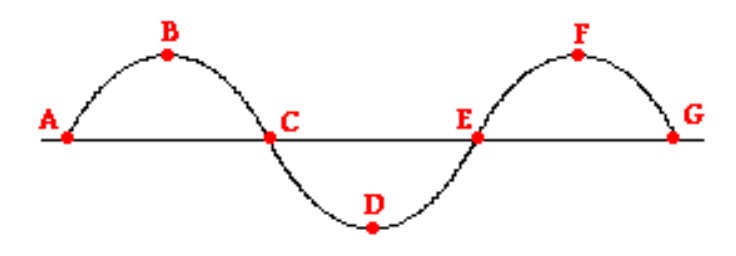
Which letter(s) represent the trough of the wave?
a)
A
b)
B
c)
C
d)
D
10.
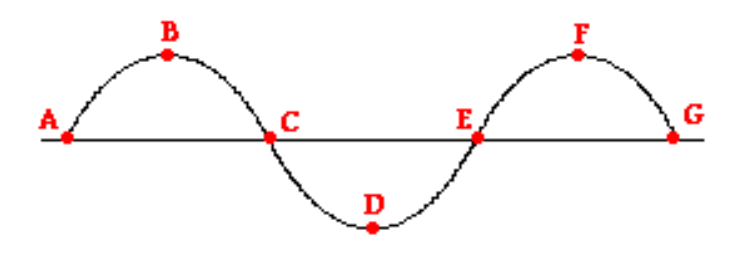
Which letter(s) represent the crest of the wave?
a)
A
b)
B
c)
C
d)
D
11.

What kind of waves can travel through space?
a)
electromagnetic waves
b)
compressional waves
c)
longitudinal waves
d)
sound waves
12.
If ALL colors of visible light are reflected back to your eye, what color will the t-shirt appear?
a)
white
b)
black
c)
red
d)
green
13.
Wax paper is an example of an ________________ object because is can scatter light.
a)
translucent
b)
transparent
c)
opaque
d)
none of the above
14.
Electromagnetic waves with the longest wavelength:
a)
xray
b)
gamma ray
c)
radiowave
d)
microwave
15.
Electromagnetic waves with the shortest wavelength
a)
xray
b)
gamma ray
c)
radiowave
d)
microwave
16.
Select the correct order of waves on the Electromagnetic Spectrum
a)
Radio, Micro, Infra, Visible, Ultra, X-ray, Gamma
b)
Gamma, X-ray, Ultra, Vis, Infra, Micro, Radio
c)
Vis, Micro, Infra, Ultra, X-ray, Gamma, Radio
d)
Micro, Radio, Vis, Infra, Ultra, X-ray, Gamma
17.
Put the visible light colors in order from longest wavelength to shortest wavelength
a)
Violet, Indigo, Blue, Green, Orange, Yellow, Red
b)
Red, Yellow, Green, Orange, Violet, Blue, Indigo
c)
Red, Orange, Yellow, Green, Blue, Indigo, Violet
18.
The _______________ determines the color of visible light.
a)
wavelength
b)
speed
c)
amplitude
d)
light
19.
All EM waves travel at
a)
different speeds
b)
the speed of sound
c)
the speed of light
d)
the speed of a vacuum
20.

The acronym (letters) used to remember visible light is____________
a)
KTPERRY
b)
ROYGBIV
c)
DOGPOUND
d)
ROMERO
21.
Violet is the visible light that has the most energy
a)
True
b)
False
22.

The units for frequency are measured in _____________.
a)
hertz
b)
seconds
c)
m/s
d)
m
23.

Refract or Reflect?
a)
Refract
b)
Reflect
24.

Absorb or Reflect all colors?
a)
Absorb
b)
Reflect
25.

Refract or Reflect?
a)
Refract
b)
Reflect
26.
Energy cannot be created or destroyed.
a)
Law of Conservation of Matter
b)
Law of Conservation of Mass
c)
Law of Conservation of Energy
d)
All of the above
27.
On which temperature scale does water freeze at 0°?
a)
Kelvin
b)
Celsius
c)
Fahrenheit
28.

The glow sticks produce light for a short amount of time. The light from the glow stick is a conversion from what to what?
a)
thermal to light
b)
gravitational to potential
c)
radiant to electrical
d)
chemical to light
29.
Stored energy that results from the position or shape of an object is called...
a)
Thermal
b)
Potential
c)
Kinetic
d)
Gravitational
30.
On a roller coaster, where is the least potential energy?
a)
at the top of the big hill
b)
at the bottom of the big hill
c)
going down the big hill
d)
at the hot dog cart
31.
On a roller coaster, where is maximum potential energy?
a)
at the top of the big hill
b)
at the bottom of the big hill
c)
Mechanical Energy
d)
at the snow cone stand
32.
In which state of matter are molecules moving the slowest?
a)
solid
b)
liquid
c)
gas
d)
Mississippi
33.

Any material that does not allow heat to pass through it easily
a)
Friction
b)
Conductor
c)
Insulator
d)
Magnet
34.
Which state of matter has the fastest molecules?
a)
solid
b)
liquid
c)
gas
d)
water
35.
Energy of motion is which type of energy?
a)
Potential
b)
Kinetic
c)
Sound
d)
heat
36.
The measure of average kinetic energy of all the particles within an object is called ____________.
a)
temperature
b)
conduction
c)
radiation
d)
heat
37.
In a solid, particles...
a)
Move quickly and are close together
b)
Move slowly and are close together
c)
Move quickly and are far apart
d)
Move slowly and are far apart
38.
The heating and cooling - rising and sinking of magma beneath the earth's crust is an example of which type of heat transfer?
a)
Conduction
b)
Convection
c)
Radiation
39.
Heat transfer through direct contact.
a)
Conduction
b)
Convection
c)
Radiation
40.
Anna is holding an ice cube. Why does the ice cube melt in her hand?
a)
Heat moves from her hand to the ice cube
b)
Cold moves from her hand to the ice cube
c)
Heat moves from the ice cube to her hand
d)
Cold moves from the ice cube to her hand
41.
The potential energy stored in the nucleus of an atom.
a)
chemical energy
b)
electrical energy
c)
electromagnetic energy
d)
nuclear energy
42.
A(n) _____________ is a device for measuring temperature.
a)
thermometer
b)
barometer
c)
anemometer
d)
psychrometer
43.
The energy of moving electrical charges.
a)
chemical energy
b)
electrical energy
c)
electromagnetic energy
d)
nuclear energy
44.
The total potential & kinetic energy of the particles of an object.
a)
mechanical energy
b)
gravitational potential energy
c)
thermal energy
d)
elastic potential energy
45.
All of the following are forms of radiant energy EXCEPT:
a)
radio waves
b)
X-rays
c)
light
d)
sound
46.
the transfer of energy by electro-magnetic waves is called
a)
conduction
b)
convection
c)
radiation
47.

How is the teapot being heated?
a)
condensation
b)
conduction
c)
convection
d)
radiation
48.

How is the cat being heated?
a)
condensation
b)
conduction
c)
convection
d)
radiation
49.
A lightbulb's job is to create light. Which of the following lightbulbs would be the most efficient?
a)
#1 - 90% light 10% thermal
b)
#2 - 75% light 25% thermal
c)
#3 - 50% light 50% thermal
d)
#4 - 10% light 90% thermal
50.
Digestion of food and batteries are an example of which type of energy?
a)
electrical
b)
chemical
c)
kinetic
d)
heat
51.
This can show the changes that occurred over time for a specific type of creature. Older fossils are found deeper than more recent fossils.
a)
Phylogeny
b)
Homologous Structures
c)
Fossils and Rock Strata
d)
Vestigial Structures
52.
A fossil of an extinct dinosaur is found and the anatomy of the fossil shows similarities to that of a bird. What could this mean?
a)
This is purely by chance and isn't significant
b)
The extinct dinosaur and modern bird share a common ancestor
c)
All dinosaurs evolved into birds and that's why there aren't any dinosaurs alive today
d)
Dinosaurs choose to fly, and evolved into birds to escape predation and capture food
53.

The hind leg bones in a whale are examples of
a)
homologous structures
b)
analogous structures
c)
fossils
d)
vestigal structures
54.

Which of the following pieces of evolution evidence deals with aged and identified fossils?
a)
fossil record
b)
comparative embryology
c)
comparative biochemistry
d)
comparative anatomy
55.

Structures with the same parts have different functions; suggests that organisms share a common ancestry
a)
vestigial structures
b)
homologous structures
c)
adaptive radiation
d)
fossil
56.
If species A and B have very similar genes and proteins, what is probably TRUE?
a)
species A and B share a relatively recent common ancestor
b)
species A evolved independently of species B for a long period
c)
species A is younger than species B
d)
species A is older than species B
57.
Transitional fossil forms are important evidence of evolution because they show
a)
how organisms change over time
b)
how animals behaved in their environments
c)
how the embryos of organisms develop
d)
molecular homologies
58.
Which of the following is an inherited trait.
a)
A parent learns how to do math.
b)
A bird has slightly longer wings.
c)
A dog is painted red
d)
A cow is branded on a farm.
59.
Which is not an example of an adaptation?
a)
A bird's beak allows it to crack open hard nuts.
b)
A zebra's stripes allow it to confuse its predators.
c)
A frog's large hind legs allow it to jump from danger.
d)
A cat sleeps on the sofa to avoid the vacuum cleaner.
60.
Which of the following is NOT a principle of Natural Selection
a)
Overproduction
b)
No Variation
c)
Variation
d)
Adaptation
61.
What are the evidences for Evolution?
a)
Fossil Records
b)
Embryology
c)
Similar body structure
d)
All the above
62.
Mutations
a)
Never have an effect on an organism
b)
are always beneficial
c)
are always harmful
d)
are occasionally beneficial
63.
The fossils found in the lower layer of rocks are ________ than those found at higher layer
a)
older
b)
Same age
c)
Younger
d)
tougher
64.
When every organism of a species has died.
a)
Evolution
b)
Natural Selection
c)
Extinction
d)
Artificial Selection
65.
The theory of evolution by natural selection means that what is changing over time?
a)
The inherited traits of a population.
b)
The acquired traits of a population.
c)
Hair color and eye color
d)
Attractive features.
66.
Modern whales developed their traits through natural selection. What occurs during the process of natural selection?
a)
Organisms choose mates from other species to create new species
b)
Breeders selectively cross organisms with desired traits
c)
Only the fittest organisms can survive and reproduce
d)
Organisms remain exactly the same over time.
67.
"Survival of the Fittest" describes which theory
a)
a) natural selection
b)
b) gravity
c)
c) heredity
d)
d) string theory
68.

All rabbits living in a particular area would be an example of a(n)
a)
population
b)
species
c)
fossil
d)
individual organism
69.
What was the name of the ship Darwin traveled the world on?
a)
HMS Beagle
b)
SS Beagle
c)
HMS Bugle
d)
SS Bugle
70.
A species lives in a particular environment. What is TRUE about the environment that the species lives in and about how the species will look over thousands of years?
a)
The environment will stay the same, and the traits of the species will stay the same.
b)
There will be changes to the environment, but the traits of the species will stay the same.
c)
There will be changes to the environment that could lead to changes in the traits of the species.
d)
There will be changes to the environment, and the traits of the species will change, but the changes in the environment could never lead to changes in the traits of species.
71.
Any variation that can help a species survive in a given environment is called...
a)
an adapatation
b)
a characteristic
c)
a homologous structure
d)
a vestigial structure
72.
What is it called when better adapted organisms survive to pass traits along to their offspring.
a)
Evolution
b)
Natural Selection
c)
Extinction
d)
Artifical Selection
73.

Which of the following is a term for a group of similar organisms that can reproduce fertile offspring?
a)
individual
b)
population
c)
species
d)
fossil
74.
Why are advantageous traits more likely to be passed onto offspring?
a)
Because they are more likely to survive and reproduce.
b)
Because they look cooler.
c)
Because they come from recessive alleles.
d)
Because the trait is an acquired phenotype.
75.
What is the advantage of having different shaped beaks?
a)
To look different from other species.
b)
To be able to eat different types of food.
c)
To fly faster.
d)
To confuse scientists.
100 %

