wayground logo

Free Printable Worksheets

NEW

Font size

S
M
L
XL
Worksheets

Noncontact Forces Review

Total questions: 74

Worksheet time: 2hrs 28mins

Name
Class
Date
1.
If you place the North pole of a magnet next to the South pole of another magnet, they will:
a)
Attract
b)
Repel
c)
Do nothing
d)
Shatter
2.
Magnetism is generated by moving
a)
protons.
b)
electrons.
c)
neutrons.
d)
elements.
3.
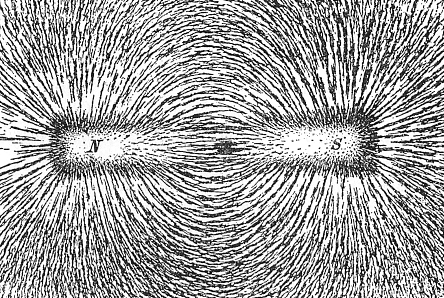
What do the lines around this magnet represent?
a)
North Pole
b)
South Pole
c)
Magnetic Declination
d)
Magnetic Field
4.
On Earth, where is Magnetic North approximately located?
a)
The Equator
b)
The North Pole
c)
The South Pole
d)
New Brighton
5.
As the distance between two magnets increases (they get farther apart), the force between them:
a)
Increases
b)
Decreases
c)
Stays the Same
6.
If you cut a magnet in half, what happens to the poles?
a)
One half gets the North Pole, the other half gets the South Pole
b)
Both halves get only a North Pole
c)
Both halves get only a South Pole
d)
Both halves get a North pole and a South Pole
7.
What is responsible for the Magnetic Field around Earth?
a)
The Earth's crust
b)
The Earth's molton iron core
c)
The Earth's mantel
d)
The Sun
8.
A refrigerator magnet is an example of a:
a)
magnetic material
b)
permanent magnet
c)
horseshoe magnet
d)
temporary magnet
9.
An electromagnet's poles may be reversed by:
a)
decreasing the voltage of the coil
b)
increasing the number of coils
c)
changing the direction of current flow
d)
altering the material used to make the coils
10.
What causes the Northern Lights?
a)
Explosions of stars
b)
Storms at the North Pole
c)
Evil Spirits
d)
Solar Winds
11.
A particle that carries a negative electric charge is called a(n) ______.
a)
neutron
b)
atom
c)
proton
d)
electron
12.
Conduction is the process of charging an object without touching it.
a)
true
b)
false
13.

Two charged objects, are brought close to each other. The two objects would-

a)

Always repel each other.

b)

Always attract each other.

c)

Either atract or repel each other.

d)

Neither attract more repel each other.

14.

Lightning is a natural electrical discharge phenomenon.

a)

True

b)

False

15.

Charging by rubbing is due to -

a)

Friction

b)

Induction

c)

Conduction

d)

Contact

16.
In a stable atom the amount of electrons is electron is equal to
a)
neutrons
b)
protons
c)
atomic mass
d)
neutrons + protons
17.
What is the charge of the electron
a)
positive
b)
no charge
c)
negative
d)
neutral
18.
What is the location of the electron?
a)
the free floating negatively charged electron cloud
b)
the free floating positively charged electron cloud
c)
the very dense positively charged electron orbital
d)
the positively charged very dense nucleus
19.
Where is the proton located?
a)
In the very dense nucleus
b)
Floating around in the negative electron cloud
c)
the loose nucleus
d)
the positive electron cloud
20.
Choose the particle that has no charge.
a)
nucleus
b)
neutron
c)
proton
d)
electron
21.
What types of charges attract?
a)
Positive and Positive
b)
Positive and Neutral
c)
Negative and Neutral
d)
Positive and Negative
22.
The accumulation of excess electric charge on an object is called
a)
Static electricity 
b)
Electric discharge
c)
Resistance
d)
Circuit 
23.
Electric charges that are alike _______ each other.
a)
Attract
b)
Repel
24.
Electric charges that are different _______ each other.
a)
Attract
b)
Repel
25.
If a substance has an excess number of electrons on its surface, what type of charge does it have?
a)
A negative charge
b)
A positive charge
c)
A neutral charge
d)
A nuclear charge
26.
What is the SI unit used to measure force? 
a)
pounds 
b)
grams 
c)
newtons 
d)
kg/ m2
27.
Any object with mass is surrounded by a gravitational field.
a)
True
b)
Sometimes
c)
False
d)
Never
28.
Gravity attracts all objects towards one another.
a)
False
b)
True
c)
It depends
d)
I don't care
29.
The force of gravity is also known as
a)
Mass
b)
Weight
c)
Distance
d)
Acceleration
30.
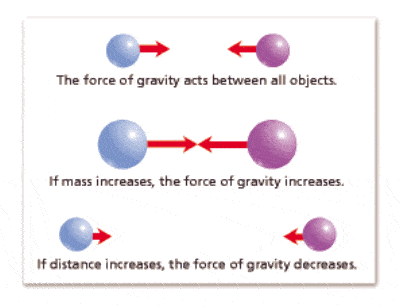
As distance between two objects increase the pull of gravity 
a)
Increases
b)
Decreases
c)
Stays the same
31.
The force of gravity acting on an object is the object's ______.
a)
mass
b)
matter
c)
weight 
d)
terminal velocity 
32.
Which of the following will not change in different gravitational fields?
a)
weight
b)
force
c)
mass
d)
pounds
33.
An object is falling but is not accelerating. What do you know?
a)
Gravity is stronger than air resistance
b)
Air resistance is stronger than gravity
c)
Air resistance is equal to gravity
d)
Forces are unbalanced
34.
Both of these are measured in Netwons
a)
Force and acceleration
b)
Force and weight
c)
Mass and weight
d)
Mass and acceleration
35.
This FORCE pulls things.  It PULLS things into orbit around the sun. 
a)
Newton
b)
gravity
c)
weight
d)
path
36.
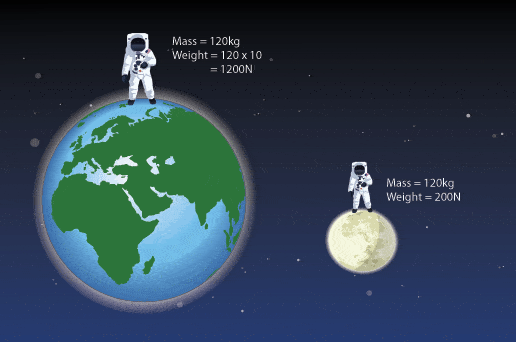
A person weighs _____ on the Earth than they do on the Moon. 
a)
less
b)
more
c)
the same
37.
Any object with mass has gravity.
a)
True
b)
Sometimes
c)
False
d)
Never
38.
As mass increases, what happens to gravitational force?
a)
increases
b)
decreases
c)
stays the same
d)
i don't know
39.
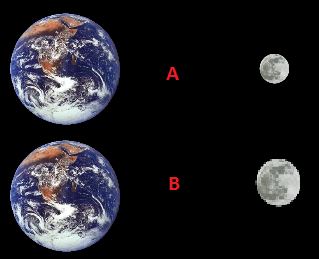
Which model has greater gravitational attraction (if any)
a)
Model A
b)
Model B
c)
Both Model A and Model B (same gravity)
40.
Which system has the greater gravitational attraction between the two objects (if any)?
a)
System A
b)
System B
c)
Same gravitational attraction fro System A and System B
41.
What are three things all planets have in common?
a)
they are spherical, they have at least one moon and they have gravity
b)
Orbit the sun, massive enough that their gravity controls all objects in the area and they are spherical
c)
they have at least one moon, they are spherical and they were made by accretion
d)
they are spherical, they orbit the sun and they have living organisms 
42.
Gravity attracts all objects towards one another.
a)
False
b)
True
c)
It depends
43.
Any object with mass has gravity.
a)
True
b)
Sometimes
c)
False
d)
Never
44.
A person would weigh less on on the Moon than on the Earth because . . .
a)
Moon has more mass, and therefore more gravity
b)
Moon has less mass, and therefore more gravity
c)
Moon has more mass, and therefore less gravity
d)
Moon has less mass and therefore less gravity
45.
Two factors effecting the magnitude of the force of gravity between 2 objects are...
a)
mass and distance 
b)
mass and matter
c)
distance and weight 
d)
weight and mass
46.
If Earth's mass was cut in half, what would happen to your mass?
a)
increase because gravitational force increases
b)
decrease because gravitational force decreases
c)
decrease because gravitational force increases
d)
nothing, mass is not affected by gravitational force
47.
If Earth's mass was cut in half, what would happen to your weight?
a)
Increase because gravitational force increases
b)
decrease because gravitational force decreases
c)
decrease because gravitational force increases
d)
nothing, weight is not affected by gravitational force
48.

It's how much stuff (atoms and molecules) make up an object.

a)

Mass

b)

Weight

c)

Gravity

d)

Force

49.

It's a measure of gravity pulling on an object's mass.

a)

Mass

b)

Weight

c)

Gravity

d)

Force

50.

Which object has a stronger gravitational pull based on mass?

a)

The Sun

b)

Jupiter

c)

Earth

d)

Pluto

51.

Which object do we feel a stronger gravitational pull of because of it's distance?

a)

The Sun

b)

Jupiter

c)

Earth

d)

Pluto

52.

Objects that are very massive (aka, are very big) have a strong gravitational pull.

a)

True

b)

False

53.

Gravity is affected by mass and distance. Which of these situations would have the STRONGEST gravity?

a)

Two objects that a very big and very close

b)

Two objects that are very big but very far away

c)

Two objects that are very small and very close

d)

Two objects that are very small and very far away

54.
Magnets attract to __________________.
a)
iron
b)
nickel
c)
cobalt
d)
all of the above
55.
_______________________ is the invisible force that flows through a magnet.  
a)
repel
b)
copper
c)
attraction
d)
magnetism
56.
True or False:  An electromagnet can function without electricity.
a)
True
b)
False
57.
What kind of magnet can be turned on and off?
a)
refridgerator magnet
b)
electromagnet
c)
magnetite
d)
iron
58.
Surrounding every magnet is a __________  __________.
a)
magnetic field
b)
electrical current
c)
another magnet
d)
an enemy
59.
What are the ends of a magnet called?
a)
East and west poles
b)
Left and Right ends
c)
North and South ends
d)
North and South poles
60.
How do electromagnets differ from regular magnets? 
a)
A. They  can be turned off and on 
b)
B. Their polarity can be reversed
c)
C. Their strength can be changed
d)
D. All of the above
61.

Magnets on refrigerator cannot be turned off. Which type of magnets they belong?

a)

electromagnets

b)

battery

c)

permanent magnets

d)

copper wire

62.

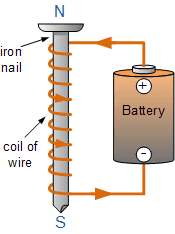
What are the components of the electromagnets?

a)

battery, wire and bulb

b)

battery , copper wire and plastic bottle

c)

battery, copper wire and iron nail

d)

battery, wire and aluminum

63.

What is the role of the battery in the electromagnet?

a)

It provides light energy for the electromagnet.

b)

It provides magnetic field for the electromagnet.

c)

It provides sound energy for the electromagnet.

d)

It provides the power source for the electromagnet.

64.

What would happen if you took one end of the wire off the battery?

a)

The nail will be a magnet.

b)

The nail would no longer be a magnet

c)

Nothing will happened.

d)

The nail will heats up.

65.
What is one difference between electromagnets and bar magnets?
a)
Bar magnets can be turned off but electromagnets cannot
b)
Electromagnets need electricity but bar magnets do not
c)
Bar magnets have a magnetic field but electromagnets do not
d)
Bar magnets are bigger than electromagnets
66.
A _______________ is a current-carrying coil of wire with many loops
a)
electromagnet
b)
solenoid
c)
magnet
d)
compass
67.
The strength of a magnet can be changed by
a)
adding less loops to the coil.
b)
adding more loops to the coil.
68.
An example of the best insulator is
a)
copper
b)
salt
c)
plastic
d)
sand
69.
The coil of current-carrying wire with an iron core is called a(n)
a)
ferromagnet
b)
electromagnet
c)
compass
d)
maglev
70.
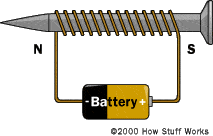
Which of the following best describes this picture?
a)
Pipes and stuff
b)
Magnet
c)
Electromagnet
d)
Resistor
71.
In order for an electromagnet to be formed, an __________ current must pass through a coil of __________ wrapped around an ________ core.
a)
wire, iron, electric
b)
electric, wire, iron
c)
iron, electric, wire
d)
excited, hair, apple
72.
An electromagnet is a solenoid with an __________ core.
a)
copper
b)
wire
c)
iron
73.

Arrows are close together on a force field when the force is

a)

stronger

b)

weaker

c)

opposite

74.

An electromagnet is a magnet that

a)

its strength can be varied and turned on and off

b)

always has a magnetic field around it

c)

has very little strength