
 Worksheets
EES Global Climate Change
Total questions: 70
Worksheet time: 39mins
What is climate?
the condition of the atmosphere at any given time and place
cloud cover and temperature
precipitation and humidity at a given time and place
weather conditions in an area over a long period of time
Climate is affected by many factors including:
latitude, elevation, and proximity to bodies of water
tides and currents
wind
snow and sleet
Which two factors determine the climate in a particular region?
temperature and latitude
precipitation and humidity
temperature and precipitation
humidity and air pressure
At which latitude would you expect to find the warmest air temperatures?
23.5° S
0°
66.5°N
66.5°S
These areas is located between 66.5°N and the North Pole and 66.5°S and the South Pole. It has low temperatures and very little precipitation.
Polar Climate Zones
Temperate Climate Zones
Tropical Climate Zones
The Arctic Climate Zones
The areas located between 23.5°N and 66.5°N and 23.5°S and 66.5°S. These zones have hot summers and cold winters and usually have four seasons.
Polar Climate Zones
Temperate Climate Zones
Tropical Climate Zones
Oceanic Climate Zones
What are the three main climate zones?
tropical, thermal, polar
tropical, temperate, polar
cold, super hot, blah
polar, tropical, humid
The rising and sinking of matter in a circular pattern due to differences in temperature:
convection current
ocean current
convection oven
climate zone
The warm climate zone near the equator:
Tropical Zone
Polar Zone
Temperate Zone
Climate
The cold climate zone near both poles:
Tropical Zone
Polar Zone
Temperate Zone
Climate
The area between the tropical and the polar zones with seasonal climate:
Tropical Zone
Polar Zone
Temperate Zone
Climate
Cold periods in Earth's history during when glaciers covered large parts of the surface:
Sunspots
Ice Age
La Niña
Global Warming
Dark, cooler regions on the surface of the sun that causes Earth's temperature to rise:
Ice Age
Monsoon
Sunspots
Leeward
A gradual increase in the average temperature of Earth's atmosphere:
Global Warming
Greenhouse Gas
El Niño
Climate
Gases in the atmosphere that trap heat; carbon dioxide (CO2) is a major one:
Greenhouse Gas
Global Warming
Sunspot
CFCs


Which of the following have been changed or altered due to climate change ?
droughts
flooding
melting of polar ice caps
all of the above
The main human activity that releases greenhouse gases is
riding bicycles
burning fossil fuels
texting on cellphones
eating meat
Possible human solutions for limiting global warming and climate change are...
being more energy-efficient
using renewable sources of energy
removing carbon from fossil fuel emissions
all of the above
MAIN greenhouse gas responsible for Climate Change is:
nitrogen
carbon
carbon dioxide
methane
Measurement of the greenhouse gases individuals produce, through burning of fossil fuels.
CO2 Footprint
Carbon Footprint
CO2 Effect
Fossil Fuels
Amount of activity of the sun can have an effect on the earth’s climate, sunspots can give off more heat and cause a warming of the earth.
Solar Activity
Sun's Activity
Radiation
Radiation Activity

Which of the following are greenhouse gases?
Carbon dioxide
Methane
Water vapor
All answers are correct


The graph shows us that
the earth temperature is always increasing
the earth's temperature has steadily increased since 1900
the earth's temperature is steadily rising since the 1960s
the earth's temperature decreased during the 19th and 20th centuries
Which of the following natural events is NOT a source of carbon dioxide?
Wildfire
Decomposing plants and animals
Volcanic eruption
Earthquake

The greenhouse effect is a natural process
true
false

The area of human activity responsible for the highest greenhouse gas emissions is
energy supply
transport
agriculture
industrial

This image demonstrates that
There is a direct correlation with the atmospheric CO2 and the CO2 in seawater
That pH of the ocean increases as the atmospheric CO2 increases
That there is no correlation between pH of the ocean and atmospheric CO2
In a more acidic ocean, the shells of organisms do not grow as easily.
True
False
Ocean acidification raises the pH of the ocean .
True
False

As the pH decreases, what happens to the pCO2?
it increases
it decreased
it stays consistent
it disappears

As the pH decreases, what happens to the ocean?
It becomes more acidic.
It becomes more basic.

Which month has the coldest temperature?
January
April
September
March
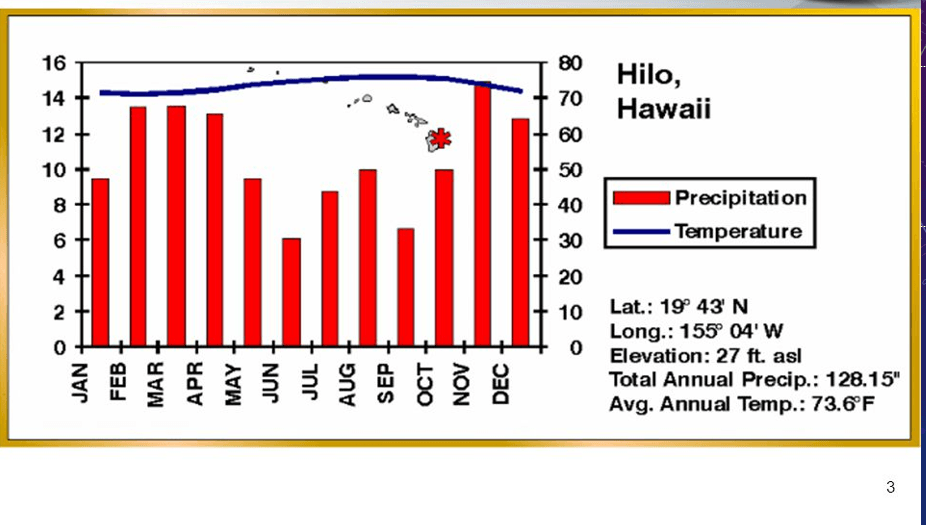
When does the least precipitation occur?
February - March
April - May
June - July
November - December

When is there the most precipitation & highest temperatures?
February
July
September
December

Which biome is represented by the climatograph?
Rainforest
Tundra
Grassland
Temperate (Deciduous) Forest

Which biome is represented by this data
tundra
desert
grassland
tropical rainforest

Local heat buildup in an area of high population density.
homeostasis
thermoregulation
urban heat island
Choose the answer that is true:
Fires and Deforestation contribute to Global Warming.
Fires and Eating contribute to Global Warming.
Deforestation, Condensation and Global Warming affect Sunlight.
Greenhouse gases, mountains, and seasonal winds all affect precipitation.
What results in "natural climate change"?
Volcanic eruptions
Changes in the sun's energy
Both of them
None of them
How does deforestation increase climate change?
Cutting down trees means we make more carbon dioxide
Cutting down trees means there is less carbon being absorbed
Cutting down trees means that cows get angry and make more gases
Cutting down trees means that we have less paper
What can you do to reduce your carbon footprint?
It cannot be changed.
Support companies dedicated to offset their carbon emissions.
Take longer showers.
Have a more plant-based diet.
What is another way we can lower our carbon footprint?
burning fossil fuels
planting a tree
recycling

