
 Worksheets
Volcanoes Summative Exam
Total questions: 70
Worksheet time: 57mins
Which of the following BEST describes a volcano?
It is a place within the mantle where rocks melt to generate magma.
It is a long tube in the ground that connects the magma chamber to Earth’s surface.
It is an opening in the Earth's mantle through which lava, volcanic ash, and gases escape.
It is an opening on the surface of the Earth that allows material warmer than its surroundings to escape from its interior.
Which of the following statements about volcanoes is TRUE?
Volcanic eruptions can be predicted.
Volcanic eruptions are always violent.
Volcanoes cannot be found in bodies of water.
Volcanoes give us information about inner Earth.
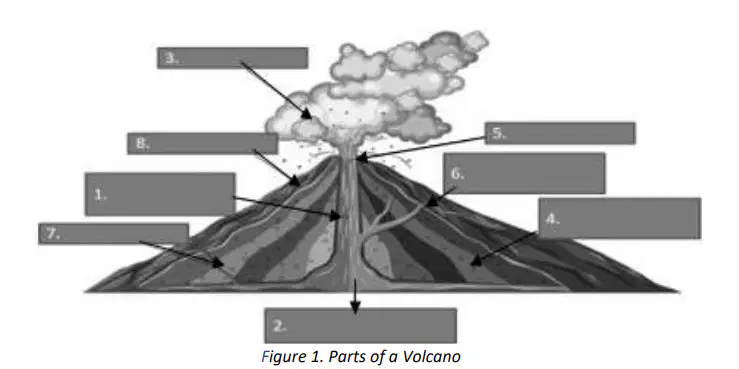
Referring to the picture on the left, which part represents the magma chamber?
1
2
3
7
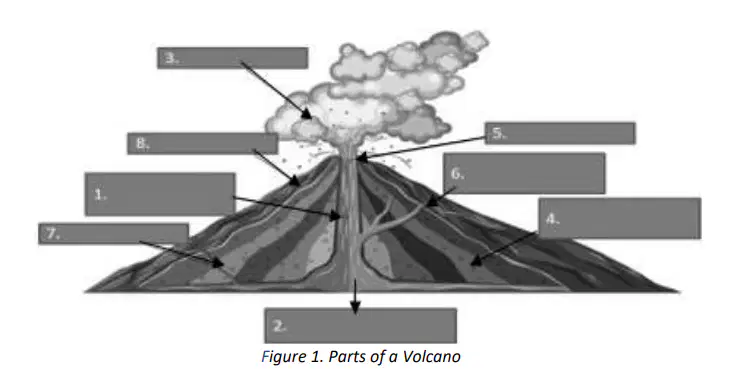
What part of the volcano is represented by Part 1?
crater
magma
main vent
magma chamber

Which of the following statements correctly describes Part 8 in Figure 1?
It is cloud of ash formed by volcanic explosion
It is a fast-moving current of hot gas and rock that is moving away from a volcano.
It is a basin, circular in form, which can be large in radius and sometimes great in depth.
It is a silicate rock that is hot enough to be in liquid form, expelled from a volcano, and reached the Earth’s surface during an eruption.
What type of volcanoes are formed from wide thin layers of lava?
lava domes
cinder cones
shield volcanoes
composite volcanoes
What type of volcano is Mayon Volcano which is formed from alternating layers of lava flow, undissolved stone and ash?
lava domes
cinder cones
shield volcanoes
composite volcanoes
Which of the following CORRECTLY describes the composition and formation of composite volcanoes?
It has a highly viscous or thick, slow moving lava.
It has a loose and fluid lava that flows over each other.
It is composed of boulders and formed by the collision of oceanic plates.
It is composed of loose fragments from basaltic lava and considered as the simplest type of volcano.
Volcanoes are classified as active or inactive. Which of the following is used to determine volcanic activity?
materials they emit
age of the volcanoes
place where they are located
historical record of eruption or volcanic activity
Mt. Akir-Akir, located in the Province of North Cotabato, has no record of activity for the last 10,000 years. Which of the following statements is CORRECT?
It is an active volcano.
It is an inactive volcano.
It is a potentially active volcano.
It is a destructive volcano.
Bicol region is highly volcanic in origin and part of the Pacific Ring of Fire. Which of the following volcano located in Bicol region is considered the most active having the most number of historical eruptions?
Iriga
Isarog
Mayon
Bulusan
Which of these statements is INCORRECT?
Vulcanian eruption is a silent eruption due to oozing lava.
Strombolian eruption is an eruption characterized by fountain lava.
Phreatic eruption is a short lived-eruption and maybe an onset of a large eruption.
A phreatomagmatic eruption is an eruption resulting in the emission of pyroclastic materials.
Taal volcano in Batangas exhibits phreatomagmatic eruption. Which of the following statements describes a phreatomagmatic eruption?
It is a violent eruption due to the contact between water and magma.
It is an excessively explosive type of eruption of gas and pyroclastic.
It is a periodic weak violent eruption characterized by fountain of lava.
It is characterized by tall eruption columns that reach up to 20 km high with pyroclastic flow and ash fall tephra.
Which of the following is a sign of an impending volcanic eruption?
Volcanic tremors
Increase level of water
Presence of hot spring
Occurrence of thunderstorm
Which of these is NOT a sign of impending volcanic eruption?
Crater glow due to presence of magma at or near the crater.
Decrease in the temperature of hot springs, wells, or crater lake near the volcano.
Increase in the frequency of volcanic quakes with rumbling sounds; occurrence of volcanic tremors.
Increase steaming activity; change in color of steam emission from white to gray due to entrained ash.
Which statement is INCORRECT?
Volcanoes give information about inner Earth.
Volcanoes can be found on land and ocean floor.
Volcanoes show precursory signs before eruption.
Volcanoes that do not produce lava is not dangerous.
Which of the following CORRECTLY describes the main vent of the volcano?
It is the part where magma is stored.
It is the central tube-like structure of the volcano.
It is the smaller outlet through which magma is ejected.
It is the channel through which magma travels to the surface of the Earth.
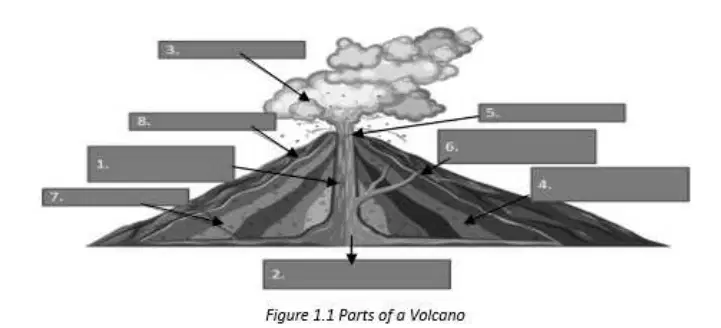
Which of these is CORRECTLY matched?
1: magma flow
2: magma chamber
3: slope
4: lava
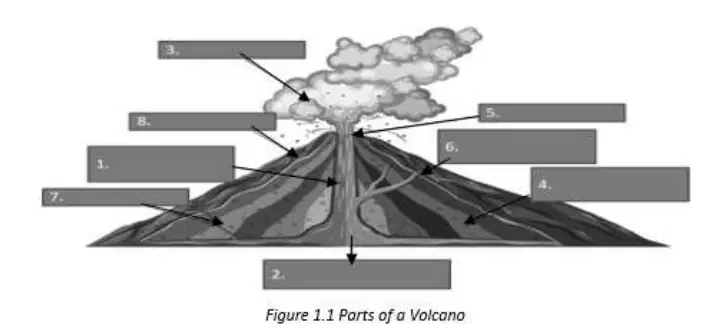
What part of the volcano serves as the region under the surface of the Earth where hot molten magma is collected?
lava flow
main vent
secondary vent
magma chamber
What is the term used to represent the opening of the volcano where magma comes out?
chamber
crater
summit
vent
What type of volcanoes are formed from viscous or sticky lava that does not flow easily?
cinder cones
composite volcanoes
lava domes
shield volcanoes
Which of the following is TRUE about cinder cone?
It is built from particles and blobs of solidified lava ejected from a single vent.
Lava coming out from this volcano is not accompanied by pyroclastic materials.
Lava blown out from this volcano breaks into small fragments solidify and fell as cinder around the vent.
It is formed from viscous magma being erupted effusively onto the surface and then piling up around the vent.
Which type of volcanoes have broad bases and steep slopes and are formed by alternating layers of lava flows, volcanic ash, cinders, blocks and pyroclastic materials?
cinder cones
composite volcanoes
lava domes
shield volcanoes
What is the basis of classifying volcanoes as active or inactive?
size of the base
shape of the cone
age of the volcano
records of eruption
Which of the following statements is CORRECT?
Active volcanoes do not have magma supply while inactive volcanoes have magma supply.
Active volcanoes exhibit volcanic activity within the last 10 000 years while inactive volcanoes have no record of eruption.
Inactive volcanoes are those that erupted recently and showing regular activity while active volcanoes exhibit no sign of volcanic activity.
Inactive volcanoes exhibit sign of emissions of molten materials and gases while active volcanoes show no sign of emission.
Which are considered active volcanoes in the Philippines?
I. Mayon Volcano
II. Calayan in Cagayan
III. Kanlaon in Negros Island
IV. Hibok-Hibok in Camiguin
I and II only
I, II, and III only
I, II, and IV only
I, III, and IV only
The eruption of Mount Pinatubo in the Philippines on June 15, 1991, was the second largest of the 20th century. Its eruption was characterized as an excessively explosive type of eruption of gas and pyroclastic. Which type of the eruption is this?
Phreatic
Phreatomagmatic
Plinian
Strombolian
Which of these is TRUE for a Phreatomagmatic eruption?
It is a silent eruption due to oozing lava
Its eruption is characterized by fountain lava.
Its eruption has resulted to sideway emission of pyroclastic.
It is a short-lived eruption and maybe an onset of a major eruption.
What is the most important sign of an impending volcanic eruption which is also referred as seismic activity?
crater glow
ground swell
volcanic tremor
dried vegetation
Which of these is NOT a sign of a forthcoming volcanic eruption?
crater glow
volcanic tremors
drying up of vegetation
increased amount of rainfall
What term is used to describe the molten material deep inside the Earth?
hot spot
lava
magma
volcano
Which is NOT a contributor in the formation of magma?
pressure
composition
temperature
distance from the core
Viscosity is a measure of a material’s resistance to flow. Which affects the viscosity of magma?
temperature of the magma
chemical composition of the magma
presence of dissolved gases in the magma
all of the choices
Which serves as the driving force that causes magma to explode to the surface?
the gravity in the core
the mass of the magma
the silica in the magma
the dissolved gases trapped in the magma
Magma is a mixture of minerals and volcanic gases. Which describes the composition of gases in magma?
Mostly H2O (water vapor) & some CO2 (carbon dioxide)
Major amounts of Sulfur, Chlorine, and Fluorine gases
Mostly CO2 (carbon dioxide) and few H2O (water vapor)
Mostly SO2 (sulfur dioxide) and some H2O (water vapor)
What are the characteristics of magma that create explosive eruptions?
high gas content and high viscosity
low gas content and low viscosity
high gas content and low viscosity
low gas content and high viscosity
What would magma with the highest viscosity contain?
a high silica content and high temperature
a high silica content and low temperature
a low silica content and high temperature
a low silica content and low temperature
At depth in the Earth, nearly all magmas contain gas dissolved in liquid. When do the gases form into a separate vapor phase?
When volume of gas is reduced as pressure increased.
When volume of gas expands as pressure is increased.
When pressure is decreased as magma rises toward the surface of the Earth.
When pressure is increased as magma rises toward the surface of the Earth.
Which type of volcano ejects a basaltic magma?
Cinder cone
Composite
Shield
Stratovolcanoes
In magma formation, what should be the temperature and pressure requirements?
High temperature and high pressure
Low temperature and low pressure
High temperature and low pressure
High pressure and low temperature
Which gas from erupting volcano causes Global Warming?
Carbon dioxide
Sulfur dioxide
methane gas
Hydrogen sulfide
During the eruption of volcano, different dissolved gases and dust particles were released into the atmosphere. What might be the effect of these materials on the environment and on the living things?
Global Warming
Respiratory illness
Disruption of aircraft travel
All of the choices
Magma is an extremely hot fluid or semi fluid materials found under the Earth surface.
TRUE
FALSE
Viscosity refers to the materials’ resistance to flow. The more viscous the material, the lesser is the resistance to flow.
TRUE
FALSE
Basaltic to andesitic magma is non-explosive while andesitic to rhyolitic magma is explosive.
TRUE
FALSE
Magma with high temperature has high viscosity, while magma with low temperature has low viscosity.
TRUE
FALSE
Composition, temperature, and pressure are the factors that contribute to the formation of magma.
TRUE
FALSE
Which are needed in the formation of magma?
composition, pressure, temperature
composition, pressure, density
pressure, temperature, distance from the surface
pressure, temperature, volume
If a volcano’s magma is high in silica, how will you describe to its volcanic activity?
It will erupt quietly
It will remain dormant
It will erupt explosively
It will produce dark-colored lava
Viscosity is a measure of a material’s resistance to flow. Which DOES NOT affect the viscosity of magma?
location of magma
temperature of the magma
chemical composition of the magma
presence of dissolved gases in the magma
Which is TRUE about the composition of magma?
It contains ash, dust, and lava
It contains dissolved gases only.
It contains fragmented rocks only.
It contains both dissolved gases and fragmented materials.
Several kilometers from a volcano, a geologist observes an old lava flow made up of dark- colored basalt rock. The geologist infers that the lava must have had____________.
low viscosity
high viscosity
medium viscosity
high silica content
Which type of lava will offer the least resistance to flow?
Andesitic
Basaltic
Rhyolitic
Basaltic and Rhyolitic
The magma in the chamber of a volcano has a very high amount of silica. If the volcano would erupt, which might happen?
The lava would flow very slowly
The volcano would erupt violently
The volcano would erupt non-explosively
There would be a build-up of pressure below the crater
Which is NOT a common gas in magma?
methane gas
carbon dioxide
sulfur dioxide
water vapor
Which geothermal plant is located at Albay province?
Tiwi Geothermal Plant
Ampiro Geothermal Power Project
Maibarara Geothermal Power Plant
Montelago Power Plant
What is being harnessed from the interior of the Earth that is used by geothermal power plants?
heat
mineral
electricity
solar power
What form of energy is generated using hot water steam from deep in the earth?
Geothermal
Hydropower
Solar power
Dendrothermal
What do dry steam, flash steam, and binary cycle geothermal plants have in common that they use to generate electricity?
Solar turbines
Nuclear turbines
Steam turbines
Water turbines
Which is being used to lead hot water or steam from the reservoirs into the power plants?
Injection wells
Rock catchers
Heating boilers
Production wells
Which draws the water up from the production wells and returns to the geothermal reservoir where it regains the thermal energy for electricity generation?
Injection wells
Rock catchers
Heating boilers
Production wells
What does “sustainable” energy source imply?
It is limited in supply
It will not be used up
It may cause global warming
It can be replenished within a human lifetime
What is the negative effect of building geothermal energy?
Cost
Pollution
Nuclear Fallout
Global warming
Which method of converting energy is used by the Geothermal plant?
Heat from the sun is used to generate electricity.
Water from the dam is used to turn the turbine to generate electricity.
Radiation from the radioactive substance is used to produce electricity.
Heat inside the Earth is used to produce steam to generate electricity.
Which among these natural hazards has potential effect on geothermal power plants?
Earthquakes
Forest fires
Hurricanes
All of the above
What is the advantage of a geothermal power plant?
renewable resources
high temperature is required
can cause surface instability
suited only in particular region
Which of the following volcanoes is a source of Negros Oriental called EDC’s Southern Negros Geothermal Production Field?
Mt. Taal
Mt. Talinis
Mt. Kanlaon
Mt. Pinatubo
Philippines is one of the world's top producers of this type of energy due to its location along the Pacific Ring of Fire. What type of energy source is being referred to?
Dendrothermal
Geothermal
Hydropower
Solar power
What are the two volcanoes that run the Mak-ban Geothermal Power Plant?
Mt. Bulalo and Mt. Olilia
Mt. Taal and Mt. Bulusan
Mt. Kanlaon and Mt. Olilia
Mt. Kanlaon and Mt. Bulusan
Which pair of geothermal power plants and location is INCORRECT?
Tiwi Geothermal Power Plant : Albay
Mak - Ban : Laguna
Mindanao Geothermal Production Field : Zamboanga
Bac-Man : Sorsogon

