
 Worksheets
Meiosis and Punnet Squares
Total questions: 45
Worksheet time: 40mins
Name
Class
Date
1.
What causes genetic variation in meiosis?
a)
chromosomes lining up
b)
crossing over of chromosomes
c)
separation of chromosomes
d)
chromosomes pulling apart
2.

When an area of a chromatid is exchanged with the matching area on a chromatid of its homologous chromosome, _________________ occurs
a)
crossing over
b)
mutagenesis
c)
hybridization
d)
fertilization
3.

Which process and type of resulting cells are represented?
a)
mitosis, gametes
b)
mitosis, body cells
c)
meiosis, gametes
d)
meiosis, body cells
4.
A male shark has 40 chromosomes in each of its sex cells. How many would be present in its body cells?
a)
20
b)
40
c)
80
d)
160
5.
What do we call the gene combination for a trait?
a)
Phenotype
b)
Alleles
c)
Genotype
d)
Genetics
6.
Which of the following is a phenotype?
a)
Aa
b)
red hair
c)
heterozygous genes
d)
mutated DNA
7.
What is a Monohybrid Cross?
a)
The trait that appears in the homozygous condition.
b)
Is used to predict the probability that certain traits will be inherited by offspring.
c)
Involves a single pair of genes, or one trait.
d)
The case when one allele is not completely dominant over another.
8.
Which is homozygous dominate?
a)
BB
b)
bb
c)
Bb
d)
BW
9.
A dog has 78 chromosomes in its body cells. What is the diploid number?
a)
78
b)
39
c)
1
d)
100
10.
A Goat has 60 chromosomes in its body cells. What is the haploid number?
a)
60
b)
30
c)
100
d)
120
11.
How many cells are produced in meiosis?
a)
1
b)
2
c)
3
d)
4
12.
Complex molecule that carries genetic information that defines an organism's traits. It is stored in the nucleus.
a)
DNA
b)
protein
c)
RNA
d)
glucose nucleic acid (GNA)
13.
Dominant alleles are represented by a:
a)
Male gene
b)
lowercase letter
c)
recessive trait
d)
capital letter
14.
How many alleles (letters) do each person carry for a trait?
a)
1
b)
2
c)
3
d)
4
15.
How many alleles (letters) does a child get from each parent for each trait?
a)
1
b)
2
c)
3
d)
4
16.
What gender has an X and a Y chromosome?
a)
male
b)
female
c)
transgender
d)
all of the above
17.
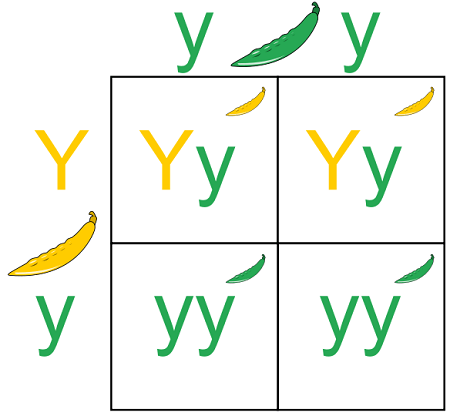
Which choice best represents the genotype of this cross?
a)
1 Yy: 2 yy: 0 YY
b)
2 Yy: 2 yy: 0 YY
c)
3 Yy: 1 yy: 0 YY
d)
1 Yy: 3 yy: 0 YY
18.
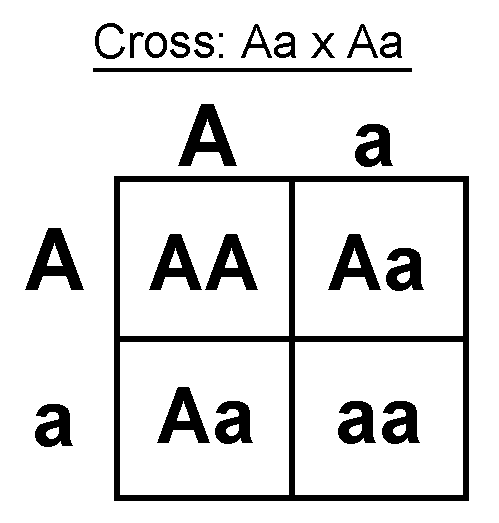
What is the phenotype of the offspring? (A-Brown hair; a-blond hair)
a)
50 % Brown Hair and 50% Blond Hair
b)
25 % Brown Hair and 75% Blond Hair
c)
75 % Brown Hair and 25% Blond Hair
d)
0% Brown Hair and 100% Blond Hair
19.

What percent of the offspring will be Heterozygous?
a)
25%
b)
50%
c)
75%
d)
100%
20.

If the dominant trait here is "WHITE", with w=yellow, for flowers...
a)
All flowers will be white...
b)
All flowers will be yellow...
c)
Half will be Yellow...
d)
75% of the flowers will be yellow...
21.
A red flower (Rr) is crossed with a white flower (rr). What is the genotype?
a)
0 RR; 0 Rr: 4 rr
b)
2 RR; 0 Rr: 2 rr
c)
4 RR; 0 Rr: 0 rr
d)
0 RR; 2 Rr: 2 rr
22.
Two heterozygous red flower (white flowers are recessive) are crossed. What is the phenotype?
a)
75% red and 25% white
b)
25% red and 75% white
c)
100 White
d)
50% red 50% red
23.
Josh has a widow's peak (Ww). His mother also has a widow's peak (WW). His father does not have a widow's peak (ww). What does this indicate about the heredity of Josh's widow's peak?
a)
He received both of his alleles for this particular trait from his father.
b)
He received both of his alleles for this particular trait from his mother.
c)
He received a dominant allele from his father and a recessive allele from his
mother.
mother.
d)
He received a dominant allele from his mother and a recessive allele from
his father.
his father.
24.
A homozygous dominant brown mouse is crossed with a heterozygous brown mouse (tan is the recessive color).
a)
100 % tan
b)
100 % brown
c)
50 % brown and 50% tan
d)
75 % brown and 25 % tan
25.
Round seeds (R) are dominant over wrinkled seeds (r). What percentage of the offspring will be round from the following cross?
Rr X Rr
Rr X Rr
a)
100%
b)
75%
c)
50%
d)
25%
26.

In the second generation-how many people are carriers of the trait?
a)
2
b)
3
c)
5
d)
6
27.

Which individual in the first generation is a carrier?
a)
The male
b)
The female
c)
individual 1
d)
None of the above
28.

How many people in this whole pedigree have the trait/disease?
a)
2
b)
3
c)
4
d)
6
29.

What is the mode of inheritance shown here?
a)
Autosomal Recessive
b)
Sex Linked
c)
Autosomal Dominant
30.

What is the mode of inheritance shown here?
a)
Autosomal Recessive
b)
Autosomal Dominant
c)
Sex Linked
31.

What is the mode of inheritance shown here?
a)
Autosomal Recessive
b)
Autosomal Dominant
c)
Sex Linked
32.

If this pedigree shows an autosomal recessive disorder, what MUST the genotype of individual II-3 be?
a)
HH
b)
Hh
c)
hh
d)
None of the above
33.
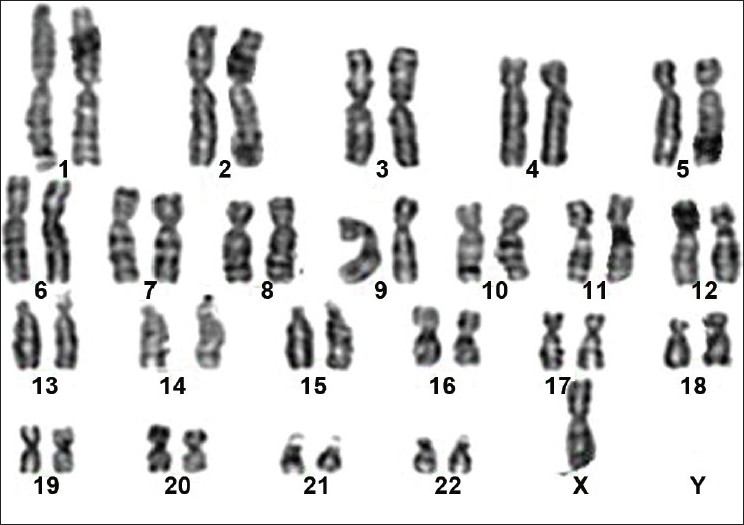
a)
This karyotype shows Trisomy 21
b)
This karyotype has no abnormality
c)
This karyotype is missing a sex chromosome (monosomy x)
d)
This karyotype is from a gamete
34.
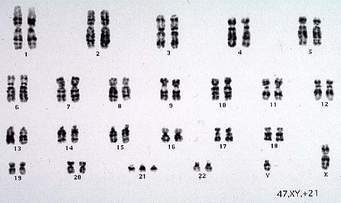
Based on the Karyotype shown, at which chromosome pair can we identify a genetic disorder?
a)
Chromosome pair 5
b)
sex chromosomes
c)
Chromosome pair 21
d)
There are no chromosomal disorders
35.
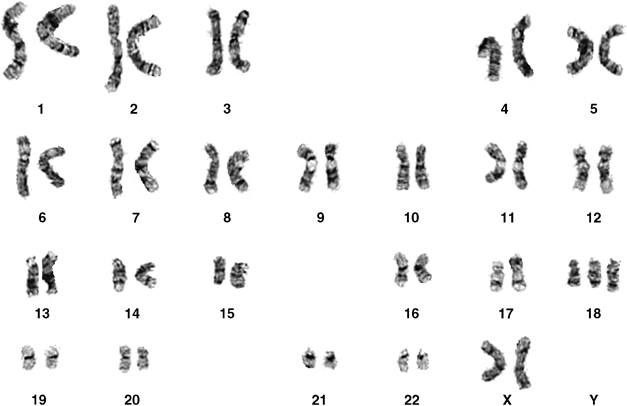
What is the chromosomal condition of the individual whose karyotype is seen in the image?
a)
Monosomy X (Turner's Syndrome)
b)
Trisomy 21 (Down's Syndrome)
c)
Trisomy 13 (Patau Syndrome)
d)
Trisomy 18 (Edwards's Syndrome)
36.
The results of the karyotype indicate that an individual has 3 chromosome #21. Which of the following genetic disorders do they have?
a)
Edwards Syndrome
b)
Patau's Syndrome
c)
Down's Syndrome
d)
Klinefelter's Syndrome
37.
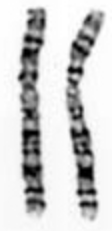
A pair of identical chromosomes shown in a karyotype, one inherited from mom, and one inherited from dad are called
a)
sister chromotids
b)
centromeres
c)
homologous chromosomes
d)
autosomes
38.

What is the gender of the individual whose karyotype is seen in the image?
a)
Male
b)
Female
39.
When there is an MISSING chromosome a geneticist would use the term...
a)
Monosomy
b)
Trisomy
c)
Quadruplegia
d)
Chromosomal Deletion
40.
When there is an EXTRA chromosome a geneticist would use the term...
a)
Monosomy
b)
Trisomy
c)
Quadruplegia
d)
Chromosomal Deletion
41.

Based on these results whose blood was found in the blood stain at the crime scene?
a)
Bob
b)
Sue
c)
John
d)
Lisa
42.

Which two bear species are most closely related?
a)
Bear 1 and Bear 2
b)
Bear 1 and Bear 3
c)
Bear 2 and Bear 3
d)
There’s no way to tell
43.

Which two bat species are most closely related?
a)
Bat 1 and Bat 2
b)
Bat 1 and Bat 3
c)
Bat 2 and Bat 3
d)
There’s no way to tell
44.

Bob was found dead in his home. Crime scene analysis showed signs of a struggle. Blood was collected from the crime scene, the victim, and three suspects. Which suspect likely committed the crime?
a)
Sue
b)
Lisa
c)
John
d)
None of these
45.

Which suspect’s DNA matches the felon’s DNA left at the crime scene?
a)
Suspect 1
b)
Suspect 2
c)
Suspect 3
100 %

