wayground logo

Free Printable Worksheets

Font size

S
M
L
XL
Worksheets

Wave Unit Review

Total questions: 148

Worksheet time: 7hrs 20mins

Name
Class
Date
1.
Light is a form of 
a)
energy
b)
radiation
c)
reflection
2.
Visible light is ...
a)
Light bulb
b)
sun
c)
light that we can see with our natural eye
d)
fire
3.
Why do we see objects as white?
a)
They absorb all light
b)
They reflect all light
c)
They absorb some light and reflect some light
4.
Another name for light bending is ....
a)
Reflaction
b)
Absorbing
c)
Refraction
d)
mirror
5.
The color you see is the color that is ___.
a)
reflected
b)
absorbed
6.
Band of color in a rainbow, or from a light passing through a prism.
a)
Spectrum
b)
Space
c)
Prism
d)
Refraction
7.
Which color absorbs all light?
a)
White
b)
Black
c)
Orange
d)
Green
8.
Which color reflects all light?
a)
White
b)
Black
c)
Orange 
d)
Green
9.
Why does the pencil look broken?
a)
Light is refracting
b)
Light is reflecting
c)
Light is absorbing
d)
Light is diffusing
10.
If light passes through two different types of matter, it will do what?
a)
Reflect
b)
Refract
c)
Absorb
d)
Diffuse
11.
What does light do when it hits a smooth, flat surface?
a)
Reflect
b)
Refract
c)
Absorb
d)
Diffuse
12.
Which of the following is NOT an example of light energy?
a)
The Sun
b)
A lamp
c)
A stove
d)
A bonfire
13.
Why can you see most objects?
a)
Light reflects off them
b)
Light is absorbed by them
c)
Light is bent by the object
d)
Light is scattered from the surface of the object
14.
What happens with light when it bounces back in your eyes?
a)
Refraction
b)
Reflection
c)
Absorption
15.
Which best describes light? 
a)
a gas
b)
a form of sound
c)
a form of energy
d)
a liquid
16.
Which of the following is an example of a translucent material?   
a)
wax paper
b)
construction paper
c)
aluminum foil
d)
clear plastic wrap
17.
Jenny wants to buy new curtains for her bedroom.  She likes to sleep late into the day.  What would be the best type of material for her new curtains to be made from? 
a)
an opaque material
b)
a translucent material 
c)
a transparent material
d)
a reflective material
18.
The visible form of electromagnetic spectrum is called 
a)
Light
b)
Sound
c)
Waves 
d)
Rays
19.
Which is true of a green grape?
a)
It absorbs green light.
b)
It absorbs white light.
c)
It reflects green light.
d)
It reflects white light.
20.
In the diagram, the REFLECTED RAY IS REPRESENTED BY LETTER
a)
A
b)
B
c)
C
21.

What is a form of energy made of many colors?

a)

light

b)

sound

c)

prism

d)

brightness

22.

What tool is used to separate white light into many colors?

a)

brightness

b)

spectrum

c)

energy

d)

prism

23.

Choose all of the following that are sources of light.

a)

candle, lightbulb, moon

b)

light bulb, sun, moon

c)

flashlight, mirror, candle

d)

light bulb, fire, sun

24.

What is our primary source of light?

a)

moon

b)

sun

c)

fire

d)

light bulb

25.

How does light travel?

a)

zig zag

b)

squiggly line

c)

straight line

d)

waves

26.

Why does an apple look red?

a)

it absorbs all the colors and they make red when they mix

b)

it reflects only red and absorbs all the colors

c)

it reflects all the colors and they make red when they mix

d)

it absorbs only red and reflects all the other colors

27.

What is the wave that has the lowest energy and lowest frequency?

a)

Radio wave

b)

Visible Light

c)

X-rays

d)

Gamma

28.

Infrared waves are found between:

a)

Radio/Microwaves

b)

Radio/ X Rays

c)

Microwaves/Visible light

d)

Visible light/Ultraviolet

29.

What is the shortest wave length in visible light?

a)

red

b)

orange

c)

blue

d)

violet

30.

What is the longest wavelength in visible light?

a)

red

b)

orange

c)

blue

d)

violet

31.

X-rays can penetrate ____but not _____

a)

skin/bone

b)

bone/skin

c)

atmosphere/water

d)

water/atmosphere

32.

The most energy is found in what wave?

a)

Visible

b)

X-rays

c)

Gamma

d)

Infra red

33.

Select the correct order of waves on the EMS.

a)

Radio, Micro, Infrared, Visible, UV, X-ray, Gamma

b)

Gamma, X-ray, UV, Visible, Infrared, Radio, Micro

c)

Visible, Micro, Infrared, UV, X-ray, Gamma, Radio

d)

Micro, Radio, Visible, Infrared, UV, X-ray, Gamma

34.

Which has the shortest wavelength and, therefore, the highest frequency/most energy?

a)

Radio waves

b)

Ultraviolet rays

c)

Gamma rays

d)

X-rays

35.
The _______________ determines the color of visible light. 
a)
wavelength
b)
speed
c)
amplitude
d)
light
36.
Cell phones use this part of the EM spectrum.
a)
Microwaves
b)
Gamma
c)
X-Rays
d)
Radio 
37.
Which of the following electromagnetic waves is given off as heat? 
a)
ultraviolet light
b)
x-rays
c)
gamma rays
d)
infrared rays
38.
The blue section of the wave is measuring _________________.
a)
wavelength
b)
crest
c)
trough
d)
amplitude 
39.
If the wavelength of an electromagnetic wave is longer, what is true about the energy? 
a)
Energy is higher.
b)
Energy is lower. 
c)
Energy is not dependent on wavelength. 
d)
energy is cancelled out
40.

Which type of radiation is used to treat cancer?

a)

infrared

b)

ultraviolet

c)

x-ray

d)

gamma

41.

The electromagnetic spectrum includes the complete range of electromagnetic waves placed in order of

a)

increasing amplitude

b)

increasing frequency

c)

increasing wavelength

d)

decreasing frequency

42.

Electromagnetic waves used in broadcasting are called

a)

radio waves

b)

visible light

c)

ultraviolet rays

d)

gamma rays

43.

Electromagnetic waves can transfer energy without a(n)

a)

medium.

b)

electric field.

c)

magnetic field.

d)

change in either a magnetic or an electric field.

44.

Electromagnetic waves are classified as longitudinal waves.

a)

True

b)

False

45.
What harmful effect can the sun have for life on Earth? 
a)
Increasing green energy with solar panels and wind turbines
b)
Vitamin D deficiency and bone loss
c)
Plants and animals dying by dehydration
d)
Ultraviolet radiation causes skin damage, leading to skin cancer
46.
Ultraviolet radiation helps your skin produce vitamin D.
a)
True
b)
False
47.
All waves carry
a)
energy
b)
light 
c)
matter
d)
particles
48.
Does the frog reflect or absorb green?
a)
Reflect
b)
Absorb
49.
The type of wave that can travel through either matter or empty space:
a)
Mechanical Waves
b)
Electromagnetic Waves
50.
The distance between two crests or two troughs of a wave is called:
a)
frequency
b)
amplitud
c)
wavelength
d)
hertz
51.
Put the visible light colors in order from longest wavelength to shortest wavelength
a)
Violet, Blue, Green, Orange, Yellow, Red
b)
Red, Yellow, Green, Orange, Violet, Blue
c)
Red, Orange, Yellow, Green, Blue, Violet
d)
Blue, Violet, Green, Yellow, Orange, Red
52.
Look carefully at the waves.  Which carries the most energy?
a)
microwave
b)
infrared
c)
ultraviolet
d)
x-ray
53.
Why do you see lightning from a distant storm before you hear thunder?
a)
The thunder is produced after the lightning.
b)
Your eyes react faster than your ears.
c)
Light travels faster than sound.
d)
Sound travels faster than light.
54.
Which letter represents the wave trough?
a)
A
b)
B
c)
C
d)
D
55.
Which letter represents amplitude?
a)
A
b)
B
c)
C
d)
D
56.
Which wave has a greater frequency?
a)
A
b)
B
57.
Which kind of wave has the greatest frequency?
a)
gamma rays
b)
infrared
c)
ultraviolet
d)
microwaves
58.

As the wavelength of a wave decreases, the frequency

a)

decreases

b)

increases

c)

remains the same

d)

increases, then decreases

59.

When you sit outside on sunny summer day. you feel warm because the sun emits

a)

radio waves

b)

microwaves

c)

infrared waves

d)

visible waves

60.

Overexposure to ultraviolet light can damage your

a)

heart and liver

b)

eyes and skin

c)

digestive system

d)

memory

61.

Which of the following statements about light is true?

a)

Light is an EM wave that cannot travel through matter

b)

Light is an EM wave that can only travel through empty space

c)

Light is an EM wave that can travel through empty space or matter

d)

Light is similar to a water wave in that it must travel through matter

62.
Pupil
a)
Focuses light
b)
Clear tissue that covers the front of the eye
c)
Opening through which light enters the eye
d)
Layer of receptor cells
63.
The clear tissue that covers the front of the eye.
a)
Lens
b)
Pupil
c)
Iris
d)
Cornea
64.
This part of the eye carries the message from your eye to the part of your brain that controls vision. 
a)
cornea
b)
lens
c)
optic nerve
d)
retina
65.
This part protects the eye, especially the iris, pupil and lens.
a)
rods
b)
cornea
c)
optic nerve
d)
retina
66.
This part of the eye changes shape to control the amount of light that enters the eye.  It is also known as the colored part of the eye.  What is it called?
a)
pupil
b)
lens
c)
iris
d)
retina
67.
Which of these is true?
a)
Cone cells detect light and dark
b)
Rods focus light
c)
Cones detect color
d)
Rods detect color
68.

Cones team up with ______ so that you can see the total picture:

a)

rods

b)

cones

c)

pupil

d)

glasses

69.
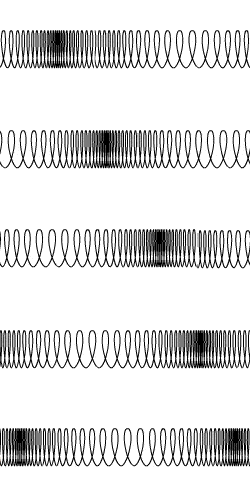
The wave seen in the image is what kind of wave?
a)
Latitudinal
b)
Longitudinal
c)
Traditional
d)
Transverse
70.
All waves carry
a)
energy
b)
light 
c)
matter
d)
particles
71.
What do we call the part of a compressional wave that is when the waves are squeezed together?
a)
compression
b)
rarefaction
c)
crest
d)
trough
72.
What do we call the part of a compressional wave that is spread a part?
a)
compression
b)
rarefaction
c)
crest
d)
trough
73.
Name the type of wave that matter moves at right angles to the direction of the wave?
a)
compressional waves
b)
mechanical waves
c)
transverse waves
d)
ultraviolet rays
74.
Why would a wave change direction?
a)
Because it kept traveling through the same medium
b)
Because it went from one medium to another
c)
the amplitude was too large
d)
the frequency was too small
75.
What is a repeating disturbance or vibration that transfers or moves energy from place to place?  
a)
Medium
b)
Wave
c)
Compression
d)
Rarefaction
76.
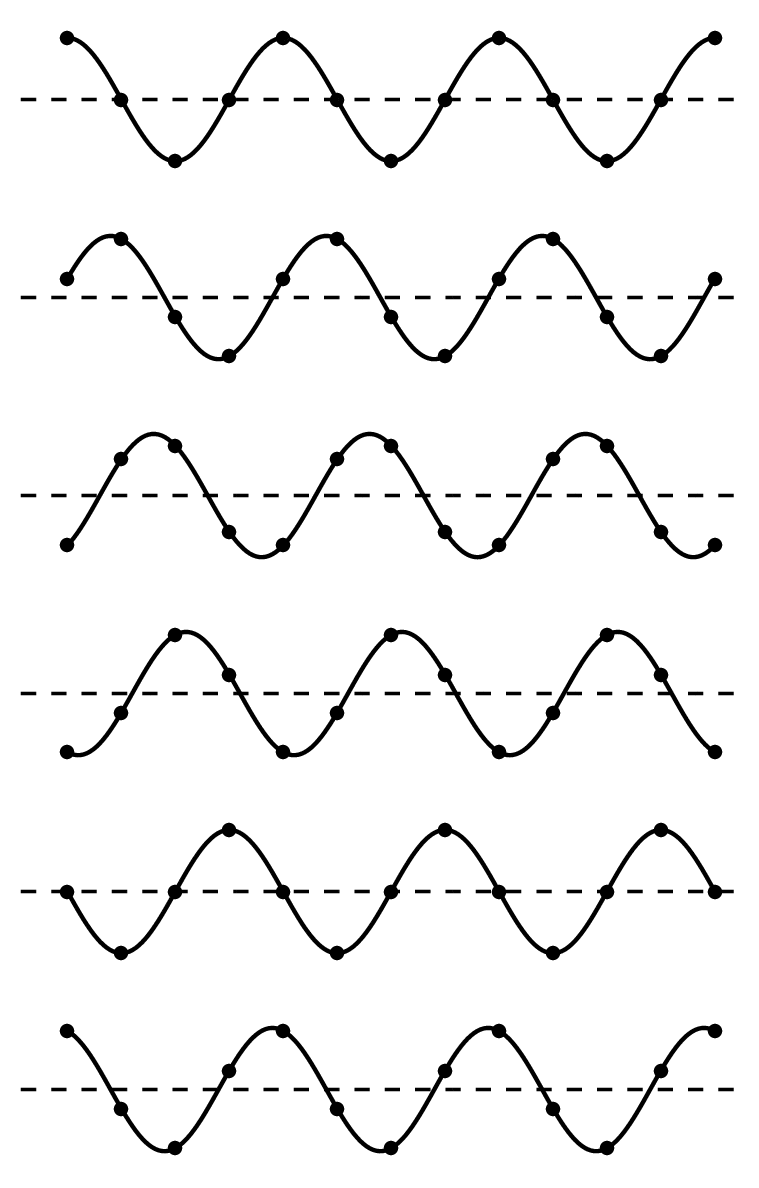
What kind of wave is pictured below?
a)
compressional wave
b)
transverse wave
c)
sound wave
d)
mechanical wave
77.
Which letter represents wavelength?
a)
A
b)
B
c)
C
d)
D
78.
Which letter represents the wave crest?
a)
A
b)
B
c)
C
d)
D
79.
Which letter represents the wave trough?
a)
A
b)
B
c)
C
d)
D
80.
Which letter represents amplitude?
a)
A
b)
B
c)
C
d)
D
81.
What is measured from crest to crest or trough to trough?
a)
Frequency
b)
Amplitude
c)
Wavelength
d)
Origin
82.
The number of waves that pass in a certain amount of time is called
a)
frequency
b)
wavelength
c)
crest
d)
amplitude
83.
Sound waves are...
a)
cool
b)
not cool
c)
transverse waves
d)
longitudinal waves
84.
The direction of a transverse waves is ____ to the disturbance/vibration. 
a)
equal
b)
less than
c)
at an acute angle
d)
at a right angle
85.
What does it mean to refract?
a)
bounce off
b)
to bend
c)
curve outward
d)
reflect
86.
What happens when light hits a mirror?
a)
it makes a color
b)
it reflects
c)
it makes a rainbow
d)
it passes through
87.

If a sound Amplitude gets smaller what do you hear?

a)

A louder sound

b)

A quieter sound

c)

A higher pitch sound

d)

A lower pitch sound

88.
A mechanical wave cannot travel through...
a)
a vacuum(empty space).
b)
water.
c)
air. 
d)
glass.
89.
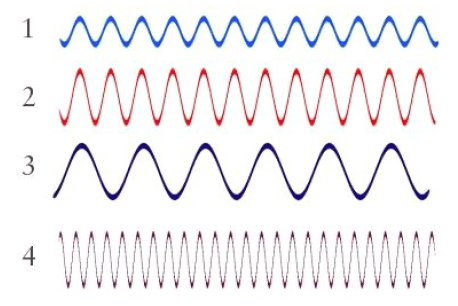
Which wave in the diagram has the greatest frequency?
a)
1
b)
2
c)
3
d)
4
90.
Which wave in the diagram has the greatest wavelength?
a)
1
b)
2
c)
3
d)
4
91.
Which wave has a greater frequency?
a)
A
b)
B
92.
It is the part of the wave where the particles are close together.  It is part A on this picture. 
a)
Compression
b)
Amplituide
c)
Rarefaction
d)
Wavelength
93.
It is the part of the wave where the particles are spread out.  It is part B in this picture. 
a)
Compression
b)
Rarefaction
c)
Amplitude
d)
Wavelength
94.
Material (matter) through which a wave travels
a)
medium
b)
Doppler Effect
c)
sound
d)
pitch
95.
What kind of wave is this?
a)
Transverse
b)
Longitudinal
96.
What kind of wave is this?
a)
Transverse Wave
b)
Longitudinal Wave
97.
Which direction does a Transverse wave travel
a)
parallel
b)
perpendicular
98.
Which direction does a compressional wave travel
a)
parallel
b)
perpendicular
99.
What phenomenon does this image demonstrate where two waves are 180 degrees out of phase?
a)
Constructive interference
b)
Destructive interference
c)
Increasing frequency
d)
Increasing period
100.
What do all waves have in common?
a)
They transfer matter.
b)
All waves travel at the same speed.
c)
They transfer energy.
d)
They transfer electricity.
101.
What is the term that applies to a wave that 'bounces off' a boundary.  (Ex. Slinky pulse changing direction)
a)
medium
b)
refraction
c)
reflection
d)
interference
102.
Which of the following can sound travel through?
a)
solid
b)
liquid
c)
gas
d)
all of the above
103.
What kind of waves can travel through space?
a)
electromagnetic waves
b)
compressional waves
c)
longitudinal waves
d)
sound waves
104.
You can't hear sounds in outer space because there is no
a)
matter
b)
light
c)
energy
d)
heat
105.
When a wave's amplitude increases it means
a)
it's carrying more energy
b)
its wavelength gets longer
c)
its frequency increases
d)
its wavelength decreases
106.
Of the following, ________ have the greatest frequency of the electromagnetic spectrum.
a)
ultraviolet rays
b)
gamma rays
c)
radio
d)
visible waves
107.
Light is a form of 
a)
energy
b)
radiation
c)
reflection
108.
Light travels in a straight line
a)
True
b)
False
109.
Visible light is ...
a)
Light bulb
b)
sun
c)
light that we can see with our natural eye
d)
fire
110.

Light waves are typically _______________ when they encounter a dark surface.

a)

refracted

b)

reflected

c)

absorbed

111.
When a sound wave hits a wall and echoes back, this is an example of what?
a)
Refraction
b)
Diffraction
c)
Reflection
d)
Interference
112.
This image is representing what wave interaction?
a)
Refraction
b)
Diffraction
c)
Reflection
d)
Interference
113.
What is the reason the pencil appears different under water?
a)
Interference
b)
Refraction
c)
Diffraction
d)
Reflection
114.
This causes rainbows
a)
Reflection
b)
Refraction
c)
Magic rays of sunshine
d)
Diffraction
115.
An interaction between 2 waves that causes a smaller amplitude
a)
Constructive interference
b)
Destructive interference
c)
Resonance
d)
Diffraction
116.
When a wave moves around a barrier or though an opening it is known as what?
a)
Diffraction
b)
Refraction
c)
Rarefaction
d)
Destruction
117.
Which wave behavior do noise cancelling headphones use?
a)
diffraction
b)
refraction
c)
constructive interference
d)
destructive interference
118.
Which letter shows reflection? 
a)
Pathway A
b)
Pathway B
c)
Pathway C
d)
Pathway D
119.
Which term explains the path of the light ray in this diagram?
a)
Convection
b)
Scattering
c)
Absorption
d)
Refraction
120.
A prism could best be described as which of the following?
a)
A triangle with an opening on one side and another side that absorbs light.
b)
A triangle object that allows light to enter and be refracted out into colors
c)
A pyramid shaped object that reflects the rats of the rainbow 
d)
A triangular object that absorbs the light from a rainbow 
121.
What are the primary colors of light?
a)
red, yellow, green
b)
red, blue, yellow
c)
red, blue, green
122.
Glass, plastic bottles, water, and air are examples of
a)
transparent
b)
translucent
c)
opaque
123.
Heat can be seen with night vision goggles or scopes is called __________.
a)
ultraviolet
b)
infrared light
c)
gamma
124.
The entire range of electromagnetic energy is called _____________.
a)
electromagnetic spectrum
b)
gamma rays
c)
frequency
d)
visible light
125.
This color has the shortest wavelength and the highest frequency.
a)
red
b)
violet
c)
green
d)
blue
126.
All colors are determined by the ___________ of the light wave.
a)
wavelength
b)
energy
c)
frequency
127.
ROY G. BIV is commonly used to help us remember the _________ spectrum.
a)
visible
b)
infrared
c)
radio
128.

________ is a lens that makes an object appear bigger

a)

prism

b)

concave

c)

convex

d)

mirror

129.

_______ is a lens that makes an object appear smaller

a)

concave

b)

convex

c)

mirror

d)

prism

130.

Why does an apple look red?

a)

because it absorbs red light and reflects white light

b)

because it absorbs red light waves and reflects the others

c)

because it absorbs all colors of light

d)

because it reflects red light waves and absorbs the others

131.

White light is made up of all of the colors of the rainbow

a)

True

b)

False

132.

Black absorbs all light and turns it to heat

a)

True

b)

False

133.

A yellow lemon absorbs the color yellow and reflects all the other colors

a)

True

b)

False

134.
Which keyword describing the structure of the eye is defined as 'the coloured part of the eye'?
a)
a) Iris
b)
b) Lens
c)
c) Cornea
d)
d) Optic nerve
135.
Which keyword describing the structure of the eye is defined as 'bends and focus the light so that it forms an image on the back of your eye'?
a)
a) Iris
b)
b) Lens
c)
c) Cornea
d)
d) Optic nerve
136.
Which keyword describing the structure of the eye is defined as 'The clear front area on the surface of the eye'?
a)
a) Iris
b)
b) Lens
c)
c) Cornea
d)
d) Optic nerve
137.
Which keyword describing the structure of the eye is defined as 'This carries the signals from your retina to your brain'?
a)
a) Iris
b)
b) Lens
c)
c) Cornea
d)
d) Optic nerve
138.
Which diagram is defined as 'Light passes straight through'?
a)
A
b)
B
c)
C
d)
D
139.

what helps us see color

a)

rods

b)

cones

c)

lens

d)

color wheel

140.

Cones team up with ______ so that you can see the total picture:

a)

rods

b)

cones

c)

pupil

d)

glasses

141.

This term describes objects that transmit no light.

a)

Transparent

b)

Translucent

c)

Opaque

d)

Diffusion

142.

This term describes objects that transmit some light.

a)

Transparent

b)

Translucent

c)

Opaque

d)

Diffusion

143.

This term describes objects that transmit all light.

a)

Transparent

b)

Translucent

c)

Opaque

d)

Diffusion

144.

Which tool was used to disperse white light into a rainbow?

a)

Prism

b)

Tuning Fork

c)

Concave Leos

d)

Convex Lens?

145.

1) Electromagnetic energy travels in waves. These waves can vary in their frequencies and wavelengths. Electromagnetic energy is classified by the length and frequency of its wave. Of the four waves types below, which has the lowest frequency?

a)

microwaves

b)

gamma rays

c)

ultraviolet waves

d)

visible light waves

146.

Which of these is an example of an electromagnetic wave?

a)

Radio Wave

b)

Sound Wave

c)

Ocean Wave

d)

Gravitational pull

147.

What medium does the sound wave travel through to get from the car to your ears?

a)

air

b)

a vacuum

c)

large vibrations

d)

energy

148.

Which of the following materials is translucent?

a)

pure air

b)

clear glass

c)

frosted glass

d)

construction paper