
 Worksheets
MidYear Review
Total questions: 150
Worksheet time: 3hrs 39mins
Name
Class
Date
1.
In which layer of the atmosphere does weather occur?
a)
a. Thermosphere
b)
b. mesosphere
c)
c. troposphere
d)
d. exosphere
2.
This layer is where auroras are found
a)
exosphere
b)
thermosphere
c)
exosphere
d)
mesosphere
3.
As you go higher in the troposphere, the temperature _______________.
a)
decreases
b)
increases
c)
stays the same
d)
gets very hot
4.
This gas makes up 78% of the atmosphere
a)
oxygen
b)
nitrogen
c)
ozone
d)
carbon dioxide
5.
21% of the air is made up of this gas.
a)
Nitrogen
b)
Argon
c)
Oxygen
d)
Carbon Dioxide
6.
Where is the ozone layer located?
a)
Mesosphere
b)
Thermosphere
c)
Stratosphere
d)
Troposphere
7.
The main factor that causes any wind to blow is ...
a)
a. Uneven heating of the Earth's atmosphere.
b)
b. Differences in air pressure and humidity.
c)
c. Warm air from the poles meeting the cold ait from the equator.
d)
d. The even heating of the Earth's atmosphere.
8.
Air always blows from
a)
a. High pressure to low pressure
b)
b. Hot air to cold air
c)
c. low pressure to high pressure
d)
d. East to west
9.
Warm air _________ and cool air ___________.
a)
rises/sinks
b)
sinks/rises
10.
If there are two forces going in the same direction how would you find the net force?
a)
Subtract
b)
Add
c)
Neither
d)
Multiply
11.
You and your dad are moving the couch from one side to another. Your dad pushes with a force of 35 N to the right and you push with a force of 25 N right. What is the net force on the couch?
a)
60 N right
b)
10 N left
c)
60 N right
d)
50 N left
12.
What is a force?
a)
the PUSH or PULL on an object
b)
The MOTION an object creates
c)
The objects HITTING one another
d)
Going REALLY FAST
13.

Which one is balanced?
a)
Top
b)
Bottom
c)
Both
d)
Cannot be determined
14.

What is the net force?
a)
17 N Right
b)
3 N Right
c)
3 N Left
d)
17 N Left
15.
If a man and woman push each other in opposite directions at both 9 N, what is the net force?
a)
81 N
b)
18 N
c)
1 N
d)
0 N
16.
Force: 23 N to the right, 23 N to the right. What is the net force?
a)
46 N right
b)
0 N Left
c)
1 N Left
d)
529 N Right
17.
A runner races in the 100 meter dash. It takes her 10 seconds to finish. What is her average speed?
a)
10 m/s
b)
1000 m/s
c)
100 seconds
d)
10 seconds
18.
What is velocity?
a)
the quickness of an object
b)
the location of an object
c)
acceleration
d)
speed in a specific direction
19.
Acceleration is
a)
increasing speed
b)
decreasing speed
c)
changing direction
d)
all of the above
20.
Which type of force(s) will cause a change in an object's motion?
a)
equal forces
b)
zero net force
c)
balanced forces
d)
unbalanced forces
21.
What is the name for a push or pull?
a)
A movement
b)
A force
c)
Speed
d)
Density
22.

Calculate the net force.
a)
5 N
b)
10 N
c)
45 N
d)
500 N
23.
What is speed?
a)
how far you go
b)
how much distance is covered over a period of time
c)
how fast you accelerate
d)
the change in the location of a object
24.
Alan travels 100km in 5hrs. Find his average speed in km/h
a)
5km/hr
b)
10km/hr
c)
50km/hr
d)
20km/hr
25.
What two measurements are necessary for calculating speed?
a)
Mass and time
b)
Temperature and mass
c)
Mass and distance
d)
Distance and time
26.

What is the net force?
a)
5000 N right
b)
4000 N right
c)
40 N left
d)
4000 N left
27.
If there are two forces going in opposite directions, would you add or subtract them to find the net force?
a)
Add
b)
Subtract
c)
Multiply
d)
Neither
28.
When a car goes around a corner at 20 mph, why do we say it accelerates?
a)
The car is accelerating because of the velocity is constant
b)
The car accelerates because it's going 20 mph
c)
Cars always accelerate when they are in motion
d)
The car is accelerating because it's changing direction
29.

What does this graph represent?
a)
Constant speed
b)
Acceleration
c)
Not moving
d)
Turning around
30.

What is happening at C?
a)
Stationary
b)
Accelerating
c)
Fast steady speed; moving away from the starting position
d)
Slower steady speed; moving away from the starting position
31.

What is happening at D?
a)
Stationary
b)
Accelerating
c)
Fast steady speed; moving away from the starting position
d)
Slower steady speed; moving away from the starting position
32.

What is happening at B?
a)
Stationary
b)
Accelerating
c)
Slower steady speed; moving away from the starting position
d)
Steady speed; returning to start position
33.

What is happening at A?
a)
Stationary
b)
Accelerating
c)
Slower steady speed; moving away from the starting position
d)
Steady speed; returning to start position
34.

LT4: The graph shows Ashley riding her bike to Maria's house.
What was occurring from point B to point C?
What was occurring from point B to point C?
a)
She was increasing her speed.
b)
She stopped for 4 minutes.
c)
She was decreasing in speed.
d)
She turned around and went home.
35.
Find the average speed of a train that traveled 540 km in 6 hours?
a)
80 km/h
b)
100 km/h
c)
90 kn/h
d)
3240 km/h
36.

Which car is accelerating?
a)
A car that is not moving
b)
A car that rounds a curve at a constant speed
c)
A car traveling at a constant speed
d)
A car that has a set speed of 60mph
37.
With unbalanced forces, the object will move in the direction of the _______ force.
a)
larger
b)
smaller
c)
equal
d)
cannot be determined
38.
Peanut ran 50 meters in 10 seconds. What was Peanut's average speed?
a)
2 m/s
b)
5 km/h
c)
5 m/s
d)
5 m/s North
39.
When an object has a net force of 0 N, it is an example of what kind of force?
a)
Balanced
b)
Unbalanced
c)
Acceleration
d)
Gravity
40.
If we drop a steel sphere and a ping pong ball, the steel sphere will...
a)
hit the ground first because it has more mass
b)
hit the ground second because it takes longer to accelerate
c)
hit the ground at the same time as the ping pong ball
41.
The net force is
a)
The force you feel when you catch a fish in a net
b)
The force acting upward on a sky diver
c)
the combination of all of the forces acting on an object
d)
always unbalanced
42.
Which of the options below is an example of velocity?
a)
20 m/s
b)
200 km/h
c)
20 m/s East
d)
20 East
43.
The SI base unit of the quantity "length" is ________?
a)
centimeter
b)
millimeter
c)
kilometer
d)
meter
44.
if you walk from your house to the supermarket a distance of 40m then you come back to your home, your displacement is ________?
a)
0m
b)
+40m
c)
-40m
d)
80m
45.

Which graph represents an object at rest?
a)
1
b)
2
c)
3
d)
4
46.

Which graph represents an object moving at constant positive velocity?
a)
1
b)
2
c)
3
d)
4
47.

Which graph represents an object moving with constant positive acceleration?
a)
1
b)
2
c)
3
d)
4
48.
A 60N force is pushing a box of 2kg for 10m. What is the work done on the box?
a)
20J
b)
30J
c)
120J
d)
600J
49.

What type of energy is the vibration and movement of molecules, creating heat?
a)
Thermal
b)
Radiant
c)
Electrical
d)
Potential
50.
What is...
The ability to do work – cause change
(vocabulary word)
The ability to do work – cause change
(vocabulary word)
a)
Energy
b)
Work
c)
Power
d)
Watt
51.
What is the unit used to express work ?
a)
Joule
b)
Watt
52.
What is unit used to express power?
a)
Watt
b)
Joule
53.
What is the energy of motion?
a)
Kinetic
b)
Potential
c)
Chemical
d)
Gravitational
54.

What is the energy an object has because of its position or shape?
a)
Potential
b)
Kinetic
c)
Radiant
d)
Thermal
55.
How much work is done if Seth moves a 20 N boulder 4m?
a)
80J
b)
80W
c)
5J
d)
5W
56.
How much power is created if Jayden S. does 20J of work in 2 seconds?
a)
10W
b)
10J
c)
2J
d)
2W
57.
Which of the following is a unit for acceleration?
a)
km/s
b)
m/s2
c)
mi/hr
d)
ft
58.
Acceleration of an object happens when things ________
a)
slow down
b)
go faster
c)
change direction (turn)
d)
All of the above
59.

The graph below represents
a)
Speed
b)
Velocity
c)
Acceleration
d)
Deceleration
60.

The graph represents
a)
Acceleration
b)
No motion
c)
Deceleration
d)
Constant Velocity
61.

The graph represents
a)
No motion
b)
Constant velocity
c)
Acceleration
d)
Deceleration
62.

The graph respresents
a)
No motion
b)
Constant Velocity
c)
Acceleration
d)
Deceleration
63.

The graph represents
a)
no motion
b)
Constant velocity
c)
Acceleration
d)
negative acceleration
64.

The graph represents
a)
no motion
b)
constant velocity
c)
acceleration
d)
negative acceleration
65.
A place or object used for comparison to determine if another object is in motion is called a
a)
comparison point
b)
reference point
c)
point of view
d)
motion detector
66.

Calculate the average speed (in meter/sec) if a cheetah runs 180 meters in 10 seconds.
a)
198 m/sec
b)
170 m/sec
c)
12 m/sec
d)
18 m/sec
67.
How far will a person go if they jog for 2 hours at a speed of 12 km/hr?
a)
6 km
b)
0.5 km
c)
10 km
d)
24 km
68.
You walk 10 meters to math class in 20 seconds. Your average speed is
a)
2 m/s
b)
0.5 m/s
c)
200 m/s
d)
5 m/s
69.
Shona cycles at an average speed of 8km/h. How far has she travelled if she cycles for 4 hours?
a)
55km
b)
32km
c)
43km
d)
32miles
70.
The correct equation to calculate speed is
a)
distance/time
b)
time/distance
c)
distance x time
d)
distance/time2
71.
Total distance divided by total time is
a)
average speed
b)
constant speed
c)
instantaneous speed
d)
acceleration
72.
Can be measured in seconds (s)
a)
Distance
b)
Time
c)
Speed
d)
Acceleration
73.
A description of the speed and direction of an object's motion
a)
Velocity
b)
Speed
c)
Acceleration
d)
Vector
74.

How will this object move?
a)
It won't move.
b)
It will move to the right.
c)
It will move to the left.
d)
It will move up.
75.

How will this object move?
a)
It won't move.
b)
It will move to the right.
c)
It will move to the left.
d)
It will move in both directions.
76.

What is the net force?
a)
30 N left
b)
25 N right
c)
5 N left
d)
55 N right
77.

What is the net force?
a)
40 N left
b)
0 N Balalnced
c)
400 N right
d)
40 N right
78.
Which could be an example of a balanced force?
a)
An asteroid moving at a constant speed through space
b)
A car accelerating from a stop sign
c)
A box of dishes falling from a counter
d)
A rocket taking off
79.
Which could be an example of an unbalanced force?
a)
A plate sitting on a dining table
b)
A ball at the top of a hill that is not moving
c)
Earth orbiting the Sun
d)
A baseball that has been thrown to home plate.
80.

Calculate the Net Force.
a)
60N, Left
b)
40N, Right
c)
0N
d)
60N, Right
81.

What is the net force?
a)
10 N
b)
0 N
c)
25 N
d)
1 N
82.
What is the name of the steady winds that flow from west to east between latitudes 30*N and 60*N and 30*S and 60*S?
a)
trade winds
b)
land breeze
c)
westerlies
d)
jet stream
83.
Why do land breezes occur at night?
a)
Land cools off slower than water, so the air above water is cooler.
b)
Water cools off faster than land, so the air above land is warmer.
c)
Land heats up slower than water, so the air stays cooler during the day.
d)
Water cools off slower than land, so the air above water is warmer.
84.
Steady winds that flow from east to west between 30*N latitude and 30*S latitude?
a)
jet stream
b)
breeze
c)
westerlies
d)
trade winds
85.
Which global winds have the greatest impact on the weather in the US?
a)
trade winds
b)
westerlies
c)
doldrums
d)
polar easterlies
86.
Winds that blow steadily over the long distance in a predictable direction.
a)
a. local winds
b)
b. global winds
c)
c. land breeze
d)
d. land breeze
87.
The movement of air from the land to the water.
a)
a. gloabal winds
b)
b. sea breeze
c)
c. land breeze
d)
d. local winds
88.
What are the 5 layers of the atmosphere in order?
a)
a. Troposphere, mesosphere, thermosphere, mesosphere, and exosphere
b)
b. Troposphere, stratosphere, mesosphere, thermosphere, and exosphere
c)
Mesosphere, thermosphere, stratosphere, troposphere, and exosphere
d)
d. Exosphere, thermosphere, mesosphere, stratosphere, and troposphere
89.
What type of winds blow inconsistently, can be influenced by geography, and can blow in any direction?
a)
land breezes
b)
mountain breezes
c)
global winds
d)
local winds
90.
What is the relationship between air pressure and wind?
a)
wind blows from areas of low pressure to high pressure
b)
there is no relationship
c)
wing changes air pressure
d)
wind blows from areas of high pressure to low pressure
91.
If you wanted to visit an area with very little wind, where might you go?
a)
The doldrums around the equator
b)
the jet streams in the northern and southern hemisphere
c)
the North or South Pole
d)
the area around the Mediterranean Sea
92.
How do jet streams influence the weather?
a)
by creating clouds
b)
by increasing the moisture in the atmosphere
c)
by moving weather from one area to another very quickly
d)
by drying out the atmosphere
93.
The reason why global winds flow from east to west and west to east, but not north to south, or south to north.
a)
Bernoulli's principle
b)
Coriolis effect
c)
high pressure
d)
low pressure
94.
When Earth's rotation causes the wind to curve
a)
cloudy
b)
Coriolis effect
c)
high pressure
d)
low pressure
95.
When heat rises cools then sinks
a)
high pressure
b)
convection current
c)
low pressure
d)
stratospheric pressure
96.
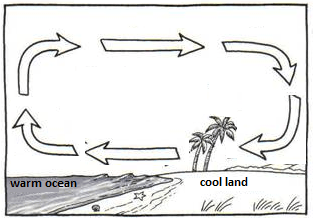
What kind of breeze is this and when would it form?
a)
Land breeze - daytime
b)
Land breeze - nighttime
c)
Sea breeze - daytime
d)
Sea breeze - nighttime
97.
Which global winds have the greatest impact on the weather in the US?
a)
trade winds
b)
prevailing westerlies
c)
doldrums
d)
polar easterlies
98.
Why do land breezes occur at night?
a)
Land cools off slower than water, so the air above water is cooler.
b)
Water cools off faster than land, so the air above land is warmer.
c)
Land heats up slower than water, so the air stays cooler during the day.
d)
Water cools off slower than land, so the air above water is warmer.
99.

The curving of air to the right in the Northern hemisphere is caused by ___________ and is called the _________ effect.
a)
Earth's rotation...Coriolis
b)
Earth's revolution...Coriolis
c)
Earth's rotation...Doppler
d)
Earth's revolution...Doppler
100.
What is the coriolis effect?
a)
The influence of Earth's rotation on global winds
b)
the influence of Earth's rotation on local winds
c)
the influence of earth's rotation on both global and local winds
d)
all of the above
101.
Near the top of the troposphere is a narrow band of high speed winds called the______.
a)
westerlies
b)
jet stream
c)
trade winds
d)
local winds
102.
Steady winds that flow from east to west between 30*N latitude and 30*S latitude?
a)
jet stream
b)
breeze
c)
westerlies
d)
trade winds
103.
Why is it warmer at the equator than at the poles?
a)
a. The sun strikes at a very slanted angle at the equator.
b)
b. The sun strikes the Earth at a 90 degree angle at the equator.
c)
c. The sun strikes at the most direct angle at both poles.
d)
d. The sun strikes the Earth at a 90 degree angle at the poles.
104.
What impact does the Coriolis effect have upon global winds in the northern and southern hemispheres?
a)
Global winds blow counterclockwise in the northern hemisphere and clockwise in the southern hemisphere.
b)
Global winds blow clockwise in the northern hemisphere and counterclockwise in the southern hemisphere.
c)
Global winds flow clockwise in both the northern and southern hemispheres.
d)
The Coriolis effect has no impact upon global winds in the northern and southern hemispheres.
105.

Which diagram shows the formation of a sea breeze?
a)
diagram Y
b)
diagram X
c)
neither
d)
both
106.

Which diagram shows the formation of a land breeze?
a)
diagram Y
b)
diagram X
c)
neither
d)
both
107.
The Coriolis effect causes ___________.
a)
the Earth to rotate on its axis
b)
continental deflection
c)
global winds and surface currents to move in a curved path instead of a straight line
d)
global winds and deep ocean currents to move in a curved path instead of a straight line.
108.
What causes global winds and convection in the atmosphere?
a)
continental deflection
b)
the rotation of the Earth
c)
Moon's gravity
d)
unequal heating of the Earth by the sun
109.
Where does the initial source of energy come from that creates winds?
a)
the moon
b)
the sun
c)
the Earth's surface
d)
the rotation of the Earth
110.
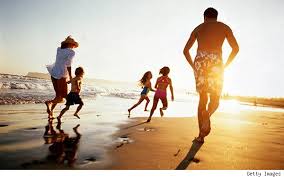
The sun shines down on this family as the play on the beach.
a)
conduction
b)
convection
c)
radiation
111.

A group of friends gather around a fire to stay warm.
a)
conduction
b)
convection
c)
radiation
112.

Walking on the warm sand sand with your bare feet.
a)
conduction
b)
convection
c)
radiation
113.

Blow drying your wet hair.
a)
conduction
b)
convection
c)
radiation
114.
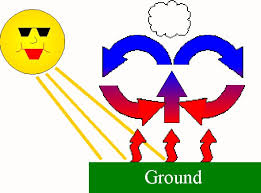
Warm air rises and the cool air sinks.
a)
conduction
b)
convection
c)
radiation
115.
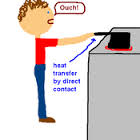
Johnny accidentally grabbed the handle of the hot pot.
a)
conduction
b)
convection
c)
radiation
116.

The chocolate bunny and the iron.
a)
conduction
b)
convection
c)
radiation
117.

The chocolate bunny and the blow dryer.
a)
conduction
b)
convection
c)
radiation
118.
How does heat energy from the sun reach Earth?
a)
conduction
b)
convection
c)
insulation
d)
radiation
119.
In which direction do prevailing westerlies flow?
a)
from east to west
b)
from west to east
c)
from north to south
d)
from south to north
120.
Which types of winds cause weather in North Carolina?
a)
polar easterlies
b)
prevailing westerlies
c)
polar westerlies
d)
prevailing easterlies
121.
An objects tendency to stay at rest or resist a change in motion
a)
Inertia
b)
Force
c)
Acceleration
d)
Reaction
122.
Any change in an objects speed or direction
a)
Inertia
b)
Force
c)
Acceleration
d)
Reaction
123.
A push or a pull measured in Newtons
a)
Inertia
b)
Force
c)
Acceleration
d)
Reaction
124.
For every _________ there is an equal
a)
Action
b)
Pair
c)
Force
125.
You calculate speed by…..
a)
D/T
b)
DxT
c)
T + D
d)
None of the above
126.
Newton's first law is called the Law of _________ because it says that objects resist changes in their motion
a)
FMA
b)
Inertia
c)
Action/Reaction
d)
None of the above
127.
Newton's 2nd Law demonstrates the relationship between force, mass and acceleration. How do we calculate force?
a)
Mass x Acceleration
b)
Mass/ Acceleration
c)
Mass- Acceleration
d)
None of the Above
128.
Work equals __________and must be measured in__________
a)
Force x Distance; Newtons
b)
Force x Mass: Joules
c)
Force x Distance; Joules
d)
Force x Mass; Newtons
129.
This organelle takes food and turns it into ENERGY for plant and animal cells.
a)
Chloroplast
b)
Mitochondria
c)
Lysosome
d)
Ribosome
130.
The site of photosynthesis
a)
ribosome
b)
mitochondria
c)
chloroplast
d)
nucleus
131.
The ___________ is the basic unit of life
a)
organ
b)
cell
c)
atom
d)
tissue
132.
When many organ systems work together it can form...
a)
organ
b)
cells
c)
organ system
d)
organism
133.

This is a example of........
a)
organ system
b)
cells
c)
organ
d)
tissue
134.

This is a example of ........
a)
cell
b)
organ system
c)
organ
d)
tissue
135.
The brain is a part of which organ system?
a)
nervous
b)
skeletal
c)
muscular
d)
digestive
136.
Which organelle is only found in a plant cell?
a)
nucleus
b)
chloroplast
c)
mitochondria
d)
cell membrane
137.

Directs all cell activities through the DNA located there.
a)
Lysosomes
b)
Nucleus
c)
ribosomes
d)
Mitochondria
138.
Which of the following is directly involved in the transportation of materials inside/within the cell?
a)
Endoplasmic Reticulum
b)
Vacuole
c)
Lysosome
d)
Mitochondria
139.

What is the name of the genetic material that is inside the nucleus?
a)
ER
b)
ATP
c)
YOLO
d)
DNA
140.

Which part of the cell is often called "the brain of the cell"?
a)
nuclear membrane
b)
endoplasmic reticulum
c)
nucleus
d)
mitochondria
141.
What is found in both plant and animal cells but is much larger in plant cells?
a)
Nucleus
b)
Mitochondria
c)
Chloroplast
d)
Vacuole
142.
Where are proteins made?
a)
Golgi body
b)
Mitoichondria
c)
Chromosomes
d)
Ribosomes
143.

I am the outer most layer of an animal cell. What am I?
a)
cell wall
b)
nucleus
c)
cell membrane
d)
cell skin
144.

A rigid layer that lies outside the cell's membrane is...
a)
Cytoskeleton
b)
Cilia
c)
Cell Wall
d)
Flagella
145.
What is the gel-like substance inside of cells called?
a)
photoplasm
b)
photosynthesis
c)
cytoskeleton
d)
cytoplasm
146.

Robert Hooke, Anton van Leeuwenhoek, Theodor Schwann, Rudolf Virchow, and Matthias Schliden were all responsible for what theory?
a)
The Theory of Gravity
b)
The Theory of Relativity
c)
The Cell Theory
d)
The Theory of Continental Drift
147.
Controls what enters and leaves the cell
a)
Mitochondria
b)
Cell Membrane
c)
Cell Wall
d)
Nucleus
148.

What do all of these organisms have in common?
a)
They all have uniform offspring
b)
They are all made of cells
c)
They possess the same features
d)
They have the same internal and external structures
149.

According to cell theory, where did this cell come from?
a)
another living cell
b)
energy from sun
c)
a multicellular organism
d)
the nonliving environment
150.
An organism made of one cell is called
a)
unicellular
b)
multicellular
100 %

