
 Worksheets
Population
Total questions: 37
Worksheet time: 14mins
Name
Class
Date
1.
What is demography?
a)
The study of land forms in a region
b)
A type of map projection
c)
The study of the government over an area
d)
The scientific study of population characteristics
2.
Approximately how many people live on Earth?
a)
7 billion
b)
6 billion
c)
5 billion
d)
6.5 billion
3.
The amount of people living in a given area is described as population
a)
expectancy
b)
morality
c)
density
d)
rate
4.
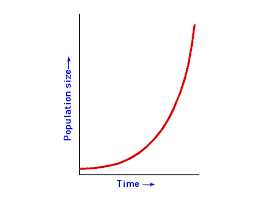
What type of growth is shown in the diagram?
a)
exponential growth
b)
logistic growth
c)
predator-prey cycle
d)
boom-bust curve
5.
The point in which an area cannot hold any more individuals in an area is called its what?
a)
carrying capacity
b)
capital capacity
c)
carrying capability
d)
limiting point
6.
If the number of births in a population is the same as the number of deaths in a population, what will happen to the growth of the population?
a)
It will increase
b)
It will decrease
c)
It will stay the same
d)
It don't matter
7.
If the number of births is greater than the number of deaths in a population, what will happen to the growth of the population?
a)
It will increase
b)
It will decrease
c)
It will stay the same
d)
It don't matter
8.
An environmental factor such as storms and extreme heat or cold that affects population regardless of their density
a)
density- dependent factor
b)
population density
c)
dispersion
d)
density- independent factor
9.
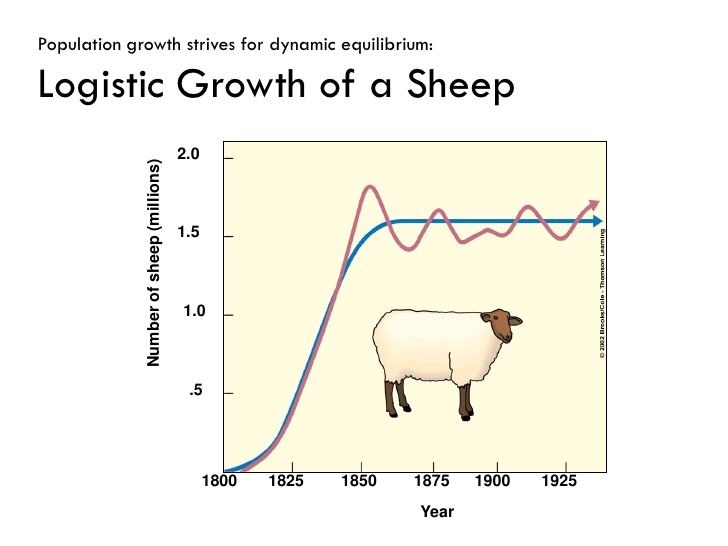
What is the carrying capacity for this sheep population?
a)
1.8 million
b)
1.25 million
c)
1.6 million
d)
1.o million
10.
An environmental factor such as predation, disease, and competition that depends on the number of members in a population per unit
a)
dispersion
b)
density- independent factor
c)
density- dependent factor
d)
population growth rate
11.

When a population grows past the ecosystem's carrying capacity, what happens to the population?
a)
Continues to grow
b)
The population starts to die off to return to carrying capcity
c)
The population will go extinct due to lack of resources
d)
The population grows then finds a new carrying capacity
12.

In a forest ecosystem, which of the following is the best example of a limiting factor for a rabbit population?
a)
Squirrel Population
b)
Sunlight
c)
Grass available
13.

Any thing or organism that regulates the size of a population is known as __________.
a)
a limiting measure
b)
a limiting factor
c)
carrying capacity
d)
biodiversity
14.
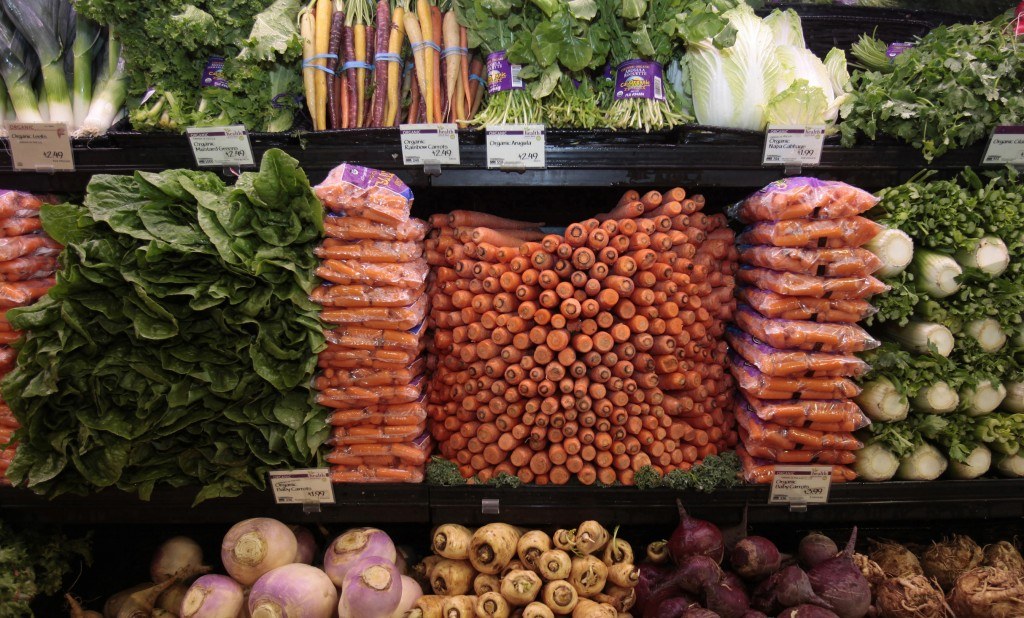
Which of the following would INCREASE the carrying capacity of an ecosystem?
a)
increase in predators
b)
disease
c)
increase in available food
d)
drought
15.
If the population of a certain predator increases, there is often _______ its prey
a)
a decrease the population of
b)
an increase of the population of
c)
great news for its prey of
d)
no impact found on
16.
A relationship between two species in which one species benefits and the other is neither helped nor harmed.
a)
Mutualism
b)
Symbiosis
c)
Commensalism
d)
Parasitism
17.
All members of one species in a certain area.
a)
Population
b)
Limiting Factors
c)
Immigration
d)
Birth Rate
18.
A snake is eaten by a hawk. The hawk is the _______.
a)
prey
b)
parasite
c)
predator
d)
all of these
19.
A species that is not native to an area is called:
a)
Native Species
b)
Natural Species
c)
Invasive Species
d)
Symbiotic Species
20.
Coral reefs are....
a)
In the ocean
b)
In Lakes
c)
In Rivers
d)
In Ponds
21.
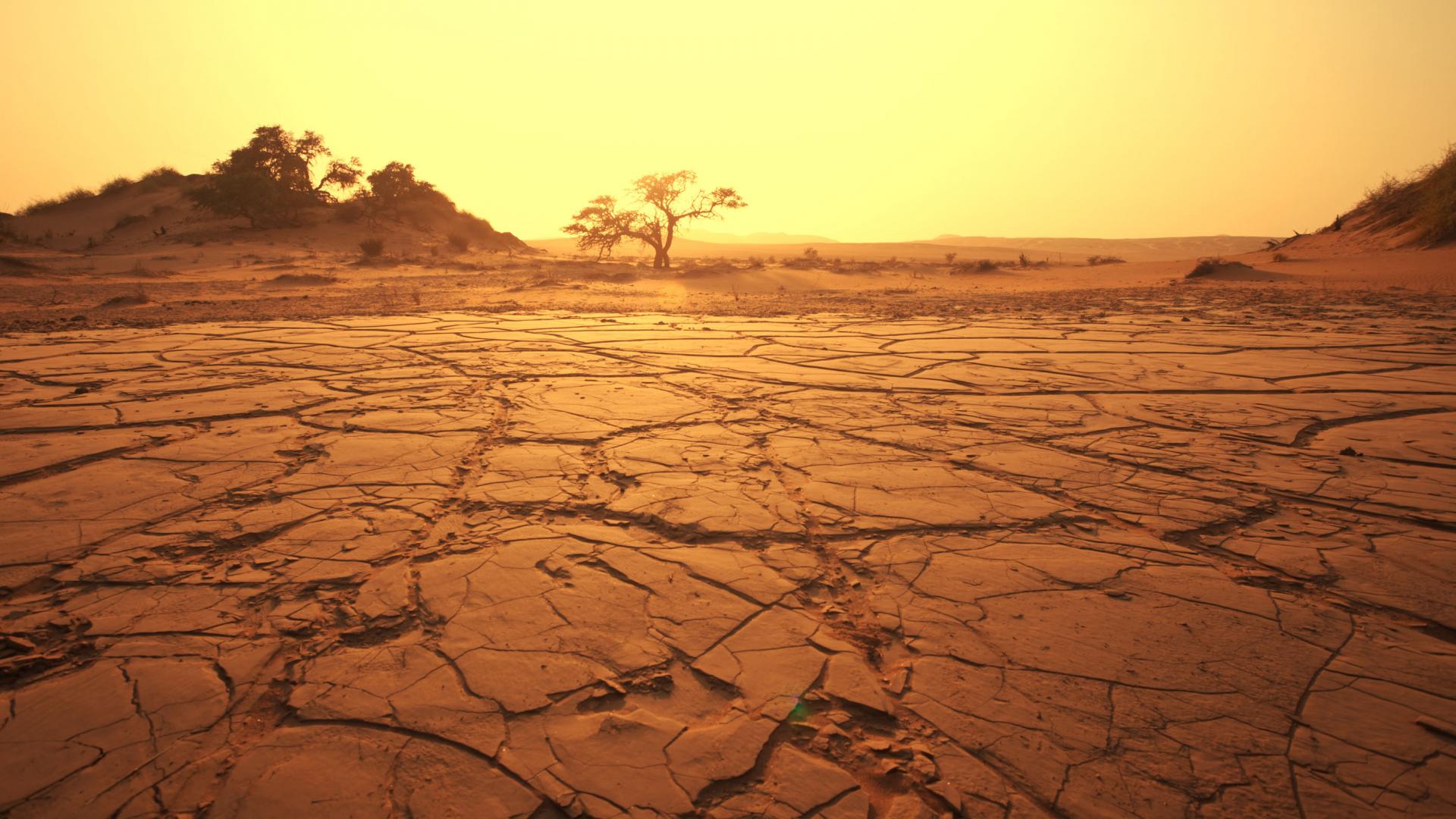
Which biome is the driest?
a)
Desert
b)
Tundra
c)
Taiga
d)
Rainforest
22.
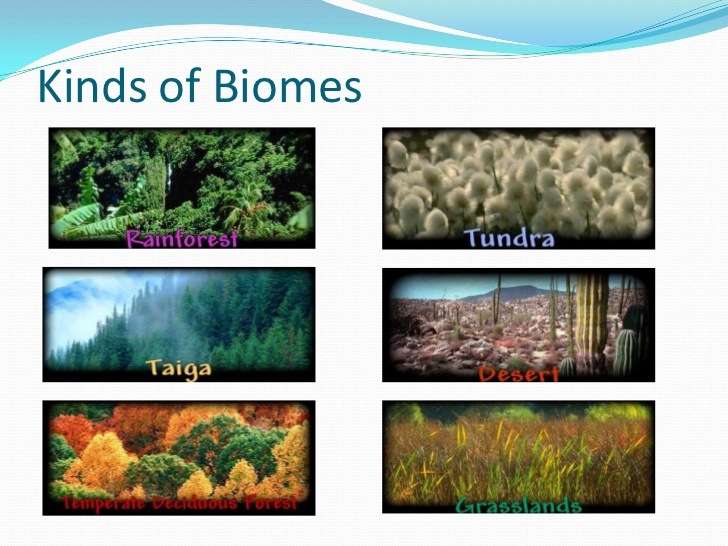
What is the main factor that separates the biomes?
a)
Land
b)
Water
c)
Climate
d)
Longitude
23.
What are the different kinds of marine biomes?
a)
coral reefs, estuaries, and oceans
b)
rivers, lakes and oceans
24.
A living or once-living organisms in an ecosystem is a
a)
population
b)
biotic factor
c)
abiotic factor
d)
community
25.
A nonliving element in an ecosystem is an
a)
animal
b)
abiotic factor
c)
biotic factor
d)
organism
26.

dead log
a)
biotic
b)
abiotic
27.
Is sunlight an abiotic or biotic factor?
a)
abiotic
b)
biotic
28.
Humans are causing extiction in which ways?
a)
By over hunting animals for food or products.
b)
By destroying the natural habitat of species.
c)
By polluting the environments of the world.
d)
All of the above.
29.
Which of the following species is extinct?
a)
woolly mammoth
b)
giant panda
c)
bald eagle
d)
green sea turtle
30.
What word do we use to describe a species which has no members still living?
a)
endangered
b)
extinct
31.
What does endangered mean?
a)
It means that it no longer exits.
b)
It means that an organism is under threat or near extintion.
c)
It means that it is in great number.
32.

What does biodiversity mean?
a)
Only one species in an area.
b)
The different amount of species in an area
c)
All abiotic life
d)
Nitrogen fixation
33.
The illegal capture or killing of an organism, often for money, is called...
a)
poaching
b)
harvesting
c)
fragementation
d)
extinction
34.
All living and nonliving things in an environment and the many ways they interact are called ______
a)
ecosystem
b)
community
35.
What characteristic do all renewable resources share?
a)
Produced by waste products
b)
Form underground from dead organisms.
c)
Replaced in a short period of time
d)
Allow energy to pass through them easily
36.
Which of the following is a fossil fuel?
a)
Wind
b)
Coal
c)
Solar
d)
Biomass
37.
Q.NO. 7 Which of the following is a cause of environmental degradation?
a)
Population explosion
b)
Increasing urbanization
c)
Rapid industrialization
d)
ALL of these
100 %

