wayground logo

Free Printable Worksheets

NEW

Font size

S
M
L
XL
Worksheets

Political Revolutions

Total questions: 52

Worksheet time: 29mins

Name
Class
Date
1.

Lawyers, craftsmen, merchants, and commoners make up which estate?

a)

First Estate

b)

Second Estate

c)

Third Estate

d)

Estates General

2.
Which of the following fueled French desires to revolt against the monarchy?
a)
The Reign of Terror and the Ideas of the Enlightenment
b)
The Napoleonic Code and ideas of the Enlightenment
c)
Ideas of the Enlightenment and the American revolution
d)
The Scientific Revolution and the Reign of Terror
3.

The clergy and church officials made up which estate?

a)

First Estate

b)

Second Estate

c)

Third Estate

d)

Estates General

4.

The nobles made up which Estate?

a)

First Estate

b)

Second Estate

c)

Third Estate

d)

Estates General

5.
Which of the following was a cause of the French Revolution?
a)
unequal tax burdens; the Third Estate paid all of the taxes
b)
a growing French Empire
c)
a law granting peasants more freedom
d)
equal land ownership
6.
Who was the king of France during the French Revolution?
a)
Louis XVI
b)
Peter the Great
c)
Robespierre
d)
Marquis de Lafayette
7.

What was the purpose of the Tennis Court Oath?

a)

To raise taxes of the the Third Estate

b)

Write a constitution for France and limit the king's power

c)

To make plans to storm the Bastille

8.
Why did the Commoners want to destroy the Bastille?
a)
It as a symbol of the king and everything wrong with France
b)
It would end the revolution in France
c)
The nobles were hiding there
d)
They were following the orders of Napoleon
9.
Which of the following was a cause of the French revolution?
a)
government debt due to overspending and involvement in wars
b)
France had a surplus of food due to bountiful harvests
c)
men between the ages of 18-25 were required to join the army
d)
France had no king to lead the country
10.
How did Napoleon address the economic issues of the French Revolution?
a)
He gave all French citizens enough money to live
b)
He created a more fair tax system
c)
He allowed Nobles to officially enslave their peasants
11.

How did Napoleon end the chaos of the French Revolution?

a)

He continued to use the guillotine against his enemies

b)

He worked with the Directory to bring peace

c)

He stabilized the country with his new policies

d)

He decreased the size of the military

12.
This map represents what portion of the French Revolution?
a)
Napoleonic Wars
b)
Storming of the Bastille
13.

How did the Robespierre and the Jacobins “protect” the revolution during the Reign of Terror?

a)

Supported constitutional monarchy and separation of power

b)

Adopted Locke’s natural rights to form a new government

c)

Used the guillotine to establish an unlimited government

d)

Restored an absolute monarchy with King Robespierre

14.
Which of the following best describes France's relation with neighbor monarchs during the FR?
a)
Threatened to invade France to protect their own country
b)
They ignored what was happening in France
c)
They supported the revolution
d)
They tried to help Robespierre find fleeing nobles
15.
How did Louis XVI react to his newly limited power?
a)
He worked with the people to improve daily life in France
b)
He started the Reign of Terror to remove his enemies
c)
He and his family tried to flee the country and escape
d)
He declared war on neighboring countries
16.
How did the Reign of Terror change the French Revolution?
a)
The original problems in France were all solved
b)
The French were taken over by neighboring Austria
c)
Robespierre used unlimited power to help the peasants
d)
Revolution took a radical turn as thousands were executed
17.
What does this images tell you about the Reign of Terror?
a)
Only the nobles were targeted and executed
b)
No citizen was safe, even 3rd Estate members
c)
The middle class was not impacted
d)
All citizens were treated as equals
18.
Which of the following was NOT one of Napoleon's mistakes that ended his rule in France?
a)
The invasion of Russia
b)
The blockade of Britain
c)
The invasion of Egypt
d)
The Peninsular War
19.

1. In France, the social classes were called:

a)

Groups

b)

States

c)

Estates

d)

Cliques

20.

Who paid all the taxes in France?

a)

First Estate

b)

Second Estate

c)

Third Estate

21.

What economic problems contributed to the causes of the French Revolution?

a)

unemployment

b)

bankruptcy and debt

c)

food shortages lead to high prices

d)

all of the above

22.

How did the Third Estate view Louis XVI

and Marie Antoinette?

a)

They were disliked because they were

unresponsive to the needs of the lower class

b)

They were loved because they “let them eat

cake”

c)

They were loved because they ruled by

divine right

d)

They were disliked because they were too

harsh on the First and Second Estate

23.

Which of the following statements explains how the leadership of King Louis XVI was a cause of revolution?

a)

He was concerned for the citizens of France & listened to their problems

b)

He was considered a weak ruler & often made poor decisions

c)

He was very careful with his spending and saved money

d)

He was cautious and did not get involved in wars

24.

Louis’ calling of the Estates General is

viewed as a cause of the revolution. Why was the organization of the Estates

General a problem?

a)

Unfair voting system

b)

Voting always ended in a tie

c)

The Third Estate always held the majority

(won)

d)

The First and Second Estates were under

represented (always lost)

25.

What was the 3rd Estate’s proposed solution to the organization of the

Estates-General?

a)

Creating the French Republic

b)

Expanding the French empire

c)

The concept of one man, one vote

d)

Giving unlimited power to the king

26.

What were the reactions of the Third

Estate when their demands were denied at the Estates General?

a)

Started the Reign of Terror

b)

Created a republic

c)

Formed the National Assembly

d)

Gave Napoleon absolute power

27.

When they took the Tennis Court Oath, the

Third Estate vowed to…

a)

Create a new absolute monarchy

b)

Establish a Committee of Public Safety

c)

Vote to tax the nobles

d)

Write a new constitution for the

government

28.

What was the reaction of the peasants to all the problems in France after the Third Estate created the National Assembly?

a)

The execution of the king

b)

The storming of the Bastille

c)

The Reign of Terror

d)

The reign of Napoleon

29.

King Louis XVI was executed on January 15, 1793 because:

a)

he refused to sign a document giving away all of his power

b)

he was found guilty of treason against France

c)

he was found guilty of starting the Reign of Terror

30.

What document gave French citizens the rights of liberty, property, security, and resistance to oppression?

a)

Tennis Court Oath

b)

Declaration of Rights of Man

c)

National Assembly

31.

How did Napoleon become ruler of France?

a)

He was appointed by the Jacobins

b)

Inherited through divine right

c)

He carried out a coup d’état

d)

Executed Louis XVI and seized power

32.

Napoleon did all of the following EXCEPT

a)

ended war in Europe

b)

created a new set of laws

c)

created a national banking system

d)

brought back the Catholic church

33.

How did Napoleon lose power?

a)

Arrested and executed by the Jacobins

b)

Surrendered his throne and was exiled

c)

Overthrown in a revolution

d)

Overthrown by his nephew in a coup d’état

34.

What was the purpose of the Congress of Vienna?

a)

to maintain Napoleon’s empire in Europe

b)

to reestablish the balance of power in Europe

c)

to create a union of nations in Europe

d)

to establish a peace treaty for Europe

35.

As a result of the French Revolution, Enlightenment ideas…

a)

Died because the people of other nations didn’t agree.

b)

Flourished and helped cause revolutions in other European countries.

c)

Were replaced by the philosophies of the Jacobins.

d)

Were the inspiration for the Glorious Revolution in England.

36.

How did France contribute to the spread of nationalism throughout Europe?

a)

Countries were happy to be part of Napoleon’s Empire

b)

Countries quickly adopted French culture

c)

Countries were inspired by the Enlightenment and the French Revolution

d)

Countries were inspired by the Glorious Revolution and Charles I

37.

What is nationalism?

a)

Conquering other nations

b)

Pride and loyalty in your country, group, or culture

c)

Economic partnership with other nations

d)

A type of limited government

38.

What are possible results of nationalism?

a)

Unification and mercantilism

b)

Unification and separation

c)

Separation and mercantilism

d)

Capitalism and separation

39.

What events helped to inspire the Latin American Independence movements?

a)

The French Revolution

b)

The American Revolution

c)

The Enlightenment

d)

All of the above

40.

He was a former slave who led the uprising in Haiti

a)

Simon Bolivar

b)

Miguel Hidalgo

c)

Toussaint L’Overture

41.

He was a creole general who led independence movements throughout Latin America

a)

Simon Bolivar

b)

Miguel Hidalgo

c)

Toussaint L’Overture

42.

He was a priest who led the independence movement in the Mexico

a)

Simon Bolivar

b)

Miguel Hidalgo

c)

Toussaint L’Overture

43.
Historians have regarded the American Revolution as being of worldwide importance because it:
a)
was won without foreign military assistance. 
b)
was led by people of recognized intellectual ability. 
c)
ended European imperialism in the Western Hemisphere. 
d)
marked the successful emergence of a new concept in government. 
44.
Prior to the French Revolution, which class has the most people but the least political power?
a)
Third Estate 
b)
Second Estate 
c)
Estates General 
d)
Estate Assembly 
45.
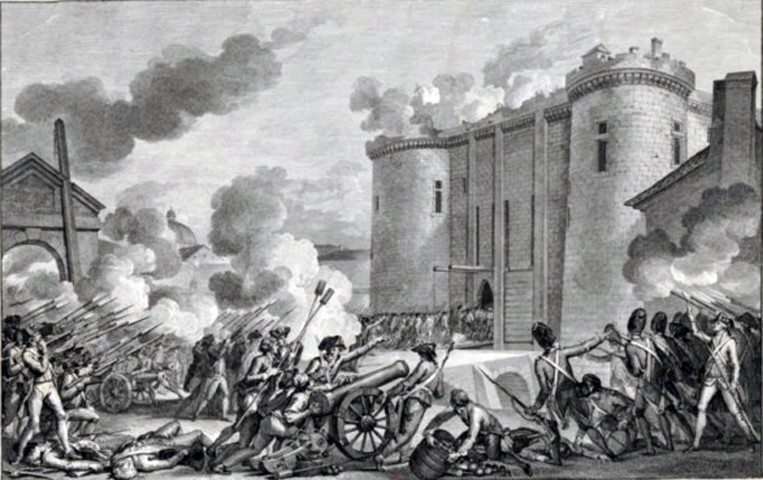
This image depicts an event that is considered to the beginning of the French Revolution. What is the name of the event?
a)
The burning of Paris 
b)
The Tennis Court Oath 
c)
The storming of the Bastille 
d)
The Beheading of King Louis XVI 
46.
Napoleon Bonaparte's rise to power came as 
a)
an opponent of the Revolution. 
b)
husband of Marie Antoinette. 
c)
after executing Louis XVI. 
d)
a French military hero. 
47.
Geography and harsh weather played a major role in Napoleon's defeat during his invasion of :
a)
Russia. 
b)
Hungary.
c)
Germany. 
d)
Great Britain. 
48.
Which statement best describes nationalism in Germany?
a)
Germany was conquered by Russia and became the nation of Prussia
b)
King Emmanuel II joined the north and south of Germany 
c)
Germany was united through the policies of ‘realpolitik’ and ‘blood and iron’
d)
Moderates established a parliamentary system to join the nation-states
49.
Which statement best describes nationalism in Italy?
a)
People from different nation-states of Italian culture united
b)
Nation-states were happy to be part of Napoleon’s Empire
c)
Nation-states wanted to restore their original monarch to the throne
d)
People from different nation-states wanted to remain independent
50.
What is the significance of the unification of Italy and the unification of Germany?
a)
To show the impact nationalists movements can have on a region
b)
To show the impact absolute monarchs have on a region
c)
To show the impact unlimited governments can have on a region
d)
To show the impact limited government can have on a region 
51.
In what way was the independence movement in Haiti DIFFERENT from the independence movement led by Simon Bolivar in South America? 
a)
Haiti's was a violent slave revolt.
b)
Haiti's movement was not successful. 
c)
Haiti revolted against Spanish control. 
d)
Haiti won their independence with U.S. assistance
52.
·  He is known as the George Washington of South America.
·  A South American country is named in his honor.
· Born in Venezuela, he fought to end Spanish control 
These statements describe:

a)
Pancho Villa. 
b)
Pedro Cabral. 
c)
Simon Bolivar. 
d)
Touissant L'Ouverture.