
NEW
Font size
S
M
L
XL
 Worksheets
Fossils, Soils, and Caves Review
Total questions: 36
Worksheet time: 24mins
Name
Class
Date
1.
Generally, only hard parts become fossils.
These hard parts include........................
These hard parts include........................
a)
fingernails
b)
bones, shells, teeth, seeds & woody stems
c)
soft tissue
d)
skin
2.
Petrified fossils means?
a)
afraid
b)
scared
c)
spooky
d)
turning into stone
3.

What type of fossil is an imprint in a rock?
a)
cast
b)
trace
c)
mold
d)
whole/part
4.

This type of fossil forms when a mold is filled with sand or mud that hardens into the shape of the organism.
a)
mold
b)
cast
c)
trace
d)
preserved
5.

This type of fossil forms when minerals soak into the buried remains, replacing the remains, and changing them into rock.
a)
mold
b)
cast
c)
petrified
d)
preserved
6.
Remains of animals can be preserved by preventing them from decaying. What substances might help preserve parts or a whole animal
a)
tar, amber, ice
b)
ice, carbonization, trace
c)
rock, amber, ice
d)
tar, carbonization, rock
7.
This type of scientist finds, preserves, and interprets fossils remains.
a)
archeologist
b)
paleontologist
c)
geologist
d)
anthropologist
8.
Hardened tree sap is called
a)
diamonds
b)
amber
c)
tar
d)
syrup
9.

These fossils are distinguishable from other fossils because they were scattered over a large region, very common, and lived during a short span of geologic time
a)
trace
b)
index
c)
permineralized
d)
mold and cast
10.
Most fossils are found in __________ rock layers
a)
metamorphic
b)
sedimentary
c)
igneous
11.
By studying fossil records scientists can make inferences about
a)
the diversity of plants and animals, past climates and geological events, and how organisms have evolved
b)
the diversity of plants and animals, how different rocks form, and past volcanic eruptions
c)
the simularities of plants and animals, how different rocks form and past volcanic eruptions
d)
the similarities of plants and animals, past climates and geological events, how different rocks form
12.

What type of fossil is pictured?
a)
cast
b)
petrified fossil
c)
preserved remains
d)
trace fossil
13.
Fossils of species that existed for short periods and were widespread
a)
uniformitarianism
b)
cyanobacteria
c)
index fossils
14.

4. What is the name of this kind of fossil?
a)
Amber Fossil
b)
Exoskeleton fossil
c)
Trace Fossil
d)
Petrification Fossil
15.

Decomposed or decomposing plant and animal material
a)
Coal
b)
Humus
c)
Plants
d)
Animal
16.
Living and once living material that is needed in soil
a)
Inorganic
b)
Organic
17.

Which layer is topsoil located in
a)
Horizon A
b)
Horizon B
c)
Horizon C
d)
Horizon Z
18.

What layer is the subsoil located in
a)
Horizon A
b)
Horizon B
c)
Horizon C
d)
Horizon Z
19.

Land forms made from dissolving limestone
a)
Soil
b)
Bedrock
c)
Karst
d)
Calcium
20.

Where is most of the Karst topography located in Virginia
a)
Blue Ridge
b)
Valley and Ridge
c)
Piedmont
d)
Coastal
21.

Which of the following is NOT formed from water dissolving limestone underground
a)
Cavern
b)
Cave
c)
Sinkhole
d)
Mountain
22.

A depression or hole formed when the roof of a cave collapses
a)
Cavern
b)
Cave
c)
Sinkhole
d)
Bedrock
23.

A stream that drops into a sinkhole and continues to flow underground would be a
a)
Disappearing stream
b)
Roaring stream
c)
Hot spring
d)
Geyser
24.

A __________ forms from the (C) ceiling when water drips from the top
a)
Stalactites
b)
Stalagmites
25.

A _________ forms when calcite deposits form from the (G) ground and reaches up
a)
Stalactites
b)
Stalagmites
26.
When water mixes with carbon dioxide in the air, what solution is formed?
a)
Carbonic acid
b)
Calcite
c)
Calcium carbonate
27.
Porosity refers to...
a)
the shape of the particles
b)
The sorting of the particles
c)
% of pore space in a material
d)
% of cement in a material
28.
Impermeable materials...
a)
have an abundance of pores.
b)
let water in.
c)
have little to no pores.
29.
Which of the following has the lowest porosity?
a)
Clay
b)
Silt
c)
Gravel
d)
Sand
30.
The ___________________ the grain size, the faster the water will move through the soil.
a)
more mixed
b)
smaller
c)
larger
31.
The measure of how easily water can flow through an aquifer.
a)
porosity
b)
permeability
c)
gradient
d)
divide
32.

Base your answer to the following question on the diagram, which represents samples of soil and bedrock at Earth’s surface. The arrows represent possible infiltration of rainwater Which sample probably has the greatest porosity?
a)
Granite bedrock
b)
Pebble-and-sand soil
c)
Pebble soil
d)
Conglomerate bedrock
33.
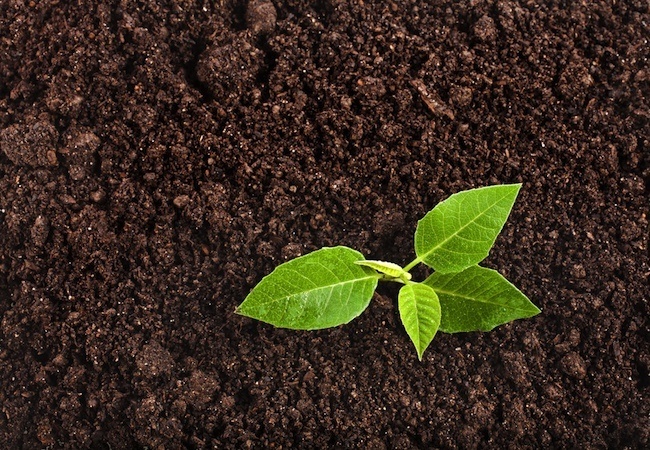
Which of the following is NOT one of the three types of soil?
a)
clay
b)
sand
c)
silt
d)
mud
34.

_______ is the type of soil used most often with plants and on farms. It is a mixture of clay, sand, and silt.
a)
loam
b)
humus
c)
soil
d)
dirt
35.

Are there minerals in soil?
a)
Yes
b)
No
36.
Which of the following is the largest particle in soil?
a)
sand
b)
silt
c)
humus
d)
clay
Reset

