wayground logo

Free Printable Worksheets

NEW

Font size

S
M
L
XL
Worksheets

9 Sci Revision

Total questions: 38

Worksheet time: 54mins

Name
Class
Date
1.

Study the Image. Which form of Heat Transfer occurs between the flame of stove and pot?

a)

Insulation

b)

Conduction

c)

Radiation

d)

Conduction

2.

Heat Transfer occurs within a fluid, such as a liquid and gas, as a current. Which for of heat transfer is described?

a)

Conduction

b)

Convection

c)

Radiation

d)

Thermal Energy

3.

Ouch! I touched the handle of the Pot on the stove. What type of movement occurred within the handle of the pot and the hot boiling water?

a)

Radiation

b)

Convection

c)

Conduction

d)

Concurrent Energy

4.

The average Kinetic Energy of a substance represents the ___________ of a substance

a)

Density

b)

Heat

c)

Thermal Energy

d)

Temperature

5.

The movement of heat transfer between the objects shown above is based on

a)

The objects temperature

b)

The objects Density

c)

The objects Mass

d)

The objects Light Energy

6.

A baseboard heater in the corner of a room circulates the air. The heated air is regularly flowing in a current until the room reaches a set temperature. Which method of heat transfer does the baseboard heater use?

a)

Convection

b)

Radiation

c)

Radial Energy

d)

Conduction

7.

Energy from the kinetic energy of particles.

a)

nuclear

b)

chemical

c)

mechanical

d)

electrical

e)

thermal

8.

What type of energy transfer occurs when warm air masses transfer heat to cold air masses in weather events?

a)

convection

b)

conduction

c)

radiation

d)

evaporative cooling

9.

Our Sun heats the Earth and other planets through the heat transfer process of _____.

a)

convection

b)

conduction

c)

radiation

d)

evaporative cooling

10.

These seats are warm to the touch because of the heat transfer process of _____.

a)

convection

b)

conduction

c)

radiation

d)

evaporative cooling

11.
Hearing your brother's music playing from down the hall is an example of what type of wave interaction?
a)
reflection
b)
interference
c)
refraction
d)
diffraction
12.
You and your father inspect an empty house with the hopes of buying it. You walk through the rooms talking to one another, and you notice that your voices and footsteps are echoing in the big, empty house. What causes the echo?
a)
sound waves reflecting off smooth, flat surfaces throughout the house
b)
sound waves moving around the large rooms
c)
sound waves moving slowly through air
d)
sound waves refracting around corners in the empty rooms
13.
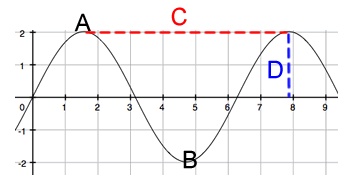
If distance C on the diagram increased, what would happen to the pitch? 
a)
The pitch would be louder. 
b)
The pitch would be softer. 
c)
The pitch would be higher. 
d)
The pitch would be lower. 
14.
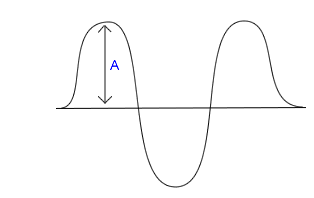
If the distance represented by the letter A were increased, how would it change the way the sound was heard?
a)
The sound would be higher. 
b)
The sound would be lower. 
c)
The sound would be softer. 
d)
The sound would be louder. 
15.
______ is how high or low a sound is; depends on the frequency.
a)
pitch
b)
frequency
c)
sound
d)
medium
16.
A wave in which the particles vibrate in the same direction as that in which the wave is traveling; sound waves
a)
longitudinal wave
b)
ocean wave
c)
transverse wave
d)
mechanical wave
17.
When comparing the two waves that are shown, how would Wave A (green wave) differ than Wave B (black wave)?
a)
Wave A and B have the same amplitude, but wave B (black) has a lower pitch.
b)
Wave A and B have the same amplitude, but Wave A has a lower pitch. 
c)
Wave A and B have the same pitch, but Wave A is a softer sound. 
d)
Wave A and B have the same pitch, but Wave B is a softer sound. 
18.
When we look into a glass mirror, light...
a)
Bends as it passes through
b)
Bounces back in a random order
c)
Hits the mirror and is absorbed
d)
Bounces back at the same angle it strikes the mirror at
19.
Light travels slower through water than it does through air, this cause the light to be ___________.
a)
reflected
b)
refracted
20.
Which explains why the fork looks different under water?
a)
light can't pass through the glass
b)
the wavelength of light lengthens
c)
the amount of light increases when going through water
d)
light is refracted at an angle
21.
Opaque means...
a)
No light passes through it
b)
All light passes through it
c)
Some light passes through it
22.
 A wave has frequency of 50 Hz and a wavelength of 10 m. What is the speed of the wave?
a)
500 m/s
b)
50 m/s
c)
5 m/s
d)
0.5 m/s
23.
A wave has wavelength of 10 m and a speed of 340 m/s. What is the frequency of the wave?
a)
34 m/s
b)
3400 Hz
c)
3400 m/s
d)
34 Hz
24.
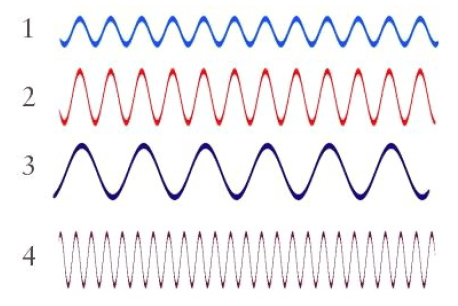
Which wave in the diagram has the greatest frequency?
a)
1
b)
2
c)
3
d)
4
25.
 A wave has frequency of 5 Hz and a speed of 25 m/s. What is the wavelength of the wave?
a)
25 m
b)
125 m
c)
5 m
d)
25 m/s
26.
What is the frequency of a wave traveling at 300 m/s with a 4 m wavelength?
a)
0.013 Hz
b)
75 Hz
c)
300 Hz
d)
1200 Hz
27.
The angle produced as a source of light bounces off a reflecting surface is called ______.
a)
angle of crookedness
b)
angle of reflection
c)
angle of incidence
d)
angle of bounce
28.

In order to see a picture it must

a)

produce light

b)

reflect light

c)

absorb light

29.
Law of reflection state that - The angle of incidence is .................. to the angle of reflection.
a)
equal
b)
double
c)
half
30.
What is reflection?
a)
Reflection is the bouncing  of light off the surface that it strikes on.
b)
Reflection is the absorbing of light off the surface that it strikes on.
c)
Reflection is the bending of light off the surface that it strikes on.
d)
Reflection is the scattering of light off the surface that it strikes on.
31.

When light waves bend as they pass through a transparent medium we call this:

a)

Refraction

b)

Reflection

c)

Absorption

32.

Light waves bending through a prism is an example of:

a)

Reflection

b)

Refraction

c)

Absorption

33.

Light waves bouncing off of this lake is an example of:

a)

Reflection

b)

Refraction

c)

Absorption

34.

A fish bowl bending light waves and distorting an image of a cat's face is an example of:

a)

Reflection

b)

Refraction

c)

Absorption

35.

A light wave bouncing off of a windshield visor is an example of:

a)

Reflection

b)

Refraction

c)

Absorption

36.

A transverse wave's oscillations move __________________ to it's energy transfer.

a)

Parallel

b)

Perpendicular

c)

Horizontal

d)

Vertical

37.

A longitudinal wave's oscillations move ___________________________ to its energy transfer.

a)

Perpendicular

b)

Parallel

c)

Horizontal

d)

Vertical

38.
What causes light to appear refracted?
a)
temperature
b)
speed
c)
weather
d)
climate