
NEW
Font size
S
M
L
XL
 Worksheets
Synapses and Action Potentials
Total questions: 25
Worksheet time: 22mins
Name
Class
Date
1.

X
a)
Axon Terminal Button
b)
Neurotransmitters
c)
Dendrite
d)
Synapse
2.
Neurotransmitters are released from the
a)
Dendrites
b)
Post-synaptic neuron
c)
Presynaptic neuron
d)
Axon
3.
When a neuron is resting, the inside of the axon has a ____________ charge.
a)
positive
b)
negative
4.
What generates a nerve impulse on the post-synaptic membrane?
a)
Calcium binding with a receptor site
b)
Potassium leaking into the post-synaptic membrane
c)
Neurotransmitter binding with receptor sites
d)
Neurotransmitter being removed from the synapse
5.
What is the chemical used by a neuron to transmit an impulse across a synapse to another nerve cell?
a)
Neurotransmitters
b)
Synapse
c)
Threshold
d)
Impulse
6.
When a neuron is not engaged in an impulse.
a)
Resting potential
b)
Action potential
c)
Neural potential
d)
Synaptic potential
7.
In order for a neuron to have an action potential, the neuron must receive more
a)
excitatory neurotransmitters
b)
inhibitory neurotransmitters
c)
agnostic neurotransmitters
d)
antagonistic neurotransmitters
8.
Excess neurotransmitters in the synapse that goes back into the presynaptic neuron.
a)
Resting potential
b)
Reuptake
c)
Retroactivity
d)
Repolarization
9.
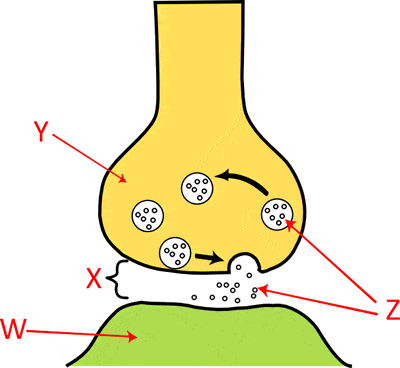
W
a)
Axon Terminal Button
b)
Neurotransmitters
c)
Dendrite
d)
Synapse
10.

Z
a)
Dendrite
b)
Axon Terminal
c)
Neurotransmitters
d)
Synapse
11.

Label the Neuron-What does the letter "A" represent?
a)
Axon
b)
Dendrite
c)
Axon Terminal
d)
Cell Body
12.

Label the Neuron-What does the letter "E" represent?
a)
Schwann Cell
b)
Node of Ranvier
c)
Axon Terminal
d)
Myelin Sheath
13.

-70 mV is the measure of a
a)
Threshold Potential
b)
Action Potential
c)
Resting Potential
d)
End Point Potential
14.

When a membrane potential reaches +30mV, ________ channels open, ________ occurs, and ________ channels close.
a)
Sodium, depolarization, potassium
b)
Potassium, depoloarization, sodium
c)
sodium, repolarization, potassium
d)
postassium, repolarization, sodium
15.
After depolarization what happens to restore resting potential?
a)
Sodium channels open & sodium ions diffuse out of the neuron.
b)
Potassium channels open & potassium ions diffuse into the neuron.
c)
Potassium channels open and potassium ions diffuse into the neuron.
d)
Sodium channels open and sodium ions diffuse into the neuron.
16.
Name the ion that is pumped into the axon to maintain resting potential.
a)
Calcium
b)
Hydrogen
c)
Potassium
d)
Sodium
17.
What describes the phase of quick entry of sodium ions into an axon during an action potential?
a)
passive transport
b)
depolarization
c)
ion transport
d)
repolarization
18.
The nucleus and most of the organelles in a neuron are located in the ______.
a)
dendrites
b)
axon
c)
cell body
d)
Schwann cells
19.
For a neuron with a resting membrane potential at -70mv, an increase in the movement of sodium ions into the neuron's cytoplasm would result in:
a)
the depolarization of the neuron.
b)
the repolarization of the neuron
c)
the replacement of potassium ions with sodium ions.
d)
the replacement of potassium ions with calcium ions.
20.
Depolarization occurs because
a)
more potassium ions diffuse into the cell than sodium ions diffuse out of
b)
more potassium ions diffuse out of the cell than sodium ions diffuse into it
c)
more sodium ions diffuse into the cell than potassium ions diffuse out of it
d)
more sodium ions diffuse out of the cell than potassium ions diffuse into it
21.

What number on the graph represents the Threshold phase
a)
1
b)
3
c)
4
d)
6
22.

What number(s) on the graph represents the Resting Potential?
a)
1 and 2
b)
1 and 5
c)
2 and 3
d)
3 and 4
23.

What number on the graph represents the Repolarization phase?
a)
1
b)
2
c)
3
d)
4
24.

What number on the graph represents the Hyperpolarization phase?
a)
1
b)
2
c)
3
d)
4
25.

What number on the graph represents the Depolarization phase?
a)
1
b)
2
c)
3
d)
4
Reset

