wayground logo

Free Printable Worksheets

Font size

S
M
L
XL
Worksheets

Mod 3 - Evolution Review

Total questions: 20

Worksheet time: 18mins

Name
Class
Date
1.
Some organisms that share a common ancestor have features that have different functions, but similar structures.  These are known as
a)
vestigial structures
b)
analogous structures
c)
homologous structures
d)
fossil structures
2.
What is suggested by the similarity of early embryos of different species of vertebrates?
a)
no evolutionary relationships between the groups
b)
recent common ancestry
c)
similar environments in the past
d)
evolution froma distant common ancestor
3.
Two organisms that are closely related would have
a)
very similar DNA sequence
b)
exactly the same DNA sequences
c)
no proteins in common
d)
completely different DNA sequence
4.
A farmer's use of the best livestock for breeding is an example of
a)
natural selection
b)
artificial selection
c)
extinction
d)
adaptation
5.
Which best describes fossils?
a)
They are the preserved remains or evidence of ancient living things
b)
They are the preserved remains or evidence of ancient living and nonliving things
c)
They are the preserved bones of ancient animals
d)
They are impressions of plant leaves in ancient rocks
6.
Why don't all living things become fossils?
a)
because some living things are too small
b)
because some living things are too big
c)
because some are subject to catastrophism and others are not
d)
because environmental conditions have to be just right to prevent decay
7.
When scientists compare the amino acid sequences for the red blood cell protein hemoglobin between various species, what can they determine about the evolutionary relationship between the species?
a)
It can be determined how efficient hemoglobin is for different species
b)
It can provide evidence about the relatedness of the different species: if they are more similar they have a more recent common ancestor.
c)
It cannot determine relatedness between different species, only individuals of the same species
d)
It can show which species evolved first
8.
The Table below shows the # of differences in amino acids in a protein called “Cytochrome C” when comparing humans to other organisms. The protein is used by many plants and animals to convert energy in cells.
List the 4 closest human relatives based on this biochemical comparison.
a)
chimpanzee, horse, rattlesnake, snapping turtle
b)
chimpanzee, gorilla, rhesus monkey, horse
c)
fruit fly, bread mold, tuna fish, snapping turtle
d)
gorilla, rhesus monkey, rattlesnake, gorilla
9.
The forelimbs of vertebrates, like the ones pictured here, are similar in terms of number of bones and the orientation of bones. Which best describes how comparing homologous structures provides evidence of evolution?
a)
The genes for the body plan and forelimb layout were present in a common ancestral species vertebrates share, thus passed onto all vertebrates.
b)
Similar anatomical structures show how animals adapt to changing environments
c)
Homologous structures show that different species evolve at different rates
d)
Homologous structures don’t actually provide evidence for evolution
10.
What do phylogenic trees do?
a)
Help you visualize how species are related.
b)
Provide windbreaks in your yard.
c)
Provide DNA details.
11.

An unclassified fossil was found within some sedimentary rock sandwiched between volcanic rock containing traces of potassium that was used to determine the fossils age. It existed between 345 million years ago and 300 million years ago. This is an example of.

a)

Relative dating

b)

Stratigraphic correlation

c)

Absolute dating

d)

Carbon dating

12.

There have been many significant events that have occurred during Earth's Geologic history, such as:

  1. 1. The appearance of eukaryotic cells

  2. 2. The first terrestrial animals

  3. 3. The appearance of prokaryotic cells

  4. 4. The development of multicellular individuals

  5. 5. The evolution of modern humans

The order of these events from most ancient to most recent is

a)

1, 2, 3, 4, 5

b)

1, 3, 4, 2, 5

c)

3, 4, 1, 5, 2

d)

3, 1, 4, 2, 5

13.

Antibiotic resistant bacteria are becoming more prominant in society and, as a result, bacterial disease is becoming more difficult to treat. With respect to the evolution of antibiotic resistant bacteria, it could be said that

a)

when bacteria are exposed to antibiotics, they develop a resistance to them

b)

the selective pressure driving the evolution of antibiotic resistant bacteria is the use of antibiotics

c)

if a new antibiotic was developed, the bacteria would no longer evolve

d)

bacteria that are not resistant to antibiotics are at a selective advantage over the bacteria that are resistant to antibiotics

14.

Natural selection acts on

a)

Genotype

b)

Alleles

c)

Phenotype

d)

Whole populations

15.
A change in the inherited characteristics of an organism over time is ________
a)
evolution.
b)
development.
c)
growth.
d)
ancestry.
16.

What type of evidence are shown in the picture above?

a)

Fossils

b)

Embryology

c)

Homologous Structures

d)

Vestigial Structures

17.
The diagram shows fossils in different rock layers. Which of these statements about the age of these fossils is most likely correct?
a)
Fossil A and C are the same age
b)
Fossil B is older than fossil C
c)
Fossils A is older than fossil B
d)
Fossil D is older than fossil C
18.
A fossil of an extinct dinosaur is found and the anatomy of the fossil shows similarities to that of a bird. What could this mean?
a)
This is purely by chance and isn't significant
b)
The extinct dinosaur and modern bird share a common ancestor
c)
All dinosaurs evolved into birds and that's why there aren't any dinosaurs alive today
d)
Dinosaurs choose to fly, and evolved into birds to escape predation and capture food
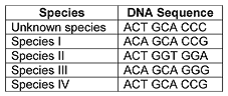
19.
According to this data, the unknown bacterial species is most closely related to: 
a)
Species I
b)
Species II
c)
Species III
d)
Species IV
20.

The appendix, tailbone, and wisdom teeth are all examples of what type of structure in humans?

a)

Homologous

b)

Analogous

c)

Vestigial

d)

Modern