
NEW
Font size
S
M
L
XL
 Worksheets
Unit 7: Meiosis and Genetics
Total questions: 25
Worksheet time: 17mins
Name
Class
Date
1.
An allele whose trait always shows up in the organism when the allele is present.
a)
recessive allele
b)
dominant allele
c)
hidden allele
d)
present allele
2.
An allele whose trait only shows up when no dominant allele is present.
a)
hidden allele
b)
dominant allele
c)
recessive allele
d)
present allele
3.
one of the alternative forms of a gene that governs a characteristic, such as hair color
a)
allele
b)
gene
c)
trait
d)
DNA
4.
having two of the same genes for the trait (sometimes called purebred).
a)
homozygous
b)
hetrozygous
c)
protein
d)
chromosome
5.
having two different genes for a trait (sometimes called hybrid).
a)
protein
b)
homozygous
c)
heterozygous
d)
genotype
6.
father of genetics
a)
Gregor Mendel
b)
James Watson
c)
Dr. Robbins
d)
Francis Crick
7.

Genotype refers to the ...
a)
physical expression of the genes
b)
the possible combination of alleles in a gene
c)
whether an allele is dominant or recessive
d)
how an organism will appear
8.

Squidward has light blue skin, and his genotype for this trait is Bb. Would Squidward be considered a purebred or hybrid for light blue skin?
a)
Purebred
b)
Hybrid
9.

An offspring will receive how many alleles from each parent to determine a specific trait?
a)
one
b)
two
c)
three
d)
five
10.
Which of the following genotypes is a purebred?
a)
Bb
b)
Gg
c)
bb
d)
Dd
11.

What phase is shown in the picture?
a)
anaphase 1
b)
anaphase 2
c)
metaphase 1
d)
telophase 1
12.

When two haploid sex fuse together during fertilization they become ______________
a)
haploid cells
b)
meiosis
c)
mitochondria
d)
diploid cells
13.
What is a phenotype?
a)
The expression of a trait; what you see.
b)
refers to the genetic makeup of an individual
c)
An organism that has the same genes for a trait (ex. TT or tt)
d)
the passing of traits from parent to offspring
14.
Factors for different traits separate independently of one another during the formation of gmaetes
a)
Principle of segregation
b)
Principle of independent assortment
c)
Law of recessiveness
d)
Law of dominance
15.
The cells produced via meiosis are called:
a)
gametic cells
b)
somatic cells
c)
body cells
d)
skin cells
16.
If the Diploid number of Carrots is 18, the haploid number is
a)
18
b)
9
c)
27
d)
36
17.
The chromosomes that pair up during meiosis, are called __________ chromosomes.
a)
homozygous
b)
asexual
c)
homologous
d)
genes
18.

Identify the phase.
a)
Metaphase I
b)
Metaphase II
c)
Prophase I
d)
Anaphase II
19.
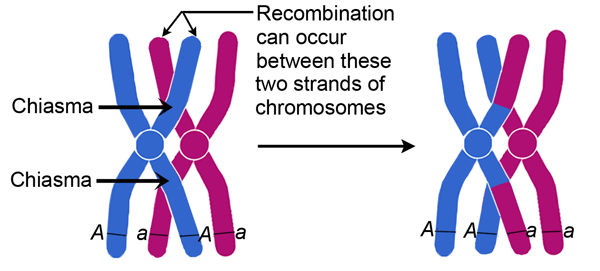
This image shows chromosomes during Prophase 1. Which of the following correctly describes the process shown?
a)
segregation of sister chromatids
b)
condensation and segregation of alleles
c)
mutationin which the DNA content of the gene is altered
d)
crossing - over in which alleles are exchanged
20.
A human zygote should have _____ chromosomes inside.
a)
46
b)
23
c)
92
d)
64
21.
Human eggs and sperm are _____, and each has ____ chromosomes.
a)
diploid, 23
b)
diploid, 46
c)
haploid, 23
d)
haploid, 46
22.
The process of crossing over occurs in what phase of meiosis?
a)
anaphase 1
b)
prophase 1
c)
prophase 2
d)
telophase 1
23.
Which of the following is NOT a gamete?
a)
egg
b)
sperm
c)
skin cell
d)
all of the above are gametes
24.
Unequal splitting of the cytoplasm during cytokinesis of meiosis produces these inactive structures.
a)
sperm
b)
egg
c)
polar bodies
d)
autosomes
25.
Oogenesis produces how many egg cells per germ cell?
a)
1
b)
4
c)
16
d)
3 million
Reset

