
NEW
Font size
S
M
L
XL
 Worksheets
NCFE Review #2 Lithosphere Part II: Plate Tectonics, Earth's Int
Total questions: 44
Worksheet time: 26mins
Name
Class
Date
1.
What is the correct order (starting from the surface) of Earth's layers?
a)
crust, outer core, inner core, mantle
b)
mantle, outer core, inner core, crust
c)
crust, mantle, outer core, inner core
d)
outer core, inner core, crust, mantle
2.
Which layer of Earth is the thinnest?
a)
crust
b)
mantle
c)
outer core
d)
inner core
3.

Part of mantle where lithosphere floats
a)
Crust
b)
Core
c)
Asthenosphere
d)
Atmosphere
4.

One large landmass
a)
North America
b)
Pangea
c)
South America
d)
PanAmerica
5.

Heat transfers within the Earth
a)
Conduction
b)
Convection Current
c)
Ocean Current
d)
Radiation
6.

Addition of new sea floor
a)
Subduction
b)
Sea Floor Spreading
c)
Sea Floor subduction
d)
Convergent
7.
To make new crust, ____ is pushed up from the mantle.
a)
Lava
b)
Iron
c)
Magma
d)
Nickel
8.

Plates sliding past each other in opposite directions
a)
Convergent
b)
Divergent
c)
Subduction
d)
Transform
9.

Geologists study the inside of the Earth by using____
a)
seismic waves
b)
sound waves
c)
light waves
d)
EM waves
10.
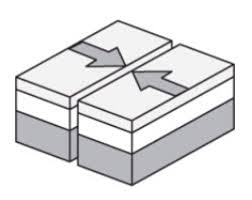
Name the boundary
a)
convergent boundary
b)
divergent boundary
c)
transform boundary
d)
sergent boundary
11.
A subduction zone is formed...
a)
when one tectonic plate sinks below another
b)
at every type of convergent plate boundary
c)
at every type of divergent plate boundary
d)
at transform boundaries
12.
What are mid-ocean ridges?
a)
A chain of underwater waterfalls
b)
A chain of underwater volcanos
c)
A chain of underwater mountains
d)
A chain of underwater rocks
13.
A collision between two pieces of continental crust at a converging boundary produces a
a)
mid ocean ridge
b)
deep ocean trench
c)
rift valley
d)
mountain range
14.
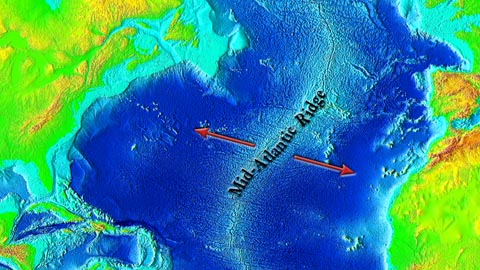
The image shows the Mid Atlantic Ridge. Which type of boundary occurs at this ridge where the ocean floor is spreading apart?
a)
convergent
b)
divergent
c)
transform fault
15.
If the focus of an earthquake occurs beneath the sea floor, as the seismic waves travel through the ocean, they create a massive and destructive
a)
epicenter
b)
tsunami
c)
focus
d)
mountain
16.
Where is the point on the Earth’s surface directly above the focus of an earthquake?
a)
Epicenter
b)
Fault
c)
Hypocenter
d)
Tremor
17.

Once magma reaches the earth's surface it is called.....
a)
Silica
b)
Rock
c)
lava
18.
Volcanoes can be found...
a)
on land
b)
under water
c)
on islands
d)
all of the above
19.

An area where magma melts through the crust in the middle of a plate is called a ________.
a)
island arc
b)
hot spot
c)
geyser
d)
pipe
20.

Point A is where the earthquake actually occurred, what is it called?
a)
Epicenter
b)
Focus
c)
Fault
d)
Seismic Station
21.

What process is occurring at Z?
a)
Convection currents
b)
Subduction
c)
Two plates moving apart
d)
New ocean floor forming
22.

The huge pieces of the earth's crust are called ____________________________.
a)
crust
b)
plates
c)
directions
d)
seismos
23.

Stress that squeezes together
a)
Compression
b)
Tension
c)
Shearing
24.

Where 2 plates are moving apart
a)
Convergent Boundary
b)
Divergent Boundary
c)
Transform Boundary
25.
Earth's interior consists of 3 major zones. Which zone makes up over 80% of Earth's interior?
a)
crust
b)
mantle
c)
core
d)
lithosphere
26.

What is a break in the Earth's crust?
a)
Fault
b)
Focus
c)
Fold
d)
Mineral
27.

What is a fault where rocks pull apart from TENSION, that can form Fault Block Mountains?
a)
Normal Fault
b)
Reverse Fault
c)
Strike Slip Fault
d)
Orbell Fault
28.

What is a fault where rock squeezes together from COMPRESSION?
a)
Normal Fault
b)
Reverse Fault
c)
Strike Slip Fault
d)
Bekken Fault
29.
What is a fault where rock squeezes together from COMPRESSION?
a)
Normal Fault
b)
Reverse Fault
c)
Strike Slip Fault
d)
Bekken Fault
30.
Which of the following occurs because of convection currents?
a)
Tectonic plates on the crust move.
b)
The mantle increases in size.
c)
Pressure in the crust increases.
d)
Pressure in the crust decreases.
31.
Ocean-to-ocean and subduction are two types of which boundary?
a)
divergent
b)
transform
c)
convergent
32.
This boundary moves away from another boundary.
a)
divergent
b)
convergent
c)
transform
33.

Which kind of plate boundary is this?
a)
divergent boundary
b)
transform boundary
c)
convergent boundary (ocean to continent)
d)
convergent boundary (continent to continent)
34.

Matching ________ on different continents are evidence for continental drift.
a)
weather systems
b)
river systems
c)
rock structures
d)
wind systems
35.

The presence of the same ________ on several continents supports the idea of continental drift.
a)
rocks
b)
fossils
c)
both fossils and rocks
d)
neither fossils nor rocks
36.
What are the two types of crust?
a)
continental and oceanic
b)
ocean and basin
c)
lower and upper
d)
thick and thin
37.
The Great Rift Valley in Africa and the Mid-Atlantic Ridge were both created by this type of plate boundary.
a)
divergent
b)
convergent
c)
transform
d)
subduction
38.
Earthquakes and volcanoes are most likely found in which locations?
a)
at plate boundaries
b)
in oceans
c)
in the middle of continents
d)
in the middle of plates
39.
Transform boundaries are most likely to produce what phenomenon?
a)
volcanoes
b)
deep sea trenches
c)
underwater mountain ranges
d)
earthquakes
40.
According to Wegener's hypothesis of continental drift,
a)
Earth's surface is made up of seven major landmasses
b)
the continents DO NOT move
c)
Earth is slowly cooling and shrinking
d)
the continents were once joined together in a single landmass
41.
What is Pangaea?
a)
the name of a German scientist
b)
the name of the super-continent that existed millions of years ago
c)
another name for continental drift
d)
the name of an ancient fossil
42.
Most geologists rejected Alfred Wegener's idea of continental drift because...
a)
it did not agree with their current theory
b)
Wegener was interested in what Earth was like millions of years ago
c)
Wegener used several different types of evidence to support his hypothesis
d)
Wegener could not identify the force that moved the continents
43.

Which was NOT evidence of Wegener?
a)
Seafloor spreading
b)
fossils
c)
puzzle piece
d)
glacier evidence
44.

Who is the person credited with developing the theory of continental drift?
a)
Harry Hess
b)
Galileo
c)
Alfred Wegener
d)
Newton
Reset

